Predicting Asteroid Positions: General Case
Recall Kepler's Equation:
 Kepler's equation is an enormous help for translating a satellite's angular distance into elapsed time. This chapter uses Kepler's equation to solve many such examples. However, we first demonstrate the importance of Kepler's Equation by considering what prediction options are available without it. We shall see they are extremely limited.
Recall Kepler's Equation:
t × √(μ/a3) = M = E - e * Sin(E)
Setting the two expressions for M equivalent, solve for t as shown below:
t = (E - e × Sin(E)) × a × √(a/μ)
where e is the eccentricity and t is time counted from a perihelion passage.
(map from E(ν) JimO)
compute some times since pericentre.
compute some times between diff orb posistion.
More difficult: If you know t, time of flight, how to determine angles traveled?
Problem: t * √(μ/a3) = E - e * Sin(E)
must be solved for E, transcendental and cannot be solved, can only be estimated perhaps in an iterative fashion.
Is there a distinction between predicting time of flight between two distinct orbital positions versus predicting an position given a time of flight. To discuss this distinction, we'll begin with some rudimentary concepts and build upon them.
Elapsed
True
Elapsed
True
t(days)
ν(deg)
t(days)
ν(deg)
9
130°
179
250°
540
20°
18
140°
206
260°
559
30°
27
150°
236
270°
576
40°
37
160°
268
280°
590
50°
47
170°
302
290°
604
60°
58
180°
337
300°
616
70°
70
190°
372
310°
627
80°
84
200°
406
320°
637
90°
98
210°
438
330°
647
100°
115
220°
468
340°
656
110°
134
230°
495
350°
665
120°
155
240°
519
360°
674
CONCLUSION: Kepler's equation provides a way to predict times of flight throughout the orbit. Following chapter discusses this further.
===================== Tentative Table of Contents INtro True Anomaly Aux. Circle Ecc. Anomaly Example - Apollo Mean anomaly Ecc Anomaly sector area > Mean Anomaly Sector area > TA sector area n, Mean Motion Revisit concepts in reverse area Mean Anomaly about time Kepler equation relates MA area concept with MA time concept EA = Rel(MA) TA = Rel(EA)
One final point before considering Kepler's Equation, one can implement a general method of time/position prediction via a brute force method. Brute force method can be observed in a table of values computed for every 15° of Apollo's orbit.
New Material Re: Ceres and Vesta
t × √(μ/a3) = M = E - e × Sin(E)
Kepler's equation is an enormous help for translating a satellite's angular distance into elapsed time. This chapter uses Kepler's equation to solve many such examples. However, we first demonstrate the importance of Kepler's Equation by considering what prediction options are available without it. We shall see they are extremely limited. Recall Kepler's Equation:
t × √(μ/a3) = M = E - e * Sin(E)
Setting the two expressions for M equivalent, solve for t as shown below:
t = (E - e × Sin(E)) × a × √(a/μ)
where e is the eccentricity and t is time counted from a perihelion passage.
(map from E(ν) JimO)
compute some times since pericentre.
compute some times between diff orb posistion.
More difficult: If you know t, time of flight, how to determine angles traveled?
Problem: t * √(μ/a3) = E - e * Sin(E)
must be solved for E, transcendental and cannot be solved, can only be estimated perhaps in an iterative fashion.
Is there a distinction between predicting time of flight between two distinct orbital positions versus predicting an position given a time of flight. To discuss this distinction, we'll begin with some rudimentary concepts and build upon them.
| t = | E - e * Sin(E)
√(μ/a3)
|
|---|
NOTE: Add conversion factor of 1 day / 86,400 sec to convert from seconds to days.
Recall that previous table relates Eccentric Anomaly to ν, True Anomaly. Combining this with above formula, we can get three element table as shown below.
| True | Eccentric | Elapsed |
|---|---|---|
| Anomaly | Anomaly | Time |
30°
|
21°
|
27 days
|
However, we're primarily interested in relationship between True Anomaly, ν and elapsed time (duration since asteroid last passed perihelion, closed point of orbit to Sun). Therefore, following table dispenses with E.
True
True
Elapsed
Anomaly
Time
Anomaly
Time
Anomaly
Time
ν(deg)
t(days)
10°9
130°
179
250°
540
20°
18
140°
206
260°
559
30°
27
150°
236
270°
576
40°
37
160°
268
280°
590
50°
47
170°
302
290°
604
60°
58
180°
337
300°
616
70°
70
190°
372
310°
627
80°
84
200°
406
320°
637
90°
98
210°
438
330°
647
100°
115
220°
468
340°
656
110°
134
230°
495
350°
665
120°
155
240°
519
360°
674
CONCLUSION: Kepler's equation provides a way to predict times of flight throughout the orbit. Following chapter discusses this further.
To demonstrate the range of velocities within a typical orbit, let's examine Apollo's orbit. To determine instantaneous velocity for any position of an elliptical orbit, use following equation:
ve = √[μ(2/r - 1/a)]
- r is instantaneous distance of asteroid from Sun in meters.
- ve is instantaneous elliptical velocity in meters/sec.
- To determine ve in km/sec: vkm =vm /(1,000 m/km)
Apollo's quickest speed should happen at the nearest point, q (known as "perihelion"), where r = .645 AU = .968 x 1011mvq = √[13.27 x 10¹⁹m3/sec2(2/(0.968 x 1011m) - 1/(2.205 x 1011))]
vq = √[13.27 x 10⁸m2/sec2(2.066- 0.454)] = 104m/sec √[13.27 x 1.612]
vq = √[21.4] * 10 km/sec = 46.25 km/sec
To obtain instantaneous angular velocity in radians, divide linear velocity by instantaneous radius:ω = v / r = 46.25 km/sec / 9.68 x 10⁷km = 4.78 x 10⁻⁷ radians/secConverting to degrees per day:ωq = 4.78 x 10⁻⁷ radians/sec (86,400 sec/day) (180°/π rad) = 2.37°/daywhich is much quicker then n (=0.551°/day).
On the other hand, Apollo's slowest speed should happen at the farthest point, Q (known as "aphelion"), where r = 2.322 AU = 3.483 x 10¹¹m. Performing similar calculations, we get following values:vQ = √[13.27 x 10¹⁹m3/sec2(2/(3.483 x 1011m) - 1/(2.205 x 1011))] = 12.63 km/secωQ = .362 x 10-7 radians/sec = 0.18°/day; much slower then n (=0.551°/day).
CONCLUSION: Mean motion is a good value for determining an orbit's period (and multiples thereof). However, it's of minimal value for predicting orbital positions at any given time during the orbit's cycle. Thus, we need the "3 Anomalies".
To define an anomaly, let a standard orbit be defined as a circle. Since most orbits have some eccentricity, let the departure from circularity be the measure of an orbit's anomaly. To suit our purposes, we'll define this anomaly in following matter.
To demonstrate the range of velocities within a typical orbit, let's examine Apollo's orbit. To determine instantaneous velocity for any position of an elliptical orbit, use following equation:
ve = √[μ(2/r - 1/a)]
- r is instantaneous distance of asteroid from Sun in meters.
- ve is instantaneous elliptical velocity in meters/sec.
- To determine ve in km/sec: vkm =vm /(1,000 m/km)
Apollo's quickest speed should happen at the nearest point, q (known as "perihelion"), where r = .645 AU = .968 x 1011m vq = √[13.27 x 10¹⁹m3/sec2(2/(0.968 x 1011m) - 1/(2.205 x 1011))]
vq = √[13.27 x 10⁸m2/sec2(2.066- 0.454)] = 104m/sec √[13.27 x 1.612]
vq = √[21.4] * 10 km/sec = 46.25 km/sec
To obtain instantaneous angular velocity in radians, divide linear velocity by instantaneous radius: ω = v / r = 46.25 km/sec / 9.68 x 10⁷km = 4.78 x 10⁻⁷ radians/sec Converting to degrees per day: ωq = 4.78 x 10⁻⁷ radians/sec (86,400 sec/day) (180°/π rad) = 2.37°/day which is much quicker then n (=0.551°/day).
On the other hand, Apollo's slowest speed should happen at the farthest point, Q (known as "aphelion"), where r = 2.322 AU = 3.483 x 10¹¹m. Performing similar calculations, we get following values: vQ = √[13.27 x 10¹⁹m3/sec2(2/(3.483 x 1011m) - 1/(2.205 x 1011))] = 12.63 km/sec ωQ = .362 x 10-7 radians/sec = 0.18°/day; much slower then n (=0.551°/day).
CONCLUSION: Mean motion is a good value for determining an orbit's period (and multiples thereof). However, it's of minimal value for predicting orbital positions at any given time during the orbit's cycle. Thus, we need the "3 Anomalies".
To define an anomaly, let a standard orbit be defined as a circle. Since most orbits have some eccentricity, let the departure from circularity be the measure of an orbit's anomaly. To suit our purposes, we'll define this anomaly in following matter.
AF = OF - AO = (a * e) - (a * Cos(E))
But the distance is also given in terms of the distance from the focus and the supplement of the angle from the semimajor axis by
AF = r * Cos(π - ν) = -r * Cos( ν)
Equating these two expressions gives
| r = | a(Cos(E) - e)
Cos(ν)
|
|---|
To solve for Cos(ν):
| Cos(ν) = | a(Cos(E) - e)
r
|
|---|
Recall equation of the ellipse
| r = | a(1 - e2)
1 + e Cos(ν)
|
|---|
| r(1 + e Cos(ν)) = | a(1 - e2) |
|---|
M can also be interpreted as the area of the shaded region in the above figure (Finch 2003).
The relation between the Eccentric anomaly and time, t:
The radius relates to other anomalies:
and
where a is the orbit's semi-major axis (segment cz). Note that z is the periapsis (closest approach to the focus or object being orbited) and also one of two points where the semi-major axis (furthest distance from the centre of the ellipse) can be measured, the other point being the apoapsis (furthest distance from the focus being orbited and 180 degrees around from the periapsis).
t = (E - e * Sin(E)) * a * √(a/μ)
where e is the eccentricity and t is time counted from a pericentre passage The mean anomaly M is then defined as
M = E - e * Sin(E)
This fictive "angle" M without direct geometrical meaning increases uniformly with time,
M = t * √(μ/a3)
To find the position of the object in an elliptic Kepler orbit at a certain time one determines corresponding mean anomaly with the relation
t = (E - e * Sin(E)) * a * √(a/μ)
and then finds correponding Eccentric anomaly using the Newton-Raphson algorithm Calculation from state vectors. Other relations The relation between ν and E, the eccentric anomaly, is:
| Cos(ν) = | Cos(E) - e
1 - e Cos(E)
|
|---|
| r = | a(1 - e Cos(E)) |
|---|
| r = | a(1 - e2)
1 + e Cos(ν)
|
|---|
Kepler's equation relates the polar coordinates of a celestial body (such as a planet) and elapsed time from a reference position. Kepler's equation is of fundamental importance in celestial mechanics, but it cannot be simply inverted to predict planet's position at a given time.
Consider the factors, M, mean anomaly, and E, eccentric anomaly. M will parameterize time, and E will parameterize the polar angle of a body orbiting on an ellipse with eccentricity, e, then
Kepler's equation is a transcendental; thus, it cannot be directly solved for E given an arbitrary M. However, many algorithms have been derived for its solution. Of these, let's consider a simple, yet effective, iterative method:
Ei+1 = M + e Sin(Ei)
where E0 = 0.
Also, consider Newton's method,
| Ei+1 = Ei + | M + e Sin(Ei) - Ei
1 - e Cos(Ei)
|
|---|
One final point before considering Kepler's Equation, one can implement a general method of time/position prediction via a brute force method. Brute force method can be observed in a table of values computed for every 15° of Apollo's orbit.
Kepler's equation relates the polar coordinates of a celestial body (such as a planet) and elapsed time from a reference position. Kepler's equation is of fundamental importance in celestial mechanics, but it cannot be simply inverted to predict planet's position at a given time.
Consider the factors, M, mean anomaly, and E, eccentric anomaly. M will parameterize time, and E will parameterize the polar angle of a body orbiting on an ellipse with eccentricity, e, then M = E - e Sin(E) Kepler's equation is a transcendental; thus, it cannot be directly solved for E given an arbitrary M. However, many algorithms have been derived for its solution. Of these, let's consider a simple, yet effective, iterative method:
Ei+1 = M + e Sin(Ei)
where E0 = 0.
Also, consider Newton's method,
| Ei+1 = Ei + | M + e Sin(Ei) - Ei
1 - e Cos(Ei)
|
|---|
=====================
cos(E) = [cos(ν) + e]/[1 + e cos(ν)]
Solving for cos(n) in terms of cos(E) gives:
cos(ν) = [cos(E) - e]/[1 - e cos(E)]
M = E - e Sin(E)
New Material Re: Ceres and Vesta
posted by JimODell at 2:46 AM
0 comments


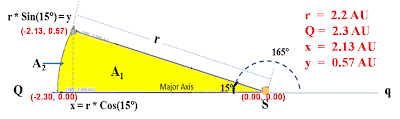


 We've demonstrated the straightforward process of determining area of a Sun anchored segment adjacent immediately above the major axis. We propose that same process can determine area of any similar segment below the major axis. Since the dimensions of these two segments must be equal (if they're not, then the orbit is not elliptical); then the areas must also be equal. Thus, according to Kepler's Second Law, the orbital transit times must also be equal.