
Table, 7G Acceleration for 100 Days, describes daily progress of vessel accelerating from zero velocity at 7g.
After 100 days of 7g acceleration, a vessel travels total distance of 9,842 AUs (.155 Light Year, LY). It gained velocity of about 150 AU/day (0.866 c=86.6% light speed).
Assume 7G vessel cruises at this velocity until the optimal time/distance to start decelerating at 7g.
|
| DECELERATE FOR 48¼ DAYS |
Decel.
Time(t) | Spot
Velocity (Vt) | Spot
Distance (dt) | Daily
Dist. (dΔ) | 7G Cum
Dist.(d7G) | Consumed
Fuel (F) |
|---|
| 0 days | 149.93 AU/dy | 86.59% c | 9,811.1 AU | 0.1551 LY | 0.0 AU | 9,811.1 AU | 27.974% GW0 |
| 1 days | 149.46 AU/dy | 86.32% c | 9,661.7 AU | 0.1528 LY | 149.4 AU | 9,960.5 AU | 28.210% GW0 |
| 2 days | 148.98 AU/dy | 86.04% c | 9,512.8 AU | 0.1504 LY | 148.9 AU | 10,109.4 AU | 28.445% GW0 |
| 3 days | 148.48 AU/dy | 85.76% c | 9,364.4 AU | 0.1481 LY | 148.4 AU | 10,257.9 AU | 28.679% GW0 |
| 4 days | 147.98 AU/dy | 85.46% c | 9,216.5 AU | 0.1457 LY | 147.9 AU | 10,405.8 AU | 28.913% GW0 |
| 5 days | 147.46 AU/dy | 85.17% c | 9,069.1 AU | 0.1434 LY | 147.4 AU | 10,553.2 AU | 29.146% GW0 |
| 6 days | 146.94 AU/dy | 84.86% c | 8,922.2 AU | 0.1411 LY | 146.9 AU | 10,700.1 AU | 29.378% GW0 |
| Given |
|
| dt-1 - dt | dΔ + ΣdΔ | 1-(1-ε∇)100+t |
|---|
 |
For success, the 7G resupply vessel must slow down to match the 1G vessel's cruise velocity (.644c = 111.5 AU/day).
This chapter describes daily progress throughout the 48¼ days of 7G deceleration. | |
| INTERSTELLAR VESSELS: 1G PAX/CARGO & 7-G RESUPPLY (SNOWBALL) |
Interstellar 1G Vesselstarts its one year of acceleration at Day 0.
After this year, vessel stops acceleration and cruises at 111.5 Astronomical Units per day (.644 c).
One year of 1G acceleration has taken vessel to 23,841 AUs, .377 Light Year (LY). |
 |
Interstellar 7G Snowball In this example, 7G snowball (traditional habitat encased in large volume of ice) starts its 100 day acceleration at day 260 of 1G vessel’s acceleration.
On day 360, 7G vessel stops propulsion, and cruises at 149.9 AUs per day (.865c).
100 days of 7G acceleration takes vessel to 9,842 AU, (= .155 LY). |
|
| AFTER 1G ACCELERATION, PAX VESSEL CRUISES AT CONSTANT VELOCITY |
|---|
NOTE: Light Year: LY = 63,240 AUs Light Speed: c = 173.145 AU/dayAstro Unit: AU = 149,597,871 km |
Decel.
Time(t) | Spot
Velocity (Vt) | Spot
Distance (dt) | Daily
Dist. (dΔ) | 7G Cum
Dist.(d7G) | Consumed
Fuel (F) |
|---|
| 7 days | 146.40 AU/dy | 84.56% c | 8,775.8 AU | 0.1388 LY | 146.4 AU | 10,846.5 AU | 29.609% GW0 |
| 8 days | 145.86 AU/dy | 84.24% c | 8,630.0 AU | 0.1365 LY | 145.8 AU | 10,992.3 AU | 29.840% GW0 |
| 9 days | 145.30 AU/dy | 83.92% c | 8,484.7 AU | 0.1342 LY | 145.3 AU | 11,137.6 AU | 30.070% GW0 |
| 10 days | 144.73 AU/dy | 83.59% c | 8,340.0 AU | 0.1319 LY | 144.7 AU | 11,282.3 AU | 30.299% GW0 |
| 11 days | 144.15 AU/dy | 83.26% c | 8,195.8 AU | 0.1296 LY | 144.1 AU | 11,426.4 AU | 30.527% GW0 |
| 12 days | 143.56 AU/dy | 82.91% c | 8,052.3 AU | 0.1273 LY | 143.6 AU | 11,570.0 AU | 30.755% GW0 |
| Given |
|
| dt-1 - dt | dΔ + ΣdΔ | 1-(1-ε∇)100+t |
|---|
|
| CRUCIAL EVENTS FOR SUCCESSFUL RENDEZVOUS |
|---|
Points ⓐ thru ⓕ map out following events:
ⓐ After 360 days, resupply vessel ends 100 days of 7G prop; starts cruise at 149.9 AU/day.
ⓑ After 365¼ days of 1G acceleration, primary vessel cruises at 111.5 AU/day.
ⓒ After 400 days (about 35 days of constant velocity), resupply vessel is about 12,000 AU behind primary vessel.
ⓓ After 500 days (about 135 days of constant velocity), resupply vessel closes the gap to slightly over 8,000 AU.
ⓔ 600 days (100 more days of constant velocity), gap closes to just over 4,000 AU.
ⓕ 684 days, gap shrinks to about 1,000 AU in prep for 7G vessel’s deceleration duration of 48¼ days needed to match speed of primary vessel.
|
 |
Describe primary vessel’s cruise distance by linear equation:
d = 111.5 t - 16,884 AU
Resupply vessel’s cruise distance:
d= 149.9 t - 44,152 AU
By inspection, we expect a pending intercept of these two cruise tracks about one LY and two years from start of primary vessel’s track. HOWEVER, the resupply vessel track must become nonlinear at about 684 days for 48¼ day deceleration maneuver.
|
|
| DAILY DIFFERENCE IN DAILY VELOCITY |
Decel.
Time(t) | Spot
Velocity (Vt) | Spot
Distance (dt) | Daily
Dist. (dΔ) | 7G Cum
Dist.(d7G) | Total
Fuel (F) |
|---|
| 13 days | 142.96 AU/dy | 82.57% c | 7,909.3 AU | 0.1251 LY | 143.0 AU | 11,712.9 AU | 30.982% GW0 |
| 14 days | 142.34 AU/dy | 82.21% c | 7,767.0 AU | 0.1228 LY | 142.3 AU | 11,855.3 AU | 31.208% GW0 |
| 15 days | 141.72 AU/dy | 81.85% c | 7,625.3 AU | 0.1206 LY | 141.7 AU | 11,997.0 AU | 31.433% GW0 |
| 16 days | 141.08 AU/dy | 81.48% c | 7,484.2 AU | 0.1183 LY | 141.1 AU | 12,138.1 AU | 31.658% GW0 |
| 17 days | 140.42 AU/dy | 81.10% c | 7,343.7 AU | 0.1161 LY | 140.4 AU | 12,278.6 AU | 31.881% GW0 |
| 18 days | 139.76 AU/dy | 80.72% c | 7,203.9 AU | 0.1139 LY | 139.8 AU | 12,418.3 AU | 32.105% GW0 |
| Given |
|
| dt-1 - dt | dΔ + ΣdΔ | 1-(1-ε∇)100+t |
|---|
 |
DAILY DIFF: Δ= 0.0198Thot Exp. brainstorm proposes persistent 7G deceleration exponentially decreases vessel velocity by about 2% c/day.
|
| 7G DECELERATION DURING DAYS 19 THRU 24 |
Decel.
Time(t) | Spot
Velocity (Vt) | Spot
Distance (dt) | Daily
Dist. (dΔ) | 7G Cum
Dist.(d7G) | Consumed
Fuel (F) |
|---|
| 19 days | 139.08 AU/dy | 80.32% c | 7,064.8 AU | 0.1117 LY | 139.1 AU | 12,557.5 AU | 32.327% GW0 |
| 20 days | 138.38 AU/dy | 79.92% c | 6,926.4 AU | 0.1095 LY | 138.4 AU | 12,695.9 AU | 32.549% GW0 |
| 21 days | 137.67 AU/dy | 79.51% c | 6,788.7 AU | 0.1073 LY | 137.7 AU | 12,833.6 AU | 32.770% GW0 |
| 22 days | 136.95 AU/dy | 79.10% c | 6,651.7 AU | 0.1052 LY | 137.0 AU | 12,970.6 AU | 32.990% GW0 |
| 23 days | 136.21 AU/dy | 78.67% c | 6,515.4 AU | 0.1030 LY | 136.3 AU | 13,106.9 AU | 33.210% GW0 |
| 24 days | 135.46 AU/dy | 78.24% c | 6,379.9 AU | 0.1009 LY | 135.5 AU | 13,242.4 AU | 33.428% GW0 |
| Given |
|
| dt-1 - dt | dΔ + ΣdΔ | 1-(1-ε∇)100+t |
|---|
|
| DETERMINE INTERSECTION POINT |
 |
Assume 1G pax vessel accelerates at 1G for one year; then, cruises at constant velocity. Thus, determine distance traveled per following linear equation:
d1G = -.267 LY + .644 c × t
Assume resupply vessel starts 7G acceleration at 265.25 days after mission begins (1G vessel starts). 100 days later (365.25 days into mission), 7G vessels stops acceleration and starts cruise. Thus, determine total distance traveled via following linear equation:
d7G = -.711 LY + .866 c × t
To determine intersection point, set equations equal as shown:
d1G = -.267 LY + .644c × t = -.711 LY + .866c × t = d7G
For convenience, substitute: LY = 63,241 AU and c = 173.15 AU/day:
-16,885 AU + 111.5 AU/day × t = -44,964 AU + 149.9 AU/day
× t
thus, solve for: tInt = 731.2 days and dInt= 64,644 AUs.
These linear equations show two cruising vessels will meet at time of 731.2 days (2 years) since day zero and distance equals 64,644 AU (about 1 LY) from 1G pax vessel's starting point. However, the two vessels cannot gracefully rendezvous because they still have a huge velocity differential of about .22 c. Following section proposes a graceful deceleration method.
| |
| INITIATE 7G DECELERATION |
|
After 684 days of mission time, resupply vessel flight profile used 7G acceleration and high speed cruise to reach a position 58,340 AU from Sol.
At this point, 7G vessel is only 1,076 AU behind the 1G vessel.
The 7G vessel must start the 48¼ days of 7G deceleration required to slow down from 149.9 AU/day to 111.5 AU/day, cruise velocity of the primary vessel.
| 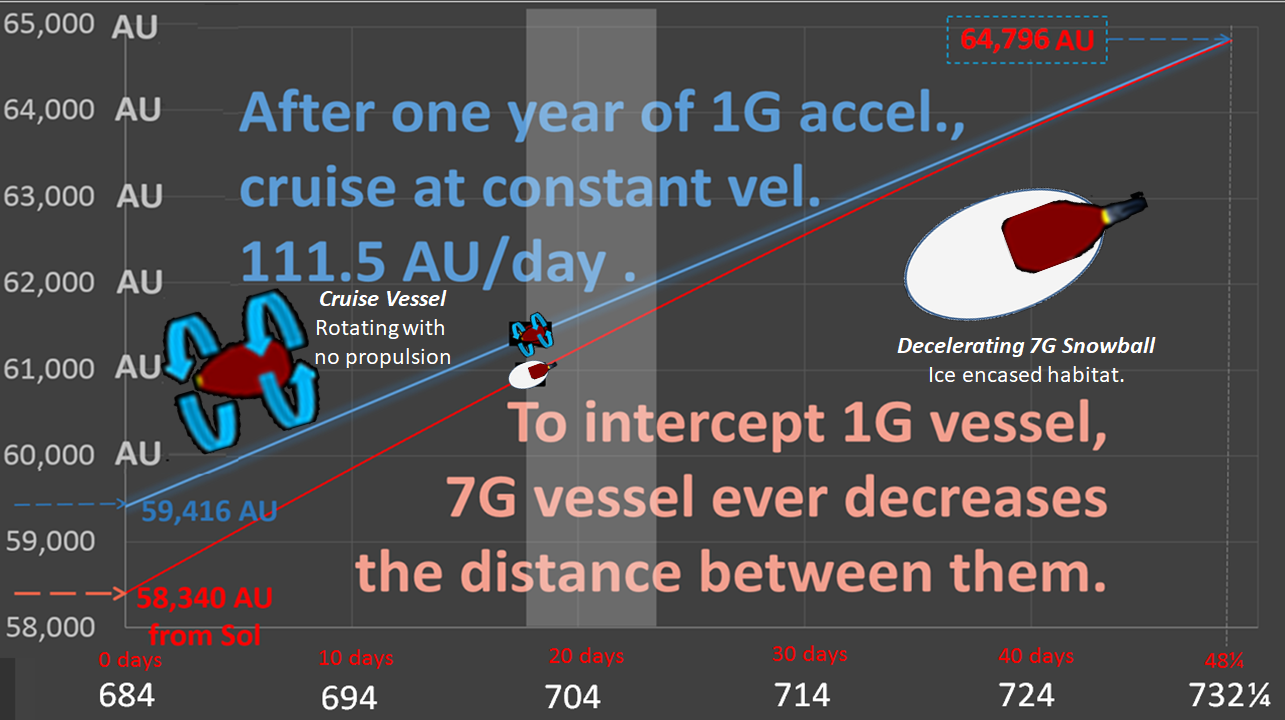 |
For functional rendezvous, both the primary mission vessel and the resupply vessel must match velocities at the same position at the same time.
In this example, both vessels simultaneously reach 64,796 AU (about one LY) along the track from Sol to neighboring star. | |
| SNOWBALL's SPOT VELOCITY FOR EACH DAY ON ITS WAY TO RENDEZVOUS |
|
For Spot Velocity (Vt), see 7G Accel for 100 Dy.
Countdown in reverse order; i.e., 100th day in 7G Accel Table is 0 day in 7G Decel Table.
75th day in 7G Accel has 134.70 AU/dy & 77.79% c;
same values as 25th day in 7G Deceleration Table.
Decel.
Time(t) | Spot
Velocity (Vt) | Spot
Distance (dt) | Daily
Dist. (dΔ) | 7G Cum
Dist.(d7G) | Consumed
Fuel (F) |
|---|
| 25 days | 134.70 AU/dy | 77.79% c | 6,245.1 AU | 0.0988 LY | 134.8 AU | 13,377.2 AU | 33.646% GW0 |
| 26 days | 133.91 AU/dy | 77.34% c | 6,111.1 AU | 0.0966 LY | 134.0 AU | 13,511.2 AU | 33.864% GW0 |
| 27 days | 133.12 AU/dy | 76.88% c | 5,977.9 AU | 0.0945 LY | 133.2 AU | 13,644.4 AU | 34.080% GW0 |
| 28 days | 132.30 AU/dy | 76.41% c | 5,845.5 AU | 0.0924 LY | 132.4 AU | 13,776.8 AU | 34.296% GW0 |
| 29 days | 131.47 AU/dy | 75.93% c | 5,713.9 AU | 0.0904 LY | 131.6 AU | 13,908.4 AU | 34.512% GW0 |
| 30 days | 130.62 AU/dy | 75.44% c | 5,583.1 AU | 0.0883 LY | 130.7 AU | 14,039.1 AU | 34.726% GW0 |
| Given |
|
| dt-1 - dt | dΔ + ΣdΔ | 1-(1-ε∇)100+t |
|---|
|
| 7G DECELERATION FOR 48¼ DAYS LEAVES SNOWBALL 800 AUs SHORT OF GOAL |
 LINEAR EQUATIONS show cruise interception after 2 years (730.5 days) of mission time at 64,567 AUs (slightly more than one LY). LINEAR EQUATIONS show cruise interception after 2 years (730.5 days) of mission time at 64,567 AUs (slightly more than one LY).
PROBLEM: 7G vessel ("snowball") is cruising at 150 AU/day; much faster than 1G vessel ("pax") at 111 AU/day.
SLOWDOWN: Inspect appropriate tables to see snowball needs 7G deceleration of 48¼ days and 6,445 AUs to match velocity of pax vessel.
ADJUSTMENT: 48¼ day cruise distance (48¼ x 150 AU/day = 7,237.5 AU) is 792.6 AU further than the 48¼ day 7G deceleration distance.
CONCLUDE: If we back off 48¼ days of cruise time to start the required deceleration of 48¼ days, we will fall short of desired intersection by almost 800 AUs. Thus, we must stop 7G deceleration at slightly above pax's cruise speed and slowly adjust as snowball approaches pax. |
|
| SNOWBALL's SPOT DISTANCE FOR EACH DECELERATION DAY |
Decel.
Time(t) | Spot
Velocity (Vt) | Spot
Distance (dt) | Daily
Dist. (dΔ) | 7G Cum
Dist.(d7G) | Total
Fuel (F) |
|---|
| 31 days | 129.76 AU/dy | 74.94% c | 5,453.2 AU | 0.0862 LY | 129.9 AU | 14,169.0 AU | 34.940% GW0 |
| 32 days | 128.88 AU/dy | 74.43% c | 5,324.2 AU | 0.0842 LY | 129.0 AU | 14,298.1 AU | 35.153% GW0 |
| 33 days | 127.98 AU/dy | 73.91% c | 5,196.1 AU | 0.0822 LY | 128.1 AU | 14,426.2 AU | 35.366% GW0 |
| 34 days | 127.06 AU/dy | 73.38% c | 5,068.9 AU | 0.0802 LY | 127.2 AU | 14,553.4 AU | 35.577% GW0 |
| 35 days | 126.13 AU/dy | 72.84% c | 4,942.6 AU | 0.0782 LY | 126.3 AU | 14,679.7 AU | 35.788% GW0 |
| 36 days | 125.17 AU/dy | 72.29% c | 4,817.3 AU | 0.0762 LY | 125.3 AU | 14,805.0 AU | 35.999% GW0 |
| Given |
|
| dt-1 - dt | dΔ + ΣdΔ | 1-(1-ε∇)100+t |
|---|
For Spot Distance (dt), see 7G Accel: 100 Dy.
Look for close correspondence in reverse order.
I.e., Day 69 in 7G Accel has 5,474.3 AU & 0.0866 LY; very near values in Day 31 in 7G Decel Table.NOTE: Just like 7G Accel values count up 100 days to 9841AUs Spot Dist, 7G Deceleration values count down similar values from 9,811 AUs, but stop at 48¼ days.
|
|
| 7G DAILY DISTANCE AND CUMULATIVE |
Daily Dist. (dΔ) is Spot Dist diff of 2 consec days. EXAMPLE: Day 38 Spot Dist is 4,569.5AU and Day 37's is 4,692.9 AU. Diff is 123.4AU , value for Daily Dist. (dΔ) in the 38 days row.
7G Cum Dist.(d7G) sums all dΔ values for total dist propelled at 7G. (Note continuity with 7G Accel: 100 Dy table's final 7G distance of 9,811 AUs, same as initial d7G value at 0 days row.)
|
Decel.
Time(t) | Spot
Velocity (Vt) | Spot
Distance (dt) | Daily
Dist. (dΔ) | 7G Cum
Dist.(d7G) | Consumed
Fuel (F) |
|---|
| 37 days | 124.20 AU/dy | 71.73% c | 4,692.9 AU | 0.0742 LY | 124.4 AU | 14,929.4 AU | 36.208% GW0 |
| 38 days | 123.20 AU/dy | 71.15% c | 4,569.5 AU | 0.0723 LY | 123.4 AU | 15,052.8 AU | 36.417% GW0 |
| 39 days | 122.19 AU/dy | 70.57% c | 4,447.1 AU | 0.0703 LY | 122.4 AU | 15,175.2 AU | 36.626% GW0 |
| 40 days | 121.15 AU/dy | 69.97% c | 4,325.7 AU | 0.0684 LY | 121.4 AU | 15,296.6 AU | 36.833% GW0 |
| 41 days | 120.10 AU/dy | 69.36% c | 4,205.4 AU | 0.0665 LY | 120.3 AU | 15,416.9 AU | 37.040% GW0 |
| 42 days | 119.02 AU/dy | 68.74% c | 4,086.1 AU | 0.0646 LY | 119.3 AU | 15,536.1 AU | 37.246% GW0 |
| Given |
|
| dt-1 - dt | dΔ + ΣdΔ | 1-(1-ε∇)100+t |
|---|
|
| ADJUST ENDPOINTS OF 7G CRUISE |
ⓐ 360 DAYS. 7G cruise starts at 9,811 AU from Sol. Cruise velocity stays at 149.9 AU/day. 7G cruise distance equation: dAU = -44,154 AU + tDy × 149.9 AU/day
ⓑ 365¼ DAYS. (stays same) Pax (1G vessel) cruises at 111.5 AU/day. ⓒ 400 DAYS. Snowball (resupply vessel) lags pax vessel by about 12,000 AU; but it is much quicker. ⓓ 500 DAYS. Snowball shortens lag to slightly over 8,000 AU. ⓔ 600 DAYS. Lag further shrinks to just over 4,000 AU. ⓕ 682¼ DAYS. When snowball reaches 58,122 AU, CRUISE ENDS AND DECELERATION STARTS!!!
|
 |
|---|
|
| TOTAL 7G FUEL (F) CONSUMED: ALL 100 DAYS OF 7G ACCEL + t DAYS OF 7G DECEL |
Decel.
Time(t) | Spot
Velocity (Vt) | Spot
Distance (dt) | Daily
Dist. (dΔ) | 7G Cum
Dist.(d7G) | Total
Fuel (F) |
|---|
| 43 days | 117.92 AU/dy | 68.11% c | 3,968.0 AU | 0.0627 LY | 118.2 AU | 15,654.3 AU | 37.452%GW0 |
| 44 days | 116.80 AU/dy | 67.46% c | 3,850.9 AU | 0.0609LY | 117.1 AU | 15,771.4 AU | 37.657%GW0 |
| 45 days | 115.66 AU/dy | 66.80%c | 3,735.0 AU | 0.0591 LY | 115.9 AU | 15,887.3 AU | 37.861%GW0 |
| 46 days | 114.49 AU/dy | 66.12% c | 3,620.2 AU | 0.0572 LY | 114.8 AU | 16,002.1 AU | 38.065%GW0 |
| 47 days | 113.30 AU/dy | 65.44% c | 3,506.6 AU | 0.0554 LY | 113.6 AU | 16,115.7 AU | 38.268%GW0 |
| 48 days | 112.09 AU/dy | 64.74% c | 3,394.2 AU | 0.0537 LY | 112.4 AU | 16,228.0 AU | 38.470%GW0 |
Resupply Vessel Matches Cruise Velocity of Baseline "Pax" Vessel (1.0 yr of 1G Accel.)
at exact time/distance of the intercept. |
|---|
| 48¼days | 111.78 AU/dy |
64.56% c | 3,366.3 AU |
0.0532 LY | 27.9 AU | 16,256.0 AU | 38.520%GW0 |
| Given |
|
| dt-1 - dt | dΔ + ΣdΔ | 1-(1-ε∇)100+t |
|---|
Total Consumed Fuel (F)
as percent initial Gross Weight (%GW0).| F = 1 - (1-ε∇)100+t | | EXAMPLE: t = 43 days |
|---|
From 7G 100 Day Acceleration Table, see 1-ε∇ = 0.9966 = daily remainder of ship's Gross Weight (GW).
F= 1 - (0.9966)143 = 37.452% GW0
|
|
| SHIFT FIVE DAYS FORWARD 7G ACCELERATION PERIOD |
 | ① t = 0.0 DAYS. Start 1G acceleration of pax vessel.
② t = 260.2 DAYS. 7G resupply vessel launches to begin acceleration. Five day set back (from 265¼ days) is needed to intercept pax vessel at exactly 2 years.
③ t = 360.2 DAYS. After 100 days, snowball starts cruise at 149.9 AU/Day. (NOTE: 5 day adjust from 365¼ days needed due to diff between 48¼ days of cruise at 149.9 AU/day and 48¼ days of 7G deceleration.)
④ t = 365¼ DAYS. 1G pax vessel stops acceleration and starts constant velocity cruise at 111.5 AU/day. |
|---|
|
|
SUMMARY Oort Snowball contains water ice and many other goodies to resupply an interstellar vessel spinning in deep space. Interstellar vessel spins to simulate Earth gravity for its human passengers and a widely diverse set of cargo. Snowball cruises at 149.9 AU/day, 86.6% light speed (c) after accelerating at 7G for 100 days. Pax vessel cruises at 111.5 AU/day (.644c) after accelerating at 1G for 365.25 days. Successful rendezvous requires snowball to 7G decelerate for 48¼ days. |


0 Comments:
Post a Comment
<< Home