Saturday, October 22, 2011

Plasma: G-force Fuel

CONTENT


Thought Experiment (TE) uses plasma as fuel for a g-force spaceship. TE's notional g-force vessel continually expels specified quantity of charged particles (ions) at a very high speeds for an extremely favorable momentum exchange.

Plasma is an amorphous mass of charged particles which can be contained and moved by electromagnetic fields. Plasmas are freely moving charged particles, i.e., electrons and ions. Formed at high temperatures when electrons are stripped from neutral atoms, plasma is by far the most common state in nature. This might prove counter intuitive because humans seldom notice plasmas close up. However, stars are predominantly plasma, and stars contain the vast majority of mass in the universe.
As the "Fourth State of Matter", plasmas are distinct from solids, liquids and gases. Plasma's numerous charged particles (ions) can channel via magnetic waveguides into particle accelerators to increase particle velocity to near light speeds.

For all rockets, a stream of high speed, exhaust particles propels a very large vehicle to a slightly higher speed in the opposite direction. Momentum is mass times velocity; in a closed system, momentum exchanges are equal. TE considers a spaceship in space to be a closed system.

Momentum
Exchange
In a closed system, total momentum (mass times velocity) remains the same.
Consider spaceship propulsion.
(In space, this is a closed system.)

Mship*Vship= mExh*vExh
LEFT SIDE MOMENTUM
=RIGHT SIDE MOMENTUM
ship's large
mass
*
small increase in
ship's vel.
=
small  mass
plasma particles
*
very high
exhaust velocities

Divide each side by one second.
Mship * Vship
1 sec
=
mExh * vExh
1 sec
Mship * 
Vship

1 sec
=
mExh 
1 sec
* vExh
Redistribute terms as shown.
9.80665 m/sec
sec
= g =
Vship
1 sec
For each second of  powered flight, let ship's velocity increase additional 9.80665 meters per second. This is same acceleration experienced by a freely falling object near Earth's surface.
TE Assumes: Einstein's "Equivalence Principle" applies, and spaceship occupants experience " virtual gravity".
Mship * 
g
=
ffsec
* vExh
Define one second's fuel flow as mass quantity of plasma particles per second which exit ship's exhaust.
mExh
sec
 ffsec
Mix Units of Mass
Express ffsec in either grams or even kilograms (per second).

Express Mship in metric Tonnes (mTs) or even kiloTonnes (kmT)

CONVERSION FACTOR: It's possible Mship could be expressed as Mega-ffsec (disregard "per sec" for now).
Solve for Mship.
Mship=
ffsec * vExh
g
TE chooses to apply conversion factor at a later step.
Express fuel particle's exhaust velocity  as  dcc, decimal light speed.
 (Light speed, c, is 299,792,460 m/s.)
dc (= vExh/c ) is decimal component of fuel particle exhaust speed.
vExh = dc c
Mix Units of Speed
g = 9.80665 meters per sec per sec
often expressed as 9.8 m/sec2
Substitute dcc for vExh and regroup terms as shown.
Mship=ffsec*dc*
c
g
Mship=ffsec*dc*
30.57×10⁶sec
c
c
g
=
299,792,460 m/sec

9.80665 m/sec2
=
30.57×10⁶sec
mT
=
106 gm
ffsec
*dc*30.57×10⁶sec*
mT
10
6 gm
1 mT ÷ 106 gms =1, and any expression times one remains equivalent.

106 factor now appears in both numerator and denominator;
thus, 106 ÷ 106 equals one and cancels out.
Term "ffsec" is normally understood to be grams of mass consumed  per second;
TE finds expedient to reexpress as the ffsec value times 1 gm per sec.
gm
sec
ffsec *dc*30.57sec*
mT
gm
Terms, gm and sec, appear in both numerator and denominator.
Thus, they become "one equivalents" and can be removed.

CONVERSION CONSTANT is 30.57
Mship
ship's mass in metric Tonnes.
ffsec
mass of exhaust plasma particles (aka "fuel flow per second") is in grams per second.
dc
decimal component of c, light speed. (Velocity of exhaust plasma particles is expressed as decimal light speed.)
ffsec*dc*30.57mT= Mship

Since humans are familiar with solids, liquids and gases, and much less familiar with plasma, plasma is often called the "fourth state of matter". However, plasma is definitely the first and foremost state of matter. All matter was plasma long before it coalesced and became gaseous, liquid or solid, the more likely "fourth state".

A plasma contains charged particles, positive ions and negative electrons. It is similar to gas in which a certain portion of the particles are ionized. Plasma constitutes the matter found in stars and thus constitutes about 99% of all matter in the universe.
Table 1: Non-Relativistic Momentum

Non-Relativistic Momentum

Mship=
30.57
*dc*ffsec
Mshipdcffsec
3.057 mT0.1 c1.0 gm
6.114 mT0.1 c2.0 gm
9.171 mT0.1 c3.0 gm
0.1 c = dc = 29,979,246 m/s
For Table 1, TE assumes neglible relativistic effects for particle exhaust speeds up to 10% light speed, c. Table 1 shows extremely simple case where ship size correlates to flow fuel quantity, a linear relationship.

One way to vary ship size: adjust quantity of exhaust particles.

At particle exhaust velocity ≈ .1 c, propulsion might be enough to g-force a spacecraft the minimum distance from Earth to Mars (approximately .5 AU).

Relativistic Growth of Exhaust Particles
Lorentz Transform (LT )
quantifies relativistic growth.

ffExh=
ffsec 
√(1-(vExh/c)2)
Express particle exhaust speed as
vExh=dc* c
vExh2/c2 reduces to dc2.
dc2=

(dc*c)2

c2


 Term, ffExh , fuel flow at exhaust speed, quantifies mass increase of fuel flow per second consumed at relative rest.

Thus, TE uses "n" as relativistic growth factor. 
Exhaust fuel flow, ffExh, reflects relativistic grow of ffsec due to very high speed achieved in particle accelerator, heart of TE's propulsion system.
ffExh=
ffsec

√(1-dc2)
=n * ffsec
where n = 1/√(1-dc2)
ffExhdcffsec
1.005 gm0.1 c1.0 gm
1.020 gm0.2 c1.0 gm
1.048 gm0.3 c1.0 gm
1.091 gm0.4 c1.0 gm
For clarity, above table uses constant unity for fuel consumed (ffsec). 
ffsec could be any value.

Thus, TE assumes that fuel flow per second (ffsec) is good descriptor of fuel consumption which subsequently reduces ship's mass. However, TE further assumes that Exhaust fuel flow (ffExh) better describes particles' collective contribution to momemtum exchange which propels ship.
To generate plasma on a spaceship, one might heat water until it becomes a gas and then further heat it to dissociate molecular bonds and obtain atoms of hydrogen and oxygen. Further heating drives electrons out of atoms (ionization) and water finally becomes an amorphous mass of ions (ie. "plasma").

Since ions have charges, plasma is electrically conductive and responds strongly to electromagnetic fields. Plasma contains ions and electrons in about equal numbers so that the resultant space charge is very small.

Like gas, plasma does not have a definite shape or volume unless enclosed in a container; unlike gas, plasma can be directly manipulated by a magnetic field, it may form structures such as filaments, beams and double layers. A common use of Earth bound plasmas is neon signs.

Plasma in Space. Plasmas are by far the most common state of matter in the universe, both by mass and by volume. Stars are made of plasma, and even the space between the stars is filled with a sparse amount of plasma. Very small grains within a gaseous plasma will also pick up a net negative charge, so that they in turn may act like a very heavy negative ion component of the plasma (see dusty plasmas).


Definition of a Plasma
Plasma is loosely described as an electrically neutral medium of positive and negative particles (i.e. the overall charge of a plasma is roughly zero). It is important to note that although they are unbound, these particles are not ‘free’. Electro-magnetic fields can control them and govern their collective behavior with many degrees of freedom.

Plasma has three characteristics:
1. Collective effects: Charged particles are close; so close, that each particle influences many nearby charged particles, not just the closest particle (such collective effects are a distinguishing feature of a plasma).
2. Bulk interactions: Ion interactions in the bulk of the plasma are much more numerous; thus, more pertinent than the much fewer interactions at the plasma edge which are affected by boundary effects.
3. Plasma frequency: The electron plasma frequency (electron oscillations) greatly exceeds the electron-neutral collision frequency (collisions between electrons and neutral particles). I.e, electrostatic interactions overcome ordinary gas kinetics.
Table 2: Low Relativistic Momentum

Relativistic Impact on Ship Size

Let ffsecstay at a constant 1.0 kilograms to more readily observe results of increasing particles' exhaust speed.
Mship=
30,570*dc*ffsec
√[1-dc2]
Mshipdc cffSec
3,072 mT0.1 c1.0 kg
6,240 mT0.2 c1.0 kg
9,614 mT0.3 c1.0 kg
13,341 mT0.4 c1.0 kg
17,650 mT0.5 c1.0 kg
22,927 mT0.6 c1.0 kg
A more accurate momentum transfer equation uses the mass that exits the ship, ffExh (=ffsec/√[1-dc2]).
Due to relativistic effects, exhaust particle mass (ffExh) is larger then original fuel flow mass (ffsec). For particle speeds up to .6c, mass growth is fairly low; up to 25%
High speed exhaust particles contribute to ship's momentum:
---Sheer velocity of the exhaust particles, dc c.
---Relativistic mass increase of the exhaust particle ffExh due to near light speed.
TE increases fuel quantities by a factor of 1,000 by using kilograms versus grams.
Reason: one gram of fuel can impart g-force to a 3 Tonne vessel; this is roughly the size of an automobile. For a vessel to accomplish interplanetary voyages, we want a much bigger vessel, perhaps a 1,000 times larger. Since a kilogram is a thousand times larger then a gram, TE now proposes 1 kg for fuel consumed per second (ffsec). This is a lot of fuel (>86 mTs/day); but such quantities of water are available in Earth's oceans (for starters) and in numerous comets for longer term.

If exhaust particles achieve low relativistic velocities (.2 c ≤ dc c ≤ .5 c), propulsion might be sufficient to g-force spacecraft minimum distance to Ceres (approximately 2.8 AU).

Table 3: Mid Relativistic Momentum

Relativistic Impact on Ship Size

n=
1 

√(1-dc2)
let ffsec = 1.0 kg
Mship=
30,570
*dc*n*ffsec
Mshipdcn
9,614 mT0.3 c1.05
13,342 mT0.4 c1.09
17,650 mT0.5 c1.15
22,928 mT0.6 c1.25
29,965 mT0.7 c1.40
40,760 mT0.8 c1.67
TE arbitrarily picks particle velocity range  from .3c to .8c.
ffExh=

ffsec

√(1-dc2)
Recall definition of Exhaust fuel flow.

n=
1

√(1-dc2)
Recall definition of relativity growth factor.

ffExh=
n*ffsec
Redefine Exhaust fuel flow.

If exhaust particles achieve mid relativistic velocities
.5 c ≤ dc ≤ .7 c
 propulsion might be enough for spacecraft to travel to Uranus (approximately 20 AU)
Man Made Plasma for Ship's Particle Stream
Mankind has several methods to make plasma; however, they all require considerable energy input to attain then sustain plasma state.

Prior to the powered flight, initial plasma supply might be generated by an electrical current  applied across a dielectric gas or fluid (an electrically non-conducting material). As the voltage increases, the current stresses the material (by electric polarization) beyond its dielectric limit (termed strength) into a stage of electrical breakdown, marked by an electric spark, where the material transforms from an insulator to a conductor (as it becomes increasingly ionized).

This plasma could be the source of particles for the initial propulsion stream in the ship's particle accelerator.

After g-force propulsion stream is flowing, longer term plasma generation could divert some high speed particles from that propulsion stream to collide with the water awaiting for plasma transformation.

This is an "avalanching" ionization process, where ions collide with neutral gas atoms to create more ions and electrons.

 After the first collision, the number of charged particles rapidly increases rapidly to "millions after "only about 20 successive sets of collisions”, mainly due to a small mean free path (average distance between collisions).

With ample current density and ionization, collision chain forms a luminous electric arc (essentially lightning) between the electrodes. Electrical resistance along this arc creates heat, which ionizes more gas molecules (where degree of ionization is determined by temperature), and as per the sequence: solid-liquid-gas-plasma, the gas gradually turns into a thermal plasma.

A thermal plasma is in thermal equilibrium; temperature is relatively homogeneous throughout the heavy particles (i.e. atoms, molecules and ions) and electrons. When thermal plasmas are generated, electrical energy goes to electrons. Since electrons are very mobile and very numerous, they rapidly disperse this energy to heavy particles via elastic collisions.


Relativistic Growth Factor
Re-express Decimal Component
New Product
n =
1 

√(1-dc2)
dc =
√(n2-1) 

n
n*dc =
√(n2-1)

dc cn
0.6 c1.25
0.7 c1.40
0.8 c1.67
0.866 c2.00

dc cn
0.866 c2
0.943 c3
0.968 c4
0.980 c5

ndcc√(n2-1)
20.866 c
1.73
30.943 c
2.83
40.968 c
3.87
50.980 c
4.90

Independently increase particle velocity, dc .

Observe corresponding increase in relativistic growth factor, n.

Note nonlinear relationship.
Solve for dc .

Independently increase n.

Combine to get:
√(n2-1)

n=
1

√(1-dc2)
Mshipffsecn
52,949 mT1.0 kg
2
86,465 mT1.0 kg
3
118,397 mT1.0 kg
4
149,762 mT1.0 kg
5
180,855 mT1.0 kg
6
211,795 mT1.0 kg
7

Relativistic Impact on Ship Size

Mship=30,5700*√(n2-1)*ffsec
If able to achieve consistent near light speed velocities, TE chooses to use relativistic growth factor, n , as independent variable and observe results for dependent variable, ship mass (Mship ).

If exhaust particles achieve high enough velocities for significant relativistic growth (2 ≤ n ≤ 4), propulsion might be enough for spacecraft to travel to exoplanetary distances (beyond 20 AU).
NOTE: TE artificially assumes 100% efficiency for particle acceleration and subsequent propulsion. Adjustments will be made in later chapters.
Examples of industrial/commercial plasma
With their sizable temperature and density ranges, plasmas now find many uses in research, technology and industry. These include: industrial and extractive metallurgy, surface treatments such as thermal spraying (coating), etching in microelectronics, metal cutting and welding; as well as in everyday vehicle exhaust cleanup and fluorescent/luminescent lamps, while even playing a part in supersonic combustion engines for aerospace engineering.

Thought Experiment (TE) built a notional spaceship which continually expels desired quantity of charged particles (ions) at a relativistic speed (expressed as decimal light speed, dc). This constant propulsive force of exhaust particles produces a 1-g force upon the contents (pax and payload) to simulate Earth's gravity throughout powered flight.

This chapter considered relationships between the exhaust particles and and the spacecraft with regards to momentum exchange.

Summary

Non-Relativistic
Mship=
30.57
*dc*ffsec
Mshipdcffsec
mTdec. cgm
3.057.1 c1.0
6.114.1 c2.0
9.171.1 c3.0
To Mars
Low Relativistic
Mship=
30,570
*dc*ffExh
MshipdcffExh
mTdec. ckg
6,240.2 c1.021
9,614.3 c1.048
13,341.4 c1.091
To Ceres
Mid Relativistic
Mship=
30,570
*dc*n*ffsec
Mshipdcn
mTdec. c
22,928.6 c 1.25
29,965.7 c1.40
40,760.8 c 1.67
To Uranus
High Relativistic Mship=30,570√(n2-1) ffsec
Mshipnffsec
mTkg
52,94921.0
86,46531.0
118,39741.0
Exoplanetary

Tuesday, October 11, 2011

TERRESTRIAL TUG UPGRADES...

TERRESTRIAL TUG UPGRADES....
to interplanetary capability.  Initially, space tugs might service the many artificial satellites around Earth as well as transport pax/cargo among many terrestrial habitats and Luna.  Eventually, tugs will expand their service to shifting between many planetary systems and many types of habitats such as orbiters, cyclers and even migrators as discussed in VOLUME I: ASTEROIDAL. Three possible ways to power such interplanetary space tugs include traditional chemical reactions, the now frequently used plasma engines (EXAMPLE: VASIMR as manufactured by Ad Astra Corp, led by Dr. Chiang-Diaz, Scientist, Astronaut & Entrepreneur.) Third, we discuss Thought Experiment's own brainstorm which nationalizes a space borne particle accelerator to someday enable G-force flights throughout the Solar System.
 
CONTENTS
   TRADITIONAL CHEMICAL PROPULSION   
CONTROLLED PLASMA LEAK
BRAINSTORM G-FORCE
1.EXHAUST PARTICLE SPEED
2.SHIP ACCELERATION (AShip)
3.SHIP MASS (MShip)
4.RELATIVISTIC GROWTH FACTOR (n)
5.PROPULSION EFFICIENCY (E)
6.EFFICIENCY FACTOR (ε)
7.DAILY DIFFERENCE (∇Day)
8.TYPICAL FLIGHT DURATION
9.TOTAL DIFFERENCE (∇Ttl)
 TRADITIONAL PROPULSION USES CHEMICAL REACTIONS
1) Current Technology - Chemical Reactants:
Chemical rockets use enormous quantities of fuel to travel from surface to Low Earth Orbit (LEO) and higher.  Once free of Earth gravity, they use short burns to leave Earth's orbit, enter a transfer orbit from Earth's orbit to Mars's orbit; then, accomplish a second short burn to enter orbit around Mars.

With only chemical reactants, the shortest possible trip to Mars would be 6 months in a partial orbit. Most trips call for a much longer duration.

Most practical use for chemical reactants would be to move vehicle from Earth's surface to Low Earth Orbit (LEO).  HOWEVER, this risky maneuver should be avoided if space elevator functionality is ever accomplished.  

REVIEW: Traditional chemical rockets have high impulse, but they're slow and consume lots of fuel.  Thus, chemical propulsion uses short duration "burns" to enter/exit TRANSFER ORBITS. Such orbits are largely constrained by Kepler's laws of orbital motion around the Sun.  Current design limitations constrain a chemical fueled rocket to short period "burns".
Chemical rockets combine chemical reactants
(such as hydrogen and oxygen) for a quick "burn", 
CONTROLLED PLASMA LEAK ACCELERATES VESSEL
2) Pending Technology - Plasma Drive:
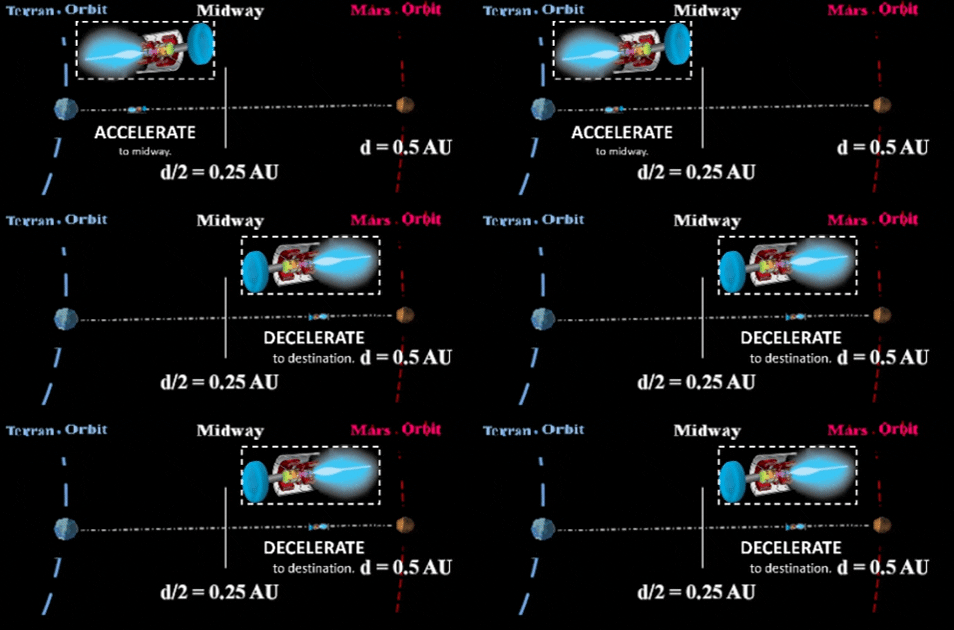
Use carefully controlled plasma leaks for constant (though small) thrust throughout the trip. This propulsion provides a constant acceleration to midway; then, deceleration from midway to destination.  The resulting trip could be as short as 3 months.

Plasma Performance is Better. Reason for plasma's improved performance, plasma engine constantly propels spacecraft (via plasma ion exhaust) throughout the voyage; this achieves greater speed and does not constrain the vessel to a purely orbital path.

Plasma engines heat gases to plasma state (millions of degrees). Thus, rocket performance improves with hotter exhaust; thrust greatly exceeds that of chemical reactants which only reach thousands of degrees in a conventional rocket engine.

Thrust from the plasma engine could boost a spacecraft for a longer time and with better efficiency than conventional engines. Plasma engines would have much longer thrust than conventional rocket engines. (Specific impulse.)
Typical plasma engine stays on throughout the entire trip to constantly increase velocity. In fact, vessel speeds so much that flight profile calls for a "slow down" at mid-way. At exactly mid-way, vessel flips around to propel in opposite direction and start decelerating. Otherwise, the vessel would arrive at destination way too fast for orbital insertion.
BRAINSTORM G-FORCE
3) Particle Accelerator Propulsion
(TE'S Brainstorm)
While shorter than 6 months, 3 months is a long time to spend in near 0-g conditions. A more practical use for a plasma engine might be as a plasma injector into a synchrotronic propulsion system.
Thought Experiment (TE) suggests a third choice. Present day accelerators routinely take ions to near light speeds; thus, TE conservatively assumes exhaust particle velocity of .866c (approaching light speed) which introduces a relativistic growth factor (n) of 2 (particle goes so fast, mass doubles).

Considering both this enormous velocity and relativistic growth of exhaust particles, TE uses simple momentum exchange equation to show that particle exhaust flow of .1 gm/sec will propel a 5 mT vehicle about 10 m/sec faster for every second of powered flight.
Such acceleration provides g-force to simulate Earth surface gravity (g-force) during powered portions of flight. Furthermore, a trip time to Mars reduces from months to just days, a much more reasonable duration.
For a third propulsion option, Thot Experiment brainstorms a notional process where a hollowed out asteroid with a synchrotron continually pumps out grams/sec of ions at 86.6% c. Such momentum could propel many tons of spacecraft at g-force.
For following nine factors, TE compares all three propulsion methods.
1. EXHAUST PARTICLE SPEED (VExh)
Exhaust particles at .866c can propel a large vehicle at g-force (9.806 m/s2).
Exhaust speed of particles expressed as decimal light speed
VExh = dc × c

Compute dcdecimal component of light speed:
  dc 
VExh / c

If vExh is already expressed as decimal c;  then, determine dc by inspection.
EXAMPLE: If VExh = .866c; then,  dc = .866.
TYPE DRIVE
VExhREMARKS
Chemical
Reactants
0.0cIf no "burn" during entire trip, then exhaust particles are static inside the vehicle.
Plasma 
Drive
.0033cTE generously assumes controlled plasma leaks about 1 million m/sec, about 1/3 of 1% light speed (c).
Particle
Accelerator
.866cTE conservatively estimates accelerated protons exit from particle accelerator at 86.6% c; much less then routinely achieved with current technology.
2. SHIP ACCELERATION (AShip)
TYPE DRIVE
AShip
REMARKS
Chemical
Reactants
0 g
With no propulsive force, ship is constrained to orbital velocity.
Thus, TE assumes zero acceleration.
Plasma
Drive
.0005g 
AShip=19.2845 km/sec

 45 days
1) Reduces to average velocity gain  of about 0.005 m/sec. 
2) Divide by g (9.8m/sec²) to convert to "decimal g". 
3) Result: Less than 0.1% Earth gravity, very little g-force!
Particle
Accelerator
1.0 g
g is 9.80665 m/sec², acceleration of a free falling object near Earth's surface. TE assumes g as the value for ship's acceleration. 
EQUIVALENCE:  Crew feels same downward force (g-force) as Earth surface gravity.
NOTE: AShip= Acceleration of vessel in decimal g.
EXAMPLE: Typical plasma drive for typical Mars profile.
AShip=ΔV

Δt
=(V1 - V0)

(t1 - t0)
Let velocity: V= 0; let time: t0 = 0.
Let V
VMax; let t1 = tMid.

Step 1Determine acceleration in meters per second per second (m/sec2).
AShip=VMax

 tMid
=19.2845 km/sec

45 days
AShip=
19,284.5 m/sec

3,888,000 sec
=.00496 meter

sec²
Step 2: Convert to decimal g (dg) as shown.
dg=AShip

g
=.00496 m/s²

9.8065 m/s²
=.0005 g
3. SHIP MASS (MShip)
G-force Examples
ffSecPlasma Drive MShipParticle Accel MShip
1 g
201.77 mT
26.47 mT
2 g
403.52 mT
52.94 mT
3 g
605.29 mT
79.42 mT
Given
dc

dg
× c

g
× ffSec
dc× c

g
× ffSec
dc= .0033; dg= .0005Let dc= .866; dg= 1
NOTE: Ignore relativistic growth in this example.
Later, we point out rate of fuel consumption (ffSec)
differs from the rate of fuel particle exhaust (ffExh).
c = 299,792,458 m/s
g = 9.8065 m/s per second
Thus, for each second, constant: c/g = 30.57×10⁶
CONCLUSION


For one gram/sec (ffSec) of consumed plasma ions, 
plasma drive might potentially push a heavier load at a much slower acceleration than Part. Accel.


HOWEVER, total travel time is much longer duration. 


(For Mars, plasma drive trip might take 90 days 

vs. 2 days for Particle Accelerator.)


TE assumes typical plasma drive vessel 
could not maintain this fuel consumption rate for so long.
If ffsec  is in grams (g),
MShip  is in metric Tonnes (mT).

MShip = (dc×c) × (ffExh)  / (dg×g)
TYPE
DRIVE
MShip
REMARKS
Chemical
Reactants
n/a
With no propulsive force, ship's mass is unconstrained.
Plasma
Drive
201.7
×106ffSec
Given particle exhaust speed at 1,000,000 m/sec, and ship acceleration about .0005g, ship's mass is constrained at about 200 million times the mass of exhaust fuel expelled per any given second.
MShip =dc

dg
×c

g
×ffSec= 2.017×10ffSec
Particle
Accelerator
26.47
×106ffSec
Ship's weight is constrained to about 26 million times the mass of exhaust fuel expelled per second.(disregard relativity)

Two kgs/sec of exhaust particles at .866c can g-force propel a vehicle of 52 kiloTonnes.
However, g-force fuel consumption must factor in Relativity and Efficiency.
4. RELATIVISTIC GROWTH FACTOR (n)
TYPE
DRIVE
n
REMARKS
Chemical
Reactants
1
Since static particles have zero velocity, relativity does not bear.
Plasma 
Drive
1.001
Since one million m/sec is slow relative to c, relativistic mass growth is very slight. Here, it is optimistically estimated as a thousandth.
Particle
Accelerator
2.000
At .866c, Lorentz Transform tells us that particle's relativistic mass is double the particle's mass at relative rest.
Relativistic growth factor (n) comes from the Lorentz Transform which can be used to quantify mass growth due to relativity.


ffSec: fuel flow per second, mass per second consumed at rest.  This quantity converts to plasma prior to injection into particle accelerator.


Note: n can be any rational number >1.0, but choosing certain dc values gives integer growth factors.  


Choosing particle exhaust speeds with corresponding growth factors as integers is a convenience but in no way a requirement.
n = 1

(1-dc2)
dc=(n2-1)

n
(n2-1)
From LORENTZ
 TRANSFORM (LT)
Solve LT
for dc
Product of
dc× n.


ndc
1
0.0 c
2
.866 c
3
.943 c
Given
(n2-1)

n
ffExh: exhaust mass / sec
exits the spacecraft for propulsion.
Due to relativistic speeds via particle accelerator,
consumed fuel mass grows to become fuel flow exhaust.


ffExh = ffSec

(1-dc2)
 =  n × ffSec 
5. PROPULSION EFFICIENCY
Efficiency (E) is a value between 0 and 100%, which quantifies how much input is deflected from output performance.  This decrease reflects inevitable design flaws and peripheral needs.  Theoretically, a perfect design would yield:
E= Input/Output = 100%


Alas, perfect efficiency will always elude us; however, continuing design improvements will always  take us ever closer.  Thus, propulsion efficiency will likely start out low as we journey to nearby destinations (like Mars and Ceres). However, TE assumes E will gradually increase as we design better vessels to journey to further destinations.
Relativity: as initial fuel mass speeds up from relative rest (0 m/s) to .866c, initial 1.0 kgm per sec grows to an exhaust flow of 2.0 kgm per second. Theoretically, this should g-force propel a vehicle of 53,000 mTs.
MShip = (dc×c) × (n×ffsec)  / g
MShip = dc × 30.57×10⁶× (n×ffsec
MShip = .866 × 30.57×106× (2×1.0 kg) = 52,947 mT 
However, above equations disregards inevitable inefficiencies.  Like all other systems, G-force spaceships will never achieve 100% efficiency; however, the conversion rate from at rest, consumed particles (ffsec) to near light speed, exhaust particles (ffExh) will improve over time.
TE previously disregarded efficiency concerns to determine a g-force ship of 52,666 mTs theoretically requires consumption rate of 1.0 kg/sec (ffSec).  This consumed quantity of particles must accelerate to .866c (VExh) to relativistically grow to 2.0 kg of exhaust particles (ffExh).


Since inefficiency is inevitable, optimistically assume E=70%. thus, we assume 70% of the 2.0 kg survives the particle acceleration process.  Sadly, this results in 70% of the desire thrust with only 70% g-force.  G-force vessel must compensate for this shortfall by increasing the consumption rate.
Since system inefficiencies are inevitable, actual thrust produced from theoretical fuel consumption requirement will be much less then needed for g-force. For this example, TE optimistically assumes system efficiency of 70%.  Thus, system inefficiencies divert 30% of plasma particles away from the thrust stream. Relativity increases the consumed 1 kg of fuel to 2 kg; HOWEVER, only 1.43 kg would actually exit the vehicle in the exhaust flow.
In this arbitrary scenario, an on-board weight scale would measure a 100 lb object at only 70 lbs. CONCLUSION: At 70% efficiency, fuel consumption of 1.0 kg produces enough thrust for only .7g-force.
Thus, TE uses an efficiency factor (ε) to determine added consumption required for g-force.
6. EFFICIENCY FACTOR (ε)
Efficiency Factor (ε) 
is reciprocal of Efficiency (E).
ε = 1/E
To compensate for inevitable inefficiencies, consumption rate must increase. Therefore, determine the Efficiency Factor (ε) by dividing 1 by E.  Then, determine increased consumption rate by multiplying original rate by ε.

EXAMPLE:  if E is 70%, increase consumption from 1.0 kg/sec to 1.43 kg/sec as shown in diagram.

TE now uses arbitrary examples of E = 70% and ε = 1.43 as a starting point. Actual g-force flights will provide empirical data tp determine actual Efficiency (E) and Efficiency Factor (ε). Items contributing to inefficiencies might include:
  1. Design flaws, for example, particle collisions will likely stop a significant portion of particles from exiting vessel.  Arbitrarily assume this causes 10% inefficiency.
  2. Systemic power needs; propulsion system components will need power. particle accelerator devices such as collision detectors, possible even the magnets (see next chapter for more on magnets) will need power even though these components don't directly contribute to propulsion. Arbitrarily assume this causes 10% inefficiency.
  3. Auxiliary Power. Life support, comm gear, nav gear and many other items are needed for ship operation and crew comfort, but not part of propulsion system. However, a portion of propulsion power will likely be diverted for these purposes. Arbitrarily assume this causes 10% inefficiency.
  4. E  = 100% - 10% -10% -10% = 70%
Actual efficiency data can't be obtained until g-force operations actually begins. Thus, TE must make do with assumptions.  For above three items, TE assumes each requires 10% of propulsion power output: thus, TE arbitrarily assumes an efficiency of 70% (a very optimistic assumption.) 
Actual efficiency (E) will need to be validated with empirical data.
 ffSec =  ε × MShip  / (dc × 30.57×10× n) 
ffSec  = 1.43 × 52,947 mT / (.866 × 30.57×106× 2 × 1.0) 
ffSec  = 1.43 kg 
TYPE DRIVE
EREMARKS
Chemical
Reactants
100%Perfect efficiency because no fuel expended,
a tautology.
Plasma 
Drive
100%
Very little fuel expended per day; so, this efficiency is close to one.
Particle
Accelerator
70%
Considerable fuel consumption; thus, inefficiencies are inevitable.  If exact values are not yet known, make reasonable assumptions.
For g-force propulsion, a 53 megaton vessel must emit an exhaust flow (ffExh) of 2 kg/sec with particle velocity of .866c. To achieve this exhaust flow, theoretical "at rest" fuel consumption rate is 1.00 kg/sec; and relativity will grow the particles to 2.0 kg/sec.  HOWEVER, practical fuel consumption must consider inevitable inefficiencies. Thus, apply the Efficiency Factor (ε), the reciprocal of Efficiency (E).  
EXAMPLE:  For E=70%, ε = 1/E = 1.43.  Increasing 1 kg by a factor of 1.43 results in 1.43 kg/sec consumed at rest.  Accelerate this to .866c, and it relativistically grows to 2.86 kg. Since this example assumes 70% survival rate, the exhaust particle flow reduces to 2.0 kg, the amount needed to create g-force.
7. DAILY DIFFERENCE (∇Day)
Ship's mass decreases due to powered flight's fuel consumption.  TE uses term, ∇Day , to describe daily decrease of ship's mass due to fuel consumption.  Recall that g-force ship capacity depends on actual quantity of high speed fuel particles (ffExh) actually expelled. Furthermore, g-force thrust particles are at relativistic velocities near light speed, dc c. Consider following factors:
(1) Relativistic growth factor, n,
depends on exhaust velocity (VExh).
VExh =dc c
 Compute n from Lorentz Transform (LT).
n =1

(1-dc2)
(2) Theoretical Exhaust Flow, ffExh
ffExh= n×fSec
As consumed fuel flow (ffSec) accelerates,

mass grows by relativity growth factor, n.
ffSec =ffExh

n
ε =1

E
(3) Practical fuel consumption, Sec.
Fuel flow, ffsec, is consumed at relative rest. 
Sec =ε×ffSec
However, this fuel consumption must also
account for inevitable inefficiencies.
(Efficiency factor, ε, is reciprocal of Efficiency, E).
ffDay= 86,400×∇sec
(4) Daily fuel consumption can be approximated.
Multiply by 86,400, seconds per day.
(5) Recall previous work:
  • c/g = 30.57×10⁶
  • dc× n = (n2 - 1)
  • For a g-force spaceship, dg = 1.
  • For other drive types, d<< 1.
MShip =vExh×ffExh

AShip
= dcc×nffsec

dgg
=30.57×(n2-1)×106×ffsec

dg
TYPE
DRIVE
Day
REMARKS
Chemical
Reactants
0No fuel expended.
However, no g-force during the flight,
and no hurry to get there.
Tolerable for robots but not humans.
Plasma
Drive
0.014%
dg=.0005ε=1n=1.001
For current plasma propulsion,
compute and apply very small values of dg.
Particle
Accelerator
0.233%
dg=1ε=1.43n=2
Relativistic growth of n=2
due to exhaust velocity of .866 c, light speed.
Resulting momentum enables g-force;
thus, dg=1.
Arbitrarily assume E = 70% 
for  efficiency factor of ε = 1/E = 1/.7 = 1.43.
Most daily fuel consumption, 
requires .233% of vessel's GW.
G-force benefits: 
1) inflight comfort 2) quick flight time.
(6) ∇Day is a percentage of ship's current gross weight (%GW). Daily decrease of ship's GW (∇Day ) depends on Efficiency Factor (ε), relativistic growth (n) and ship's acceleration (dg, expressed as decimal). 
Day =ffDay

MShip
Day= ε× 86,400 × ffsec

30.57×(n2-1)×106×ffsec/dg
Day =ε × dg × 86,400

30.57 × 10⁶ × (n2-1)
Day =ε × d× 0.283% GW

(n² - 1)
8. TYPICAL FLIGHT DURATION (t)
Type
Drive
Travel
TIme
REMARKS
Chemical
Reactants
180 days
Flight profile calls for a partial orbit at orbital speeds.
Plasma 
Drive
90
days
A small amount of constant propulsion can reduce trip time by as much as half.
Particle
Accelerator
2
days
A constant amount of near light speed propulsion particles can reduce trip time to much shorter durations in much more tolerable conditions
9. TOTAL DIFFERENCE (Ttl)
To determine trip's total fuel consumption,
accummulate all the daily GW differences for entire trip.
NOTE: ∇TtlGWFinal - GWInitial= ΣDay 
Quick way to approximate:
Multiply daily diff (∇Day) times total trip time (t).
Ttl = ∇Day × t
This works well for extremely small daily fuel consumptions
or for short trip durations.
Both these circumstances exist in following table.
TYPE
DRIVE
FUEL
REMARKS.
Chemical
Reactants
0
No fuel expended during flight.
Disregard chemical reactions ("burns")
to enter/exit orbit of flight
.
Plasma 
Drive
1.26%
For extremely small daily fuel consumptions, 
product of trip time times daily fuel consumption:
t ×Day = 90 dy × .014%GW/day 
t × Day  ≈ 1.26% GW0
Particle
Accelerator
0.466%
For a short 2 day trip, approximate as follows:
t × ∇Day = 2 dy ×.233% GW/day 
t × ∇Day ≈ 0.466% GW0
EXPONENTIALS
However, many flight profiles have significant fuel consumption and/or lengthy trip duration.  EXAMPLE: Let daily fuel consumption to be 1% ship's gross weight (GW).
Day = 1% GW/day = .01 GW/day
EXAMPLE:  Let total trip duration (t) be 40 days.
To determine total fuel consumption, our intuition might mislead us.  Initially, we might estimate total fuel consumption at forty times one percent, for a fuel burn of 40% initial gross weight (GW0).  Thus, if GW0 = 100 mTs; then, total fuel consumptions might be 40 mTs, and final gross weight (GW40) might be 60 mTs.  However, this intuitive approximation would be very imprecise.
Ttl = .01 GW/day × 40 days ≈  .4 GW0
GWFin =  GW40 GWTtl = .6 GW0
Multiplying daily differences
is easy but inaccurate!!!
A more accurate model of fuel consumption 
might involve exponents.
Axiomatic: If daily fuel consumption is 1% gross weight (t = .01 GWt), then tomorrow's gross weight will be 99% of today's;
GW1 =  .99 GW0
Example: If ship's initial gross weight GW0 is 100 metric Tonnes (mTs), then ship's GW can be computed for first, second and following days:
Day 1: GW1 = .99 GW0 = 99 mT
Day 2: GW2 = .99 GW1= .99 × 99 mT =  98.01 mT
Day t: GWt = .99 GWt-1= (1 - Day)t × GW0
Day 40: GW40 = .9940  × 100 mT =  66.897 mT
Exponentials more accurately determine fuel consumption 
for longer duration flights. 
SUMMARY:  In coming days of powered flight, ship's Gross Weight (GW) decreases due to fuel consumption.  Subsequently, slightly lighter ship requires slightly less fuel; thus, absolute fuel consumption decreases even though percentage Gross Weight (%GW) remains the same.  To model this, TE initially considers a convenient rate of fuel consumption (ffsec=1.0 kg/sec); then, TE determines ship's GW.
For particle exhaust speed (VExh) of 86.6% light speed (c), relativity doubles mass size; thus, growth factor(n)=2.
Thus, (n2-1) = 1.73.  For g-force propulsion,  d= 1. 
MShip=30.57×(n2-1)×106×ffsec

dg
For convenience, consider fuel flow (ffsec) of 1.0 kgm/sec.  Theoretically g-force propels a ship of 52,886 mTs.
However, it's much more likely that flight planners will first determine Take Off Gross Weight (TOGW); then, flight engineers will determine practical fuel flow requirements based on planned TOGW and known efficiency factor (ε).
Sidebar: SPECIFIC IMPULSE(Isp)
Type DriveVExhIsp
Solid rocket2,500 m/sec250 sec
Bipropellant liquid rocket4,400 m/sec450 sec
Ion thruster29,000 m/sec3,000 sec
VASIMR30,000-120,000 m/sec3,000-12,000 s
Part. Accel. Propulsion.866c≈260,000,000 m/s26,000,000 sec
GIVEN
OBSERVED
VExh /g
Specific impulse is measured in seconds.
EXAMPLE: one pound of typical solid rocket motor fuel produces one pound of thrust for 250 seconds.

Specific Impulse (Isp) is the length of time (usually “seconds”) that each unit weight of propellant propels its own weight.  For ships in vacuum of space, it proves convenient to compute specific impulse as average particle exhaust speed divided by g, near Earth gravity.