Thursday, September 22, 2011

HABITATS CAN EXTRACT ELEMENTS from the Gas Giants

Future habitats might mine resources
from the gas giants
as well as the many objects
in the Kuiper Belt.
However, getting there in a practical time
will require a space tug upgrade.


CONTENT
BACKGROUND: GAS GIANT ATMOSPHERES
MINING CONCEPTS
TRANSFER ORBITS TO/FM GAS GIANTS
HABITATS PROPELLED BY SPACE TUGS
SLOW TRANSFERS VS. MINI "g" ACCELERATION
SUMMARY


BACKGROUND: Atmospheres of the Outer Planets
Sheer abundance of gases and their locations make the gas giants good way stations beyond Mars.
ATMOSPHERIC GASES
by volume percentage (%)
Gas
Giant
Hydrogen
H2
Helium
He
Methane
C H4
Trace
Elements
Jupiter89.8%10.2%
Saturn96.3%3.3%0.4%
Uranus 82.5%15.2%2.3%1.0%
Neptune80.0%19.0%1.0%
Fuel for Propulsion Systems
Hydrogen and methane are excellent fuels for chemical rockets for travel to/from the local moons. Also, hydrogen can power both fission and fusion rockets. ³He is an excellent fusion reactor fuel to power internal systems.
Why Go There?
Mining operators could gather many metric Tonnes (mTs) of fusion fuel; notably ³He.

The ³He-³He fusion process emits no neutrons (aneutronic). This eliminates neutron radiation to greatly extend the life of the vessel's fusion reactors.
BACKGROUND: Mining gas giants for 3He has been widely studied for many years.  EXAMPLE: More than 50 years ago, the British Interplanetary Society proposed a Project Daedalus interstellar probe, fueled by 3He from the atmosphere of Jupiter. Further study has caused many scientists to also consider extracting 3He from the other gas giants because Jovian gravity might prove problematic.).


Daedalus project used an unmanned spacecraft  to go one-way to Barnard's Star. At an average speed of 0.15c  (15% light speed), the vessel would take about 50 years to travel the 6 light years distance. Before starting the long journey, the vessel would need a lengthy stay in orbit around a gas giant to mine some 3He. 
BACKGROUND:Atmospheric Mining Concepts for Gas Giants
AEROBOT could drift through atmospheres of Jupiter and other gas giants.  It could launch video probes to the surface to record images in various wavelengths.

On-board robot could gather gas samples, analyze them, and send results to orbiting habitats.

Aerostat Vehicle
 could persist in the atmosphere to continually process atmospheric gases.

Aerostat will periodically transfer the final product to nearby habitat either orbiting the planet or one of its moons.
Scooper “scoops” a portion of the planet’s atmosphere inside the vehicle for later processing.

After hundreds of missions, the scooper may show considerable strain from icy particles and potentially reactive materials (hydrogen, methane, etc.).
Cruiser gathers atmospheric gases as it flies in the atmosphere for an extended period.

To deploy many cruisers, in-situ manufacture and assembly of parts as well as vehicle maintenance may prove essential.
TRANSFER ORBITS TO/FM GAS GIANTS
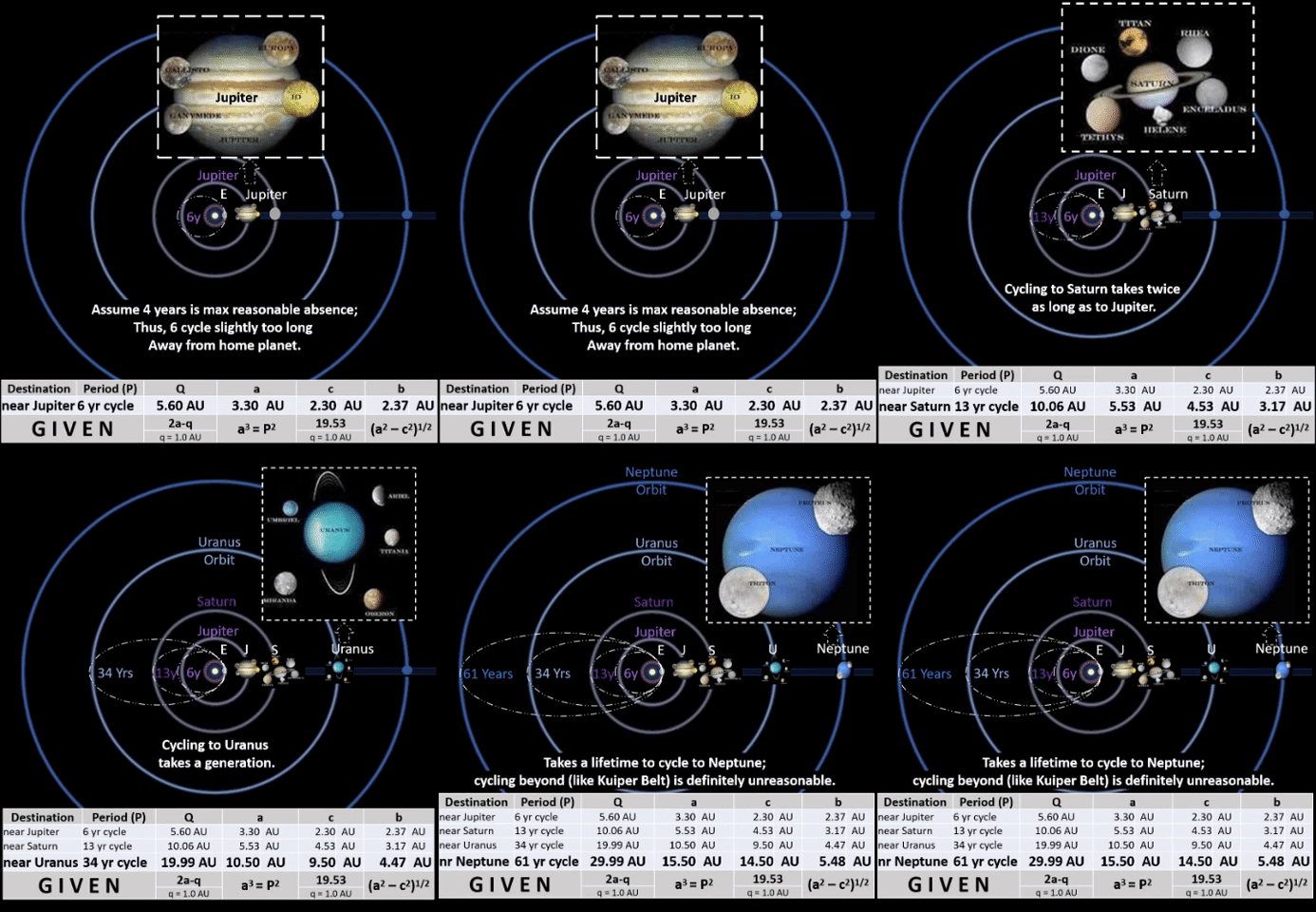
Transfer orbits
to Mars and ABOs
could take years;
HOWEVER, transfer orbits 
to gas giants 
will take decades; 
far longer than practical.
SLIDESHOW OF LEFT SIDE DIAGRAM
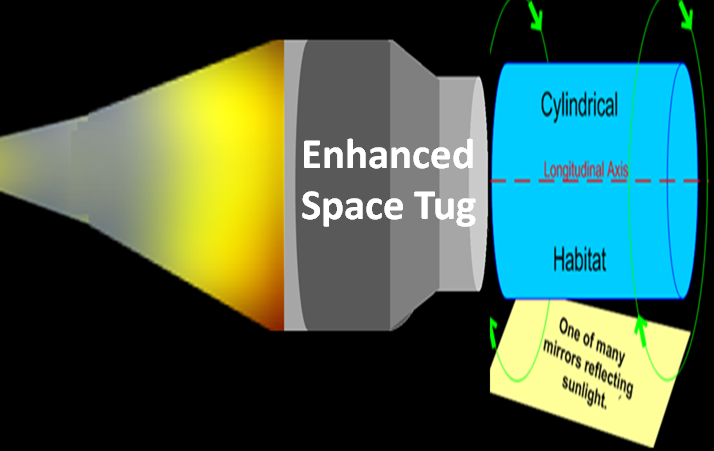
TE PROPOSES HABITATSPROPELLED BY ENHANCED SPACE TUGS.
On habitats, thousands of humans can enjoy all the comforts of Mother Earth such as: gravity simulated by spinning hull's centrifugal force, energy via ³He fusion reactors, on-board water supply for many uses, terraformed interior for plentiful flora and fauna.  Habitats can even use in situ materials to expand their size or even replicate other habitats.

For mining operations, these huge cylindrical habitats will have plenty of volume to manufacture and/or transport numerous devices to mine the gas giants. HOWEVER, one may assume that most commercial enterprises will not wait decades for their expensive vessels to travel via transfer orbits, harvest some resources and return to Earth.

To greatly decrease travel time to practical limits, enhance space tugs  to provide propulsion throughout the flight.  A constant acceleration as small as one percent earth gravity (.01 g) would greatly increase the vessel's average speed.
COMPARE SLOW TRANSFERS WITH MINI 'g' ACCELERATION
TRANSFER
ORBIT

versus
MINI 'g' ACCELERATION
  Distance from Sol:      d
5.6 AU10.06 AU20.00 AU30.00 AU40.00 AU
  TO Semi-major Axis:  a
3.3 AU5.53 AU10.495 AU15.495 AU20.525 AU
  TO Period:                 P
6.0 Yr13.0 Yr34.0 Yr61.0 Yr93.0 Yr
USING TRANSFER ORBITS to extract elements from gas giants will take years/decades.  
SPACE TUGS will be much quicker.  They might use "mini-g force" to propel habitats at small percentage of Earth Gravity, 'g'.
Assume 1% g = 0.1 m per sec/sec = .1 m/s2 which converts to A = .00449 AU/dy2 = .00449 Astro Unit per dy/dy.
  =  tAccel = [d/A]
 35.3 days48.6 days 66.7 days 81.7 days94.4 days
 2t = tAccel + tDecel  
 70.6 days 99.2 days 133.4 days 163.4 days188.8 days
 4t = tDest + tRetn
 141.2 days198.4 days 266.8 days 326.8 days377.6 days
Typical Transfer Orbit Period Typical Q as Line of Sight Dist. Total Travel Time: Accel = .01g
To construct typical Transfer Orbit (TO) between Earth and gas giant, assume perihelion, q, as 1 AU, distance from Sol to Terra.

Next, assume aphelion, Q, as typical observed distance from Sol to destination.

To determine period, compute semi-major axis, a, by averaging q and Q.
a = (q + Q) / 2

From semi-major axis, a, determine period, P, via Kepler’s Third Law:
P = a3
Typical P is decades; way too long!


Perhaps our vehicle can accelerate throughout the trip; then, we can assume path from Earth to destination will not be elliptical. Perhaps, the vehicle might approximate a linear path.


For convenience, assume typical distance along this linear path is same distance as aphelion (Q) used to construct corresponding transfer orbit.


One percent of Earth gravity (g) is 0.1 m per second per second (.1 m/s2). This acceleration value converts to A = .00449 AU/dy2; thus, we can determine accelerated times in days.
Common motion formula lets us compute acceleration time (tAccel) to midway (distance = d/2):
t = tAccel = [(2×dist)/A] = [d/A]
Assume deceleration time from midway to dest: tDecel = tAccel; thus, time from Earth to dest:
One Way Trip Time
tDest = tAccel + tDecel = 2t
Finally, assume destination time (2t) is same value as return time (2t); thus,
Two Way Trip Time
tTotal = tDest + tRetn= 2t + 2t = 4t
SUMMARY
Beyond the orbit of Jupiter, the main mission will likely be mining Helium-3 (³He) from gas giants.  However, there are also plenty of minerals and volatiles among the asteroids and comets among the Trojans, Centaurs, and other asteroid families.

Mining the atmospheres of the outer planets will prove essential. Using specialized factories to harvest hydrogen, helium, and helium 3 gases, we can power nuclear fusion power systems for many far flung habitats.

Many issues complicate the harvesting of these valuable resources. The dynamics of the atmosphere, radiation, and the energy for orbital transfer all call for very energetic and reliable propulsion systems to allow for rapid, reliable, and repetitive visits to the planets and their moons.

To handle the rigorous requirement of constant acceleration, space tugs might upgrade their propulsion systems from perhaps gangs of cyclotrons to a basic synchrotron.


CONCLUSION
Effective harvesting of available resources will control the timetables for human exploration. Indeed, the outer planets' resources will lead to the stars.
Positions of known outer Solar System objects.  
The Centaurs lie generally inwards of the Kuiper belt and outside the Jupiter Trojans.
● Giant planetsJ · S · U · N● Sun
● Centaurs (44,000)●  Jupiter Trojans (6,178)
● Kuiper belt (>1,000)● Scattered disc (>300)


VOLUME 0: ELEVATIONAL
VOLUME I: ASTEROIDAL
VOLUME II: INTERPLANETARY
VOLUME III: INTERSTELLAR


Sunday, September 18, 2011

FUSION WILL WARM US.


CONTENT
THREE PHASE PROFILE
PHASE-1. ACCELERATE
PHASE-2. CRUISE
PHASE-3. DECELERATE
FUSION FUEL GENERATIONS
1ST GEN FUSION FUEL: D + T
2ND GEN FUSION FUEL: D + He-3
3RD GEN FUSION FUELHe-3 + He-3
PROTON + BORON-11
CNO CATALYTIC CYCLE
GAS GIANTS
BRIEF AFTER THOUGHT


Fusion reactors 
will provide the power
(though not the propulsion)
for humans to live well and prosper
during multi-year journeys to the stars.

What Power?? On Earth, humanity gets life support power directly from Sol. It's likely that interplanetary habitats will also leverage Solar power.
HOWEVER, interstellar flights will spend long periods between stars; since power decreases per distance squared, vessels won't get much power from solar/stellar radiation. How will the onboard flora and fauna flourish without solar energy??

RECALL THREE PHASE PROFILE
of Thought Experiment's typical interstellar profile from Sol to AC.
PHASE-1. ACCELERATE AT G-FORCE FOR ABOUT ONE YEAR
Previous work indicates that 365.26 days of g-force acceleration achieves cruise velocity, VCru, 63.8% c, light speed, for a distance of about .38 Light Year (LY). Einstein conducted thought experiments to determine Principle of Equivalence:"occupants will not distinguish between g-force accleration or being static on Earth's surface".


Thus, the g-force which accelerates the spacecraft will also impart near Earth gravity throughout the vessel. Our Thought Experiment (TE) assumes that fuel limitations will restrict acceleration duration to about one year.
PHASE-2. CRUISE AT 63.8% LIGHT SPEED (c) FOR SEVERAL YEARS.
TE considers it impractical for an interstellar vessel to carry enough fuel to accelerate for entire interstellar flight; thus, the vessel needs to spend a long portion of flight at a constant velocity "cruise" phase.  Fortunately, a year of g-force acceleration brings this constant velocity to a significant portion of light speed, c. For example, Sol's nearest stellar neighbor is Alpha Centauri, about 4 LYs away; .638c makes the cruise time about about 6 years (tCru= 4 LY / .638c = 6.3 years ).


Cruise Phase. Having achieved a significant portion of light speed (.64 c), travel time between stars  reduces from centuries to just years. Since g-force propulsion will be off for cruise phase, near Earth gravity is maintained by spinning the habitat section of the vessel just like asteroidal habitats will have done for centuries back at the Solar System.
For the long cruise phase of interstellar flight, propulsion is off and the ship travels at constant velocity. With no propulsion, how does the vessel satisfy the human requirement for Earth like gravity? Vessel will need to transform from an accelerating g-force vessel to a spinning habitat and simulate gravity via centripetal force.
PHASE-3. DECELERATE AT G-FORCE FOR ABOUT A YEAR
Deceleration Phase reduces ship's velocity down to operational speed at destination to orbit around the star and it's children such as planets, asteroids, etc.


Without this essential deceleration, interstellar vessel would stay imprisoned at two thirds light speed forever!!
Without sunlight available to planetary habitats, interstellar habitat relies on fusion reactors to provide internal power.  A helium isotope, Helium-3, is the best candidate for fusion fuel.  Two most likely sources include:
  1. A gas giant, perhaps Uranus, can be mined for huge quantities. (NOTE: See "To Uranus".)
  2. A large magnetic field might collect/fuse enough interstellar protons to fuel onboard fusion reactors. (NOTE: See "Interstellar Ramjets".)

FUSION FUEL GENERATIONS

Since the 1950s, scientists have pursued much more efficient energy methods by fusing Hydrogen isotopes into Helium-4.  However, third generation fusion reactions won't need Hydrogen isotopes.
Deuterium (D) and Tritium (T) fuse most readily; their nucleonic electrical charge is the lowest of all elements. A deutrerium nucleus fuses with a tritium nucleus to form an alpha particle (4He nucleus) and a neutron. This reaction produces about 17.6 million electron volts (MeV) of  energy.
PROBLEM:  Above neutrons have no electrical charge and can't be controlled by magnetic fields. Thus, as an unwanted byproduct of first generation fusion reactors, neutral neutrons disregard magnetic forces and fly off into the walls of a fusion chamber, making them radioactive. Destructive power of those neutrons is cumulative and eventually adds up.  After several years, reactor walls irradiate beyond repair and must be replaced. Also, this process creates large volumes of high-level radioactive waste.
CURRENT RESEARCH: Commonwealth Fusion Systems is pursuing D + T fusion.
Second generation fuels (Deuterium and Helium-3) generate more energy than first generation fuels, but they require much more stringent confinement methods. A Deuterium atom fuses with a Helium-3 isotope (3He) to produce a proton and 4He nucleus (also known as an "alpha" particle). 
Sum of components going into the reaction weigh more then the reaction results, because the missing mass converts to energy.
Fusion When we fuse Helium-3 with Deuterium, we get the following aneutronic fusion reaction,

2D  + 3He → 4He (3.7 MeV) + 1p (14.7 MeV)

This is currently the most promising process for power generation; this is due to the nature of its reaction products. Most other fusion processes produce radioactive neutrons which bombard reactor components and eventually render them useless. In contrast, Helium-3 itself is non-radioactive. Fortunately, magnetic fields can contain high-energy protons and generate electricity.
PROBLEM: Inevitable side reactions  (D-D fusion) result in minor low energy neutron production; thus, second generation fusion reactions will most likely never be completely 'clean'.
CURRENT RESEARCH: Helion Energy is now pursuing D + He-3 fusion.
Helium 3 fusion would be ideal for powering spacecraft during the long stints of interstellar travel. While offering fusion's high performance power, 3He-3He reactors would require less shielding then the 2nd generation process.
(3He-3He) "third generation" fusion power fuses many Helium-3 atoms, to produce only protons and alpha particles with total energy of 12.9 MeV; this eliminates stray neutrons and radioactive waste.  Third generation fusion fuels produce only charged particles in the primary reactions. With almost no neutrons, there would be little induced radioactivity in the walls of the fusion chamber. This is often seen as the end goal of fusion research. 3He has the highest Maxwellian reactivity of any 3rd generation fusion fuel.
Thought experiment assumes 3rd Gen. fusion reactors will be essential for starship's auxiliary power needs. In this regard, Helium-3 (3He) might prove an essential resource for interstellar travel but not necessarily directly toward propulsion. This fusion process might provide essential power for the many power hungry life support processes as well as some components of the accelerator. In this aspect, 3He might someday become an essential part of the propulsion process.
CURRENT RESEARCH:  Assume not yet commercially pursued, perhaps due to scarcity of He-3.
PROTON + BORON-11 YIELDS 3 ALPHAS
Injecting proton into Boron-11 atom
forms an unstable carbon-12
which breaks up into 3 alpha particles.
BENEFITS:
Aneutronic process drastically reduces radiation concerns.
Electricity could directly form via  moving charged particles,  bypassing the need for inefficient steam turbines.
CHALLENGES:
Higher Temperatures: Reaction requires plasma temperatures roughly a billion° K.
Energy Losses: High temp electrons release massive amounts of X-ray energy via bremsstrahlung radiation. This energy loss might exceed any gains from fusion reactions.

CURRENT RESEARCH: TAE Technologies is pursuing p+B-11 fusion

CARBON, NITROGEN, OXYGEN (CNO) CATALYTIC CYCLE
SEQREACTIONDESCRIPTION
112C+1H13N+γCarbon-12 captures a proton to form Nitrogen-13.
213N13C+e++νeUnstable N-13 does beta-plus decay to Carbon-13.
313C+1H14N+γCarbon-13 captures 2nd  proton to become N-14.
414N+1H15O+γNitrogen-14 captures a third proton to become Oxygen-15.
515O15N+e++νeOxygen-15 undergoes beta-plus decay into Nitrogen-15.
615N+1H12C+4HeNitrogen-15 captures 4th proton, releasing a Helium nucleus to regenerate C-12.

 The CNO cycle commences once the stellar core temperature reaches 14 × 106 K and is the primary source of energy in stars of mass M > 1.5 M.

TE assumes no current commercial research into CNO fusion production.

POTENTIAL HELIUM-3 IN GAS GIANTS
PlanetTypical
Distance
to Earth
Planet
Mass
Escape 
Velocity
Estimated
Mass of Helium-3
Estimated
Energy Capacity
Earth=
1.0 AU
M = 1 Earth mass
Earth's e = 11.2 km/sec
mT = metric Tonne
1 yr = Earth 
annual consume
Jupiter
5 AU
318×M
59.5 kps
350×1012 mT
65×109 yr
Saturn
10 AU
95×M
35.5 kps
104×1012 mT
19×109 yr
Uranus
20 AU
15×M
21.3 kps
16×1012 mT
3×10⁹ yr
Neptune
30AU
17×M
23.7 kps
19×1012 mT
3.5×10⁹ yr
He-3 from Uranus
Uranus has the lowest escape velocity;
therefore, it might be the optimal mining site for Helium-3.
Mining operations would require a mix of artificial intelligence (AI) and human activity.


BRIEF AFTER THOUGHT

Dr. Gerald Kulcinski, previous director of the University of Wisconsin's Fusion Technology Institute (FTI), managed the "inertial electrostatic confinement device," an experimental low-power reactor that has successfully used lasers to perform continuous deuterium-helium-3 fusion.  May 2001, FTI researchers created fusion from steady-state deuterium-helium 3 plasma in a small reactor with a basketball sized chamber.   While it produced some radioactive waste, it was much less than the standard deuterium-tritium fusion reaction.
"Proof of principle," says Dr. Kulcinski, "but the next generation of Helium-3 fusion reactors will perform better and be completely free of radiation. Pure Helium-3 fusion (3He-3He) is a long way off, but it's worth the effort," says Kulcinski, "You'd have a little residual radioactivity when the reactor was running, but none when you turned it off. It would be a nuclear power source without the nuclear waste."
NOTE: In addition to He-3, additional energy might come from an external source.  See INTERSTELLAR RAMJET which leverages concepts from Bussard and Whitmire for harvesting enroute high speed particles.