Thursday, January 07, 2010

Isaac Newton

Sidebar: Newton

Centuries ago in merry old England, Isaac Newton was a young student at Cambridge. These were considered his "golden years" because he was young, full of energy, and motivated, and he put all this youthful enthusiasm into study. Isaac's Cambridge studies were interupted by the Black Plague and forced Newton to take a lengthy break at his home farm. Legend has it that he was sitting under an apple tree and observed an apple falling by itself from a branch to the ground.

"Something made that apple move from the end of a tree branch to the ground; what was it?", he thought to himself. Being a genius, Newton eventually deduced a force that "acts at a distance" throughout the universe. This is best described by Newton's universal constant of attraction (gravitation) which applies between any two bodies of mass. There are literally libraries full of books about the phenomena of gravity, but we care most about the following aspect: Earth's surface gravity attracts objects at a force that tends to accelerate them at 9.8 meters per sec per sec. It turns out that gravity and acceleration are closely intertwined.

Isaac Newton wrote that he might see further then others because he was "blessed to stand on the shoulders of giants". He wrote this phrase in a letter to the Royal Academy and was implying his two colleagues, Robert Hooke and Edmond Halley. Of course, both Hooke and Halley were well known scientists both then and throughout history, but they were nowhere near the stature of Newton. In modern times, many people now take Newton's famous analogy to mean the two emminent historical figures, Johannes Kepler and Galileo Galilei.

Another interesting item: Newton is reputed to be born on Christmas Day of the same year (1642) that Galileo died.

Of Newton's many discoveries, perhaps the most reknown is the concept that an object continues to travel at a constant velocity until a force changes either its direction or speed. Given that concept, it's an easy leap to conclude that a force causes mass to accelerate, or force is the result of mass accelerating (F = ma).

Universal constant of gravity, G, describes "force at a distance". Force makes objects accelerate (change velocity); conversely, acceleration gives objects a force. Thus, gravity (force at a distance) causes objects to accelerate; thus, this same acceleration can produce same force as gravity.

Paraphrasing text from "The Life of Isaac Newton" by R.S. Westfall.

In 1684, Dr. Halley came to visit Sir Isaac at Cambridge. After some conversation, Dr. Halley asked what Sir Isaac thought the curve would best describe path of the planets given the force of attraction towards te Sun to be reciprocal to the square of the distance from it (inverse square).

Sir Isaac immediately replied that it would be an ellipse.

Dr. Halley: "How did you come to that conclusion?"

Sir Isaac: I calculated it.

Dr. Halley asked for that calculation. Sir Isaac looked for the paper and could not find it right away; however, he later rewrote it as "On the Motion of Bodies in an Orbit". This became the impetus for Sir Isaac's masterwork, "The Principia"; and Halley is now famous for many things, most notably the comet that bears his name, but most importantly for ensuring that Newton eventually produced that work. Among many other key players involved in producing the Principia are included: Edward Paget and Humphry Newton (no relation).

Suggested Outline for relevant Newton research:

-gravity

-orbits

-momentum exchange

Friday, January 01, 2010

Walter Hohmann

Walter Hohmann became a luminary of astronautical history.

In 1912, Hohmann read a book on astronomy which sparked his lifelong interest in space flight. During the 1920s, it was a part of everyday life within the Hohmann family: poems, bookmarks decorated with rockets, and even birthday celebrations were infused with extraterrestrial enthusiasm.

Born March 18, 1880 in Germany, Hohmann became an engineer and worked for various companies in Vienna, Berlin, Hanover, and Breslau. In 1912, he became city engineer of Essen, Germany. in 1915, he filled a war-service position for eight months in WWI. Walter and Luise Juenemann were married in 1915 and had two sons, Rudolf in 1916 and Ernst in 1918.
*****
In 1933, the Nazis ascended to power. Not sympathetic to the Nazi cause, Hohmann became isolated from German space and rocket activity. Thus, he did not participate in developing rockets for military applications, such as the work done at Peenemunde.
*****
Walter Hohmann died on March 11, 1945 during an Allied bombing raid on Essen, a week before his 65th birthday and less than two months before the end of the war in Europe. He was preceded in death by his son, Ernst, a soldier in the German Army.

After WWI, many Germans contemplated space travel. Using basic math: basic calculus, simplifying assumptions, and numerical experimentation; Hohmann published an important work in astronautics. As Hohmann later explained: “I'm an engineer, not a mathematician; thus, clumsy approximations occasionally appear in the calculations; the results should still be valid.” Hohman presented his ideas with clarity, without mathematical formalism.

Walter Hohmann was a huge influence on a famous rocket society, VfR. Other members included Hohmann, Oberth, Wernher von Braun (1912–1977) as well as many other Germans involved in early space and rocket work. In 1929, the society accomplished a series of designs and tests served to advance the discipline from infancy to a credible branch of engineering.

Hohmann invokes precedents for the concept of a rocket-in-space in science fiction (e.g., Verne and Lasswitz), engineering (e.g., Oberth, Tsiolkovsky, Hermann Ganswindt, and Valier), and science (e.g., Newton).

Free-Space “Maneuver Analysis.” He envisages a vehicle departing radially from Earth and designs maneuvers for a parabola suitable for reentry. (Here, he introduces the important concept of ΔV (“delta vee”): change in velocity of a spacecraft by means of propulsion.)

For spacecraft orientation, current technology uses thrusters (high intensity nozzles that expel high speed gases; i.e., little rocket engines); however, Hohmann devised a method for crew members to clamber about the walls of the vehicle to cause desired rotation.

Circumnavigation of Other Heavenly Bodies

The first interplanetary trajectory used the now well known "Hohmann Transfer" to travel from Earth to Venus. Similar calculations are done for a trip to Mars. After a flyby, orbit about the Sun will bring it back to the point of departure. Of course, Earth continues in its orbit while the the spacecraft is off on its trip. Thus, Earth will probably not be at departure when the spacecraft returns to Earth's orbit.

For the spacecraft to return to Mother Earth, Hohman considers two methods:

  1. Maneuver into a holding orbit about Venus and, waiting until Earth is suitably positioned, thrust out of Venusian orbit and rendezvous with Earth.
  2. Conduct a space maneuver and return to Earth without going into orbit about Venus.

A trip to Mars is similar in principle, but he notes that the greater eccentricity (compared to Earth and Venus) of the Martian orbit must be taken into account. A single trajectory, departing Earth and passing by Venus and Mars before returning home, is possible when the three planets are suitably configured: the length of the journey is 580 days. Hohmann adapts his previous estimate of spacecraft mass and arrives at a figure of 16,720 kg, not including fuel.

Considering several onerous requirements with regard to mass for landing and return to Earth (humans are aboard), Hohmann specifies, “The fuel necessary for a return [should] be manufactured by simple means of raw materials available [on Venus]” (Hohmann 1960, 91). This technique of “in-situ propellant production” is now under consideration for certain NASA missions.

Landing on Mars is analyzed without aerobraking: the engine is used to decelerate the vehicle and place it on the surface. The results, in terms of mass and energy requirements for the system are, of course, less favorable than for landing on Venus. Again, in-situ propellant production is prescribed for powering the return to Earth.

Hohmann addresses optimal transfer orbits between planets: “For simplicity, we have up to now only discussed those connecting elliptic segments between planets, which touch the two planets, which are to be connected… It is not obvious that these tangential ellipses constitute the most favorable connection. Rather it is conceivable that other ellipses, intersecting planetary orbits, would be more expeditious, since without doubt they would provide shorter connections.” By comparing tangential transfer orbits with ellipses that cross one or both of the planetary orbits, he establishes his famous result that the smallest ΔV is required for the tangential case.

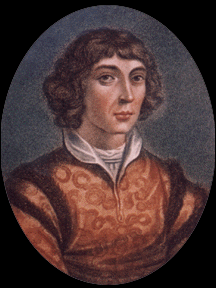
Nicholas Copernicus

Sidebar: Nicholas Copernicus

Nicholas Copernicus (1473-1543) postulated the Sun as the center of the Universe in his De Revolutionibus Orbium Coelestium (1543). Born in Torun, Poland, Copernicus first studied astronomy and astrology at the University of Cracow (1491-94). Later, he matriculated in 1496 in the University of Bologna, where he assisted Domenico Maria the Ferrarese of Novara (1454-1504), professor of mathematics and astrology and also the official compiler of prognostications for the university.
After briefly returning to Frombork, Copernicus studied medicine at the University of Padua (1501-3) and then moved on to the University of Ferrara where he obtained a doctorate in Canon Law (1503). He then returned to Varmia, where he was based for the rest of his life. He acted as medical advisor and secretary to his uncle, a church bishop at Heilsberg, and was later heavily involved with the administrative tasks in the diocese of Frombork.
In 1514, the Lateran Council sought Copernicus's opinion on calendar reform. Around the same time, he began to circulate in manuscript the 'Commentariolus' (A Brief Description), in which he criticised then prevalent Ptolemaic system for not adhering to the principle of uniform circular motions and offered instead his own system in which the earth and all the other planets rotate around the sun.
By the 1530s, Copernicus's reputation as a skilled mathematician had even reached the ears of the Pope. A professor of mathematics at the University of Wittenberg, Georg Joachim Rheticus (1514-1574) who was on a tour of visiting distinguished scholars, visited Copernicus in 1539. Copernicus shared his ideas with him, and Rheticus published the Narratio Prima (First Report on the Books of Revolution) in 1540 at Gdansk, in which he reported Copernicus' heliostatic theory in an astrological framework: the changing fortunes of the kingdom of the world, according to Rheticus, depended on the changing eccentricity of the sun. Following the favourable reception of the Narratio Prima, Rheticus persuaded Copernicus to publish a full account. This, of course, became the De Revolutionibus Orbium Coelestium (On the Revolutions of the Heavenly Spheres), published in March 1543 at Nuremberg. Copernicus died two months later.
In his De Revolutionibus, Copernicus ordered the planets and proposed the view that the universe is centered on Sol (our sun) versus Terra (our Earth) which was commonly believed to be the center of the universe. Thus, Copernicus is often incorrectly portrayed as a controversial figure who advocated a heliocentric system for the express purpose of overthrowing existing systems and institutions. In fact, his monumental work, the De Revolutionibus, is far from a revolutionary manifesto for modern astronomy. The work follows closely the structure of Ptolemy's Almagest, it is based on parameters and data from Ptolemy, and his dedication to the Pope is written in a fashionable style.
He does indeed provide a model of the universe in which the earth and all the other planets orbit around the sun and the earth acquired a daily rotation, but the sun itself was not quite in the center of that universe. He established the order of planets and devised a system which accounted for the movements of planets without equants, but he was motivated by the desire to establish uniform circular motion, itself a classical ideal. Copernicus certainly believed that this was the true system of the physical universe, but this conviction was not shared widely by his peers for contemporary reasons.

Copernicus then went on to briefly discuss the following cosmological topics. Like Ptolemy, he only presented a brief discussion of each point. The universe is spherical;The earth is also spherical;The earth forms a single sphere with water;The motion of the heavenly bodies is uniform, eternal, and circular or compounded of circular motions;Does the earth have a circular motion? What is its position?;The immensity of the heavens compared to the size of the earth;Why the ancients thought the earth was at rest at the middle of the universe as its centre;The inadequacy of the previous arguments and a refutation;Can several motions be attributed to the earth?
The centre of the universe. In this section, Copernicus stated that 'since nothing prevents the earth from moving, I suggest that we should now consider also whether several motions suit it, so that it can be regarded as one of the planets. For, it is not the centre of all the revolutions'. Following a short consideration of the questions, he concludes that 'it will be realised that the sun occupies the middle of the universe', explaining that 'all these facts are disclosed to us by the principle governing the order in which the planets follow one another, and by the harmony of the entire universe, if only we look at the matter, as the saying goes, with both eyes'.
Copernicus suggested the following order of the heavenly spheres:

  • highest heavenly sphere is the heaven of the fixed stars;
  • highest planet is Saturn,
  • Jupiter is next,
  • followed by Mars,
  • Venus,
  • Mercury,
  • the Earth (together with its attendant Moon),
  • Finally, the Sun resides in the centre of the universe.

He admitted that 'all these statements are difficult and almost inconceivable, being of course opposed to the beliefs of many people'. But he hoped that 'as we proceed, with God's help I shall make them clearer than sunlight, at any rate to those who are not unacquainted with the science of astronomy'.Copernicus went on to elaborate his cosmological views:At rest in the middle of everything is the sun.


Sidebar: Nicholas Copernicus

Nicholas Copernicus (1473-1543) postulated the Sun as the center of the Universe.


Born in Torun, Poland, Copernicus first studied astronomy and astrology at the University of Cracow (1491-94). After considerable more study in mathematics, medicine and law; he returned home for an extremely busy life.
In 1514, he began to circulate in manuscript the 'Commentariolus' (A Brief Description), in which he criticised then prevalent Ptolemaic system for not adhering to the principle of uniform circular motions and offered instead his own system in which the earth and all the other planets rotate around the sun.
By the 1530s, Copernicus's reputation as a skilled mathematician had even reached the ears of the Pope. Thus, the distinguished Professor Georg Joachim Rheticus (1514-1574), University of Wittenburg, included Copernicus on a tour of distinguished scholars and visited Copernicus in 1539. Thus, Rheticus reported Copernicus' heliostatic theory in his subsequent book, Narratio Prima (First Report on the Books of Revolution) in 1540 at Gdansk. Following the favourable reception of the Narratio Prima, Rheticus persuaded Copernicus to publish a full account. This became the De Revolutionibus Orbium Coelestium.

Copernicus ordered the planets and proposed the universe to be centered on Sol (our sun) versus Terra (our Earth) then considered as the center of the universe. Thus, Copernicus is often incorrectly portrayed as a controversial figure who advocated a heliocentric system for the express purpose of overthrowing existing systems and institutions. In fact, his monumental work follows parameters and data from Ptolemy, and it's even dedicated to the Pope in a fashionable style.
He presents a model in which the earth rotates daily and orbits the sun, but the sun itself was not quite in the center of the universe. He established the order of planets and devised a system which accounted for the movements of planets without equants, but he was motivated by the desire to establish uniform circular motion, itself a classical ideal. Copernicus certainly believed that this was the true system of the physical universe, but this conviction was not shared widely by his peers for contemporary reasons.

"On the Revolutions of the Heavenly Spheres" was published in March 1543 at Nuremberg. Copernicus died two months later. (For more.)

Copernicus suggested the following order of the heavenly spheres:

  • highest heavenly sphere is the heaven of the fixed stars;
  • highest planet is Saturn,
  • Jupiter is next,
  • followed by Mars,
  • Venus,
  • Mercury,
  • the Earth (together with its attendant Moon),
  • Finally, the Sun resides in the centre of the universe.

He admitted: 'all these statements are difficult and almost inconceivable, being of course opposed to the beliefs of many people'.


He hoped: 'as we proceed, with God's help I shall make them clearer than sunlight, at any rate to those who are not unacquainted with the science of astronomy'.

Copernicus introduced a new cosmological view: At rest in the middle of everything is the sun.