Oort
Jan Hendrik Oort
"Great Oak of Astronomy"
 Jan Hendrik Oort (28 April 1900 - 5 November 1992) was a Dutch astronomer; known for Oort cloud of comets which bears his name. Oort Cloud is now considered the de facto boundary of our Solar System.
In 1935 he became professor at the observatory of the University of Leiden, where Ejnar Hertzsprung was the director. (Dr. Hertzsprung is well known as one of the primary contributors to the Hertzsprung-Russell diagram, an essential tool in the study of stars.)
Oort was fascinated by radio waves from the universe. After WWII, he pioneered the new field of radio astronomy, using an old radar antenna confiscated from the Germans.
In the 1950s, he raised funds for a new radio telescope in Dwingeloo, in the east part of the Netherlands, to research the center of the galaxy. In 1970 a bigger telescope (the Westerbork Synthesis Radio Telescope) was built in Westerbork, near the old one. It consisted of twelve smaller telescopes working together to perform radio interferometry observations, a technique which had been previously suggested by Oort, but which was first tested experimentally in Cambridge by Martin Ryle and in Sydney by Joseph Pawsey.
Best known for his namesake, the Oort Cloud, he hypothesisized in 1950 that most comets came from a common region of the Solar System. This was later proven to be correct.
Oort's other discoveries include:
- In 1924, Oort discovered the galactic halo, a group of stars orbiting the Milky Way but outside the main disk.
- In 1927, he calculated that the center of the Milky Way was 5,900 parsecs (19,200 light years) from the Earth in the direction of the constellation Sagittarius.
- He showed that the Milky Way had a mass 100 billion times that of the Sun.
- He found that the light from the Crab Nebula was polarized and produced by synchrotron emission.
Oort died on 5 November 1992 in Leiden. Subrahmanyan Chandrasekhar remarked "The great oak of Astronomy has been felled, and we are lost without its shadow".
Jan Hendrik Oort was the son of a physician from Franeker in the Netherlands, Oort was educated at the University of Gröningen where he worked under Jacobus Kapteyn and gained his PhD in 1926. After a short period at Yale University in America he was appointed to the staff of the University of Leiden where he was made professor of astronomy in 1935 and from 1945 to 1970 served as director of the Leiden Observatory. He also served as director of the Netherlands Radio Observatory.Oort's main interest was in the structure and dynamics of our Galaxy.
In 1927, he confirmed the hypothesis of galactic rotation proposed by Bertil Lindblad. He argued that just as the outer planets appear to us to be overtaken and passed by the less distant ones in the solar system, so too with the stars if the Galaxy really rotated. It should then be possible to observe distant stars appearing to lag behind and be overtaken by nearer ones. Extensive observation and statistical analysis of the results would thus not only establish the fact of galactic rotation but also allow something of the structure and mass of the Galaxy to be deduced.
Based on various stellar motions, Oort calculated the Sun to be some 30,000 light-years from the center of the Galaxy; he also calculated about 225 million years for Sol to complete one galactic orbit. Oort also showed that stars in the outer regions of the galactic disk rotate more slowly than those nearer the center. Thus, the Galaxy does not rotate as a uniform whole but exhibits ‘differential rotation’.
Oort was also one of the earliest to see the potential of the newly emerging discipline of the 1940s, radio astronomy. As one of the few "pure research" scientists in the war years, Oort interested Hendrik van de Hulst in the work which eventually led to the discovery in 1951 of the 21-centimeter radio emission from neutral interstellar hydrogen.By measuring the distribution of this radiation and thus of the gas clouds, Oort and his Leiden colleagues traced the spiral structure of the galactic arms and substantially improved the earlier work of William Morgan.
They also investigated the central region of the Galaxy: the 21-centimeter radio emission passed unabsorbed through the gas clouds that had hidden the center from optical observation. They found a huge concentration of mass there, later identified as mainly stars, and also discovered that much of the gas in the region was moving rapidly outward away from the center.
Oort made major contributions to two other fields of astronomy. In 1950 he proposed that a huge swarm of comets surrounded the solar system at an immense distance and acted as a cometary reservoir. A comet could be perturbed out of this Oort cloud by a star and move into an orbit taking it toward the Sun.
In 1956, working with Theodore Walraven, he studied the light emitted from the Crab nebula, a supernova remnant. The light was found to be very strongly polarized and must therefore be synchrotron radiation produced by electrons moving at very great speed in a magnetic field.
JH Oort (1900-1992) overturned the idea that our sun is at the center of the Milky Way galaxy and contributed greatly to knowledge about the structure and evolution of our galaxy; however, he's best known as the discoverer the origin of most comets, the Oort Cloud.
Jan Oort was born on April 28, 1900, in the farming village of Franeker in Holland. At 17, he entered the University of Groningen and earned his doctoral degree in 1926. He received the Bachiene Foundation Prize (1920), undertook research at the Leiden Observatory (1924), and lived abroad as a research associate at the Yale University Observatory (1924-1926).
In 1926, Oort became an instructor at the University of Leiden, and the following year he married Johanna M. Graadt van Roggen. They had three children, sons Coenraad and Abraham and a daughter, Marijke. Oort became a professor of astronomy (1935) and director of the observatory (1945) at the University of Leiden. In his career, he was elected leader of several international astronomical groups. He received numerous awards, including the important Vetlesen Prize in 1966 from Columbia University.
Oort studied under Dr. Jacobus Kapteyn and became familiar with Kapteyn's celestial model, which placed the sun at the center of a relatively small galaxy. However, Harlow Shapley later (1917) challenged Kapteyn's model, proposing a far bigger one. Oort's first major scientific achievement was to provide observational evidence that confirmed the main features of Shapley's model.
Shortly after he joined the Leiden faculty in 1926, Oort found that stars with velocities greater than about 65 kilometers per second move predominantly toward one hemisphere of the night sky. That is consistent with the theory that our solar system rotates around the distant center of our galaxy and that other solar systems move around the same center. It was the first direct evidence of the Milky Way's rotation.
From his observations and calculations, Oort was able to show that our galaxy was much bigger than previously thought with many more stars. Oort also determined that the sun far from the galaxy's center. "Like a modern Copernicus, Oort showed that our position in nature's grand scheme was not so special," said Seth Shostak, a U.S. astronomer.
After WWII, Oort and his Leiden associates built a huge radio telescope to detect hydrogen radio waves to make far-reaching discoveries on the structure of our galaxy. They found evidence to hypothesisize that stars are formed out of hydrogen and dust clouds; they proved the spiral structure of our galaxy and found its period of rotation to be over 200 million years; and they located and investigated the processes occurring in the galactic core and the vast corona of hydrogen encircling the galaxy. They also investigated the origin of radio signal sources, including the group of stars known as the Crab Nebula, which they demonstrated to be a remnant of the supernova that appeared in 1054. Oort was credited with promoting radio astronomy in its early years and with putting the Netherlands in the forefront of postwar astronomy.
Oort's observations showed that there is much more mass in the universe than can be detected visually. This was a pioneering recognition of the undetected "missing mass" or "dark matter" that is believed to make up more than 90 percent of the universe.
Though he considered it a sideline, Oort is best known for his discoveries in the study of comets. By plotting their trajectories, Oort traced comets back to a region on the outskirts of the solar system. He theorized that in the distant past a planet that occupied a position between Mars and Jupiter exploded, sending most of its material into interstellar space, but a small percentage of the material became trapped in a region roughly 4,000 times as far away from our sun as Pluto. Fragments of this material are occasionally pulled by the gravity of the outer planets or a passing star into an orbit around the sun. The region that is the birthplace of comets became known as the Oort Cloud.
Oort Cloud
Oort Cloud is a huge, spherical body of small, icy bodies (i.e. "comets") orbiting the Sun at distances ranging from about 0.3 light-year to perhaps one light-year. This cloud is probably the source of most long-period comets.
In 1950, a Dutch astronomer, Jan Hendrik Oort (1900 – 1992), noted that most comet observations indicate origins from within our Solar System. He proposed our Sun, Sol, to be surrounded by billions of these objects, which are occasionally detected when they enter the inner solar system. Thus, we inferr the Oort Cloud's existence from a careful analysis of the orbits of comets from the cloud. We can further infer the Oort Cloud Objects (OCOs) are primordial bodies from the formation of the solar system (see solar nebula).
 Forming a rough sphere at its largest radius, Oort Cloud is wedge-shaped where it merges with the outer planet region in the vicinity of the Kuiper Belt Objects (KBOs).
If we assume the average OCO distance from Sol at 1 LY, this places the cloud at nearly a quarter of the distance to Proxima Centauri, Sol's nearest neighbor.
The Kuiper Belt is less than one thousandth the Oort cloud's distance from Sol.
The outer extent of the Oort cloud defines the gravitational boundary of our Solar System.
Perturbations (as by other stars) can upset a comet's orbit and may send it tumbling toward the sun.
Astronomers believe the Oort Cloud to be the source of all long-period and Halley-type comets entering the inner Solar System as well as many of the Centaurs and Jupiter-family comets.
Oort Cloud contains following regions:
- Inner Oort Cloud: 2,000-15,000 AU; a disc-shaped inner Oort Cloud, or Hills Cloud. Astronomers believe that the matter comprising the Oort Cloud formed closer to the Sun and was scattered far out into space by the gravitational effects of the giant planets early in the Solar System's evolution.
· - Outer Oort Cloud: 15,000-100,000 AU; spherical region more affected by stellar perturbations and galactic tidal forces. The outer Oort Cloud is only loosely bound to the Solar System, and thus is easily affected by the gravitational pull both of passing stars and of the Milky Way galaxy itself. These forces occasionally dislodge comets from their orbits within the cloud and send them towards the inner Solar System.
The Oort cloud is alternatively known as the Öpik-Oort Cloud. In 1932, Estonian astronomer Ernst Öpik postulated that long-period comets originated in an orbiting cloud at the outermost edge of the Solar System. In 1950, the idea was independently revived by Dutch astronomer Jan Hendrik Oort to resolve a paradox: over the course of the Solar System's existence, the comet's orbits become unstable; dynamics dictate that a comet must eventually collide with the Sun or a planet or exit the Solar System by planetary perturbations. Moreover, their volatile composition means that as they repeatedly approach the Sun, radiation gradually boils the volatiles off until the comet splits or develops an insulating crust that prevents further outgassing.
This led Oort to conclude that a comet could not have formed on its current orbit; thus, it must have been held in an outer reservoir for almost all of its existence.
Two main comet classes:
- short-period comets (also called ecliptic comets) Ecliptic comets have relatively short orbits, below 10 AU, and follow the ecliptic plane, the same plane in which the planets lie.
- long-period comets (also called nearly isotropic comets). Nearly all isotropic comets have very long orbits, on the order of thousands of AU, and appear from every corner of the sky.
Of the isotropic comets, Oort noted a peak in comet quantity with aphelia (farthest distance from the Sun) of roughly 20,000 AU. This suggests a reservoir at that distance with a spherical, isotropic distribution. On the other hand, relatively rare comets with orbits of about 10,000 AU aphelia have probably gone through one or more orbits through the Solar System and have had their orbits drawn inward by the gravity of Sol and the planets.
Structure and composition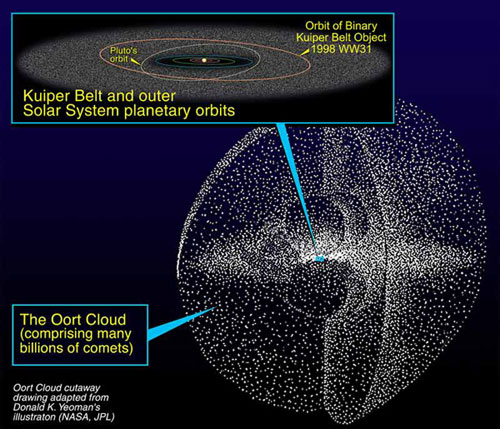 The Oort cloud probably occupies a vast space from 2,000 AU to well past 50,000 AU from the Sun. Some estimates place the outer edge at between 100,000 and 200,000 AU. This region can be subdivided into a spherical outer Oort cloud (20,000–50,000 AU), and a doughnut-shaped inner Oort cloud (2,000–20,000 AU). The outer cloud is only weakly bound to the Sun and supplies the long-period (and possibly Halley-type) comets to inside the orbit of Neptune.
The inner Oort cloud is also known as the Hills Cloud, named after J. G. Hills, who proposed its existence in 1981. Models predict that the inner cloud should have tens or hundreds of times as many cometary nuclei as the outer halo; it is seen as a possible source of new comets to resupply the relatively tenuous outer cloud as the latter's numbers are gradually depleted. The Hills cloud explains the continued existence of the Oort cloud after billions of years.
Some astronomers prefer to refer to the "extended scattered disc" rather than to the inner Oort cloud.
The outer Oort cloud is believed to contain several trillion individual comet nuclei larger than approximately 1.3 km (about 500 billion with absolute magnitudes brighter than 10.9), with neighboring comets typically tens of millions of kilometres apart. Its total mass is not known with certainty, but, assuming that Halley's comet is a suitable prototype for all comets within the outer Oort cloud, the estimated combined mass is 3 × 1025 kilograms, or roughly five times the mass of the Earth. Earlier it was thought to be more massive (up to 380 Earth masses), but improved knowledge of the size distribution of long-period comets has led to much lower estimates. The mass of the inner Oort cloud is not currently known.
Oort cloud objects probably consist of various ices such as methane, ethane, carbon monoxide, hydrogen cyanide, ammonia, and perhaps even water.
The discovery of the object 1996 PW, an asteroid in an orbit more typical of a long-period comet, suggests the Oort Cloud might also contain rocky objects.[19] Analysis of the carbon and nitrogen isotope ratios in both the Oort cloud and Jupiter-family comets shows little difference between the two, despite their vastly separate regions of origin. This suggests that both originated from the original protosolar cloud,[20] a conclusion also supported by studies of granular size in Oort cloud comets[21] and by the recent impact study of Jupiter-family comet Tempel 1.
Origin
The Oort cloud is thought to be a remnant of the original protoplanetary disc that formed around the Sun approximately 4.6 billion years ago. The most widely accepted hypothesis is that the Oort cloud's objects initially coalesced much closer to the Sun as part of the same process that formed the planets and asteroids, but that gravitational interaction with young gas giant planets such as Jupiter ejected the objects into extremely long elliptic or parabolic orbits. Simulations of the evolution of the Oort cloud from the beginnings of the Solar System to the present suggest that the cloud's mass peaked around 800 million years after formation, as the pace of accretion and collision slowed and depletion began to overtake supply.
Models by Julio Ángel Fernández suggest that the scattered disc, which is the main source for periodic comets in the Solar System, might also be the primary source for Oort cloud objects. According to the models, about half of the objects scattered travel outward towards the Oort cloud, while a quarter are shifted inward to Jupiter's orbit, and a quarter are ejected on hyperbolic orbits. The scattered disc might still be supplying the Oort cloud with material. A third of the scattered disc's population is likely to end up in the Oort cloud after 2.5 billion years.
Computer models suggest that collisions of cometary debris during the formation period play a far greater role than was previously thought. According to these models, the number of collisions early in the Solar System's history was so great that most comets were destroyed before they reached the Oort cloud. Therefore, the current cumulative mass of the Oort cloud is far less than was once suspected. The estimated mass of the cloud is only a small part of the 50–100 Earth masses of ejected material.
Gravitational interaction with nearby stars and galactic tides modified cometary orbits to make them more circular. This explains the nearly spherical shape of the outer Oort cloud. On the other hand, the Hills cloud, which is bound more strongly to the Sun, has yet to acquire a spherical shape. Recent studies have shown that the formation of the Oort cloud is broadly compatible with the hypothesis that the Solar System formed as part of an embedded cluster of 200–400 stars. These early stars likely played a role in the cloud's formation, since the number of close stellar passages within the cluster was much higher than today, leading to far more frequent perturbations.
Comets
Comets are believed to have two separate points of origin in the Solar System.
- Short-period comets (those with orbits of up to 200 years) are generally accepted to have emerged from the Kuiper belt or scattered disc, two linked flat discs of icy debris beyond Neptune's orbit at 30 AU and jointly extending out beyond 100 AU from the Sun.
- Long-period comets, such as comet Hale-Bopp, whose orbits last for thousands of years, are thought to originate in the Oort cloud.
Orbits of Kuiper belt objects are relatively stable; thus, very few comets are believed to originate there. The scattered disc, however, is dynamically active, and is far more likely to be the place of origin for comets. Comets pass from the scattered disc into the realm of the outer planets, becoming what are known as centaurs. These centaurs are then sent farther inward to become the short-period comets.
There are two main varieties of short-period comet: Jupiter-family comets (those with semi-major axes of less than 5 AU) and Halley-family comets.
Halley-family comets, named for their prototype, Halley's Comet, are unusual in that while they are short-period comets, their ultimate origin lies in the Oort cloud, not in the scattered disc. Based on their orbits, it is believed they were long-period comets that were captured by the gravity of the giant planets and sent into the inner Solar System. This process may have also created the present orbits of a significant fraction of the Jupiter-family comets, although the majority of such comets are thought to have originated in the scattered disc.
Oort noted that the number of returning comets was far less than his model predicted, and this issue, known as "cometary fading", has yet to be resolved. No known dynamical process can explain this undercount of observed comets. Hypotheses for this discrepancy include the destruction of comets due to tidal stresses, impact or heating; the loss of all volatiles, rendering some comets invisible, or the formation of a non-volatile crust on the surface. Dynamical studies of Oort cloud comets have shown that their occurrence in the outer planet region is several times higher than in the inner planet region. This discrepancy may be due to the gravitational attraction of Jupiter, which acts as a kind of barrier, trapping incoming comets and causing them to collide with it, just as it did with Comet Shoemaker-Levy 9 in 1994.
Tidal effects
Most of the comets seen close to the Sun are believed to have reached their current positions through gravitational distortion of the Oort cloud by the tidal force exerted by the Milky Way galaxy. Just as the Moon's tidal force bends and deforms the Earth's oceans, causing the tides to rise and fall, so the galactic tide also bends and distorts the orbits of bodies in the outer Solar System, pulling them towards the galactic centre. In the charted regions of the Solar System, these effects are negligible compared to the gravity of the Sun. At the outer reaches of the system, however, the Sun's gravity is weaker and the gradient of the Milky Way's gravitational field plays a far more noticeable role. Because of this gradient, galactic tides can deform an otherwise spherical Oort cloud, stretching the cloud in the direction of the galactic centre and compressing it along the other two axes. These small galactic perturbations may be enough to dislodge members of the Oort cloud from their orbits, sending them towards the Sun. The point at which the Sun's gravity concedes its influence to the galactic tide is called the tidal truncation radius. It lies at a radius of 100,000 to 200,000 AU, and marks the outer boundary of the Oort cloud. Some scholars theorise that the galactic tide may have contributed to the formation of the Oort cloud by increasing the perihelia—closest distances to the Sun—of planetesimals with large aphelia. The effects of the galactic tide are quite complex, and depend heavily on the behaviour of individual objects within a planetary system. Cumulatively, however, the effect can be quite significant: up to 90% of all comets originating from the Oort cloud may be the result of the galactic tide. Statistical models of the observed orbits of long-period comets argue that the galactic tide is the principal means by which their orbits are perturbed toward the inner Solar System.
Star perturbations
Besides the galactic tide, the main trigger for sending comets into the inner Solar System is believed to be interaction between the Sun's Oort cloud and the gravitational fields of near-by stars or giant molecular clouds. The orbit of the Sun through the plane of the Milky Way sometimes brings it in relatively close proximity to other stellar systems. For example, during the next 10 million years the known star with the greatest possibility of perturbing the Oort cloud is Gliese 710. This process also serves to scatter the objects out of the ecliptic plane, potentially also explaining the cloud's spherical distribution.
Stellar Companion Hypotheses
In 1984, Physicist Richard A. Muller postulated that the Sun has a heretofore undetected companion, either a brown dwarf or gaseous giant planet, in an elliptical orbit within the Oort cloud. This object, known as Nemesis, is hypothesized to pass through a portion of the Oort cloud approximately every 26 million years, bombarding the inner Solar System with comets. However, no direct evidence of Nemesis has been found.[38]
A somewhat similar hypothesis was advanced by astronomer John J. Matese of the University of Louisiana in 2002. He contends that more comets are arriving in the inner Solar System from a particular region of the Oort cloud than can be explained by the galactic tide or stellar perturbations alone, and that the most likely cause is a Jupiter-mass object in a distant orbit.
Possible Inner Oort Cloud Objects
Apart from long-period comets, only four known objects have orbits which suggest that they may belong to the Oort Cloud: 90377 Sedna, 2000 CR105, 2006 SQ372 and 2008 KV42. The first two, unlike scattered disc objects, have perihelia outside the gravitational reach of Neptune, and thus their orbits cannot be explained by perturbations from the gas giant planets.[40] If they formed in their current locations, their orbits must originally have been circular; otherwise accretion (the coalescence of smaller bodies into larger ones) would not have been possible because the large relative velocities between planetesimals would have been too disruptive. Their present-day elliptical orbits can be explained by a number of hypotheses:
These objects could have had their orbits and perihelion distances "lifted" by the passage of a nearby star when the Sun was still embedded in its birth star cluster.
Their orbits could have been disrupted by an as-yet-unknown planet-sized body within the Oort cloud.
They could have been scattered by Neptune during a period of particularly high eccentricity or by the gravity of a far larger primordial trans-Neptunian disc.
They could have been captured from around smaller passing stars.
Of these, the stellar disruption and “lift” hypothesis appears to agree most closely with observations.
posted by JimODell at 5:36 AM
2 comments


 According to data provided by the Polar satellite, the snowballs are no danger to people on Earth or astronauts, spacecraft or airplanes because they break up at altitudes from 600 miles (965 km) to 15,000 miles (24,140 km).
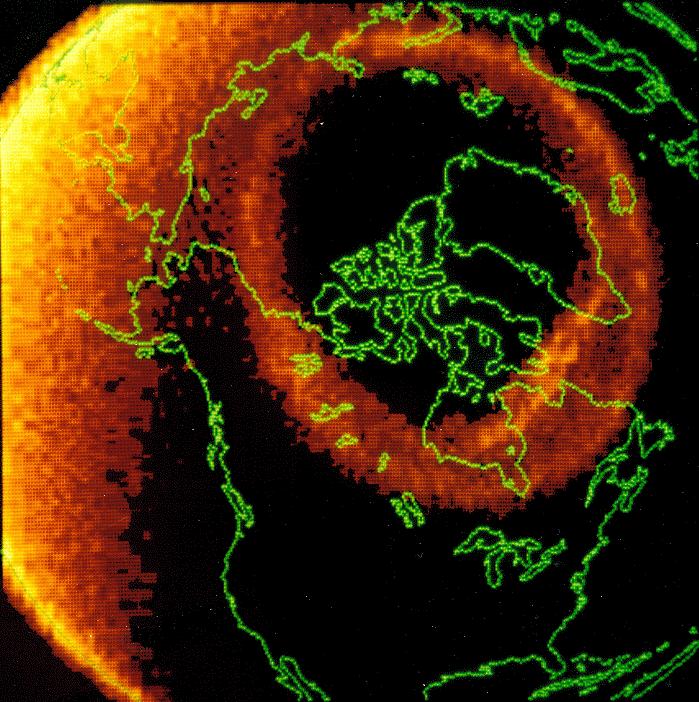 This satellite examined Earth for certain light emissions invisible to the naked eye. I and other scientists hoped for further insight into the nature of the auroral lights in Earth's polar atmosphere .... I was particularly interested in getting the first global pictures of Earth's aurora and I was not disappointed.
 Comets melting into water vapor clouds upon impact with Earth's atmosphere was the only reasonable explanation we could find. Many people said there had to be other explanations for the dark spots. But no one has ever come out with one.