Gauss Bio
Gauss and Ceres
History of Mathematics Term Paper, Rutgers, Spring 1999 by Leorah Weiss
"... for it is now clearly shown that the orbit of a heavenly body may be determined quite nearly from good observations embracing only a few days; and this without any hypothetical assumption." - Carl Friedrich Gauss
Born in 1777 in Brunswick, Germany, Gauss quickly showed his ability in mathematics. He corrected his father's arithmetic when he was three [1,5]. When he was seven, he startled his teachers by quickly adding integers from 1 to 100, (he determined the sum to be easily reduced to a simple multiplication problem by reducing the 100 numbers to 50 pairs of numbers, each summing to 101 [50 * 101 = 5,050].
The Duke of Brunswick noticed him in 1792 and sponsored his education. Gauss attended the Collegium Carolinium from 1792 to 1795, where he independently discovered the binomial theorem, the arithmetic-geometric mean, and the prime number theorem . (though he didn't prove the later).
In 1795, Gauss left Brunswick for the University of Goettingen. While there, he discovered how to construct a 17-sided polygon with ruler and compass. Gauss left the university in 1798 without a degree.
In 1799, Gauss developed the concept of complex numbers and also submitted a dissertation to the University of Helmstedt providing a proof for the fundamental theorem of algebra. [1,5] This dissertation won Gauss a doctoral degree in abstentia.
In 1801, Gauss completed "Disquisitiones Arithmeticae," a major volume on number theory.
Uranus was discovered in 1781.
On January 1, 1801, the Italian astronomer Joseph Piazzi discovered a planetoid, working from an observatory in Palermo, Italy. This object, which he christened Ceres, was moving in the constellation Taurus. Astronomers were only able to observe the planetoid for 41 days, during which its orbit swept out an angle of only 9 degrees. Ceres was then lost to sight when its light vanished in the rays of the sun, and the astronomers could no longer find it. There was now a challenge of calculating Ceres' orbit using only the observations Piazzi made, so that astronomers would be able to sight Ceres when it reemerged. Zach published Piazzi's observations of Ceres in June of 1801. Most of the leading astronomers in Europe already knew of these observations when they were published, and were scrambling to determine its orbit.
The main problem with calculating Ceres's orbit was a lack of precedent. The only possible precedent was William Herschel's fairly recent discovery of Uranus (1781). However, astronomers were able to observe Uranus's position on many different nights and recorded many position changes with respect to the Earth [11].
Astronomers assumed a circular orbit, which was fairly valid for Uranus. The reigning method for calculating orbits assumed that the orbit of a planet was circular, and that the orbit of a comet was parabolic [5]; that is, in both cases the eccentricity of the orbit was taken as known. The general form of a planet's or a comet's orbit depends on its eccentricity, which is the measurement of the orbit's deviation from circularity. A circle's eccentricity is 0, and the eccentricity of a parabola is 1. The problem of Ceres's orbit was that since no one knew the shape of its orbit, it could only be assumed to be an ellipse, with eccentricity between 0 and 1. This case had been dealt with by Euler, Lambert, Lagrange, and Laplace, but they used difficult methods which did not allow for a complete determination of the orbit from observations (necessarily involving observational errors) over only a short period of time. Laplace, among many others, thought the problem would be unsolvable in this form. Apparently, the orbit of Ceres could not be determined accurately from the data, at least with known methods. [5]
At this point, Gauss had already worked with astronomical questions, such as the theory of the motion of the moon.
At 18, Gauss had developed, but not published, his method of least squares, which made it possible to determine an orbit as long as it is assumed that it is a conic section [10]. He decided to work out a more useful method for determining orbits, and was soon ready [5,11]. Gauss differed from his contemporaries by avoiding any arbitrary assumption for the eccentricity of the initial orbit. His ellipse was based only on some of the available observations, without any additional hypotheses. The original computation was based largely on heuristic considerations. Gauss used methods similar to those used for the theory of the motion of the moon, especially the approximation of the elements of the orbit by finite parts of Taylor and trigonometric series. He also used the method of least squares to minimize the inevitable errors of observation [1,4,10].
Gauss first adopted Kepler's hypothesis that the motion of a celestial object is determined solely by its orbit. No information is needed about the mass, velocity, or any other details of the object itself. Gauss adopted a secondary hypothesis also, which was also derived from Kepler. It basically states that the orbit of an object that does not pass extremely close to another body in the solar system has the form of a conic section with its focal point at the center of the sun. Under these conditions, the motion of the object is determined by a set of 5 parameters, or elements, which specify the form and position of the orbit in space. Once the elements of an orbit are specified, the motion of the object is determined, as long as it remains in that orbit [11] (unperturbed by large planets such as Jupiter).
The elements of an orbit consist of the following: 2 parameters determining the position of the plane of the object's orbit relative to the Earth's orbit; the relative scale of the orbit; the eccentricity of the orbit or perihelial distance, the shortest distance from the orbit to the center of the sun; the relative "tilt" of the main axis of the orbit. In addition to these 5 parameters, a single time when the object was, or will be, in a particular point in the orbit is needed, so that its location at a given time can be computed [11].
Gauss had a total of 22 observations made by Piazzi over 41 days. The data from these observations consisted of a specific moment in time together with 2 angles defining the direction in which the object had been seen relative to an astronomical system of reference defined by the sphere of fixed stars. In principle, each of these observations defined a line in space, starting from the location of Piazzi's location at the moment of observation and directed along the direction defined by the 2 angles. Gauss had to make corrections for various effects such as the rotation of the Earth's axis, the motion of the Earth's orbit around the sun, and possible errors in Piazzi's observations or in their transcription [11].
The technical execution of Gauss's method is very involved, and required over 100 hours of calculation for him. His first tactic was to determine a rough approximation to the unknown orbit, and then refine it to a high degree of precision. Gauss initially used only 3 of Piazzi's 22 observations, those from January 1, January 21, and February 11. The observations showed an apparent retrograde motion from January 1 to January 11, around which time Ceres reversed to a forward motion. Gauss chose one of the unknown distances, the one corresponding to the intermediate position of the 3 observations, as the target of his efforts. After obtaining that important value, he determined the distances of the first and third observations, and from those the corresponding spatial positions of Ceres. From the spatial positions Gauss calculated a first approximation of the elements of the orbit. Using this approximate orbital calculation, he could then revise the initial calculation of the distances to obtain a more precise orbit, and so on, until all the values in the calculation became coherent with each other and with the three selected observations. Subsequent refinements in his calculation adjusted the initial parameters to fit all of Piazzi's observations more smoothly [11].
In September of 1801, Zach published several forecasts of the prospective orbit, his own and Gauss's among them; Gauss's prediction was quite different from the others and expanded the area of the sky to be searched [1]. Using Gauss's ephemeris for Ceres (astronomical almanac showing its predicted location at various times), astronomers found Ceres again between November 25 and December 31. Zach, on December 7, and then Olbers, on December 31, located Ceres very close to the positions predicted by Gauss. Between the discovery of Ceres in 1801 and the present day, over 1,500 planetoids have been identified, with Ceres remaining the largest [5,10]. While continually improving and simplifying his methods, Gauss calculated ephemerides for the new planetoids as they were discovered. When Olbers found Vesta in 1807, Gauss calculated the elements of its orbit in only 10 hours. His calculations of parabolic orbits were even faster, as is natural. He could calculate the orbit of a comet in a single hour, where it had taken Euler 3 days using the previous methods [5,6].
Gauss published his methods in 1809 as "Theoria motus corporum coelestium in sectionibus conicus solem ambientium," or, "Theory of the motion of heavenly bodies moving about the sun in conic sections." [1,2,3,5,6,11]. Gauss first wrote this work in German, but his well-known publisher, Perthes, requested he change it to Latin to make it more widely accessible (sic). In fact, the astronomical methods described in Theoria Motus Corporum Coelestium are still in use today, and only a few modifications have been necessary to adapt them for computers [11]. Gauss's determination of Ceres's orbit made him famous in academic circles worldwide, established his reputation in the scientific and mathematical communities, and won him a position as director at the Gottingen Observatory. [5,10]
Ceres was the first asteroid or minor planet to be discovered. It was found completely by accident by Giovanni Piazzi from his Palermo Observatory in Sicily on the evening of 1st January 1801. In respect of his patron, the then Sicilian monarch Ceres Ferdinandea, Piazzi named this new planetary body after him. Almost immediately this long name fell out of vogue and was soon shortened to just Ceres.
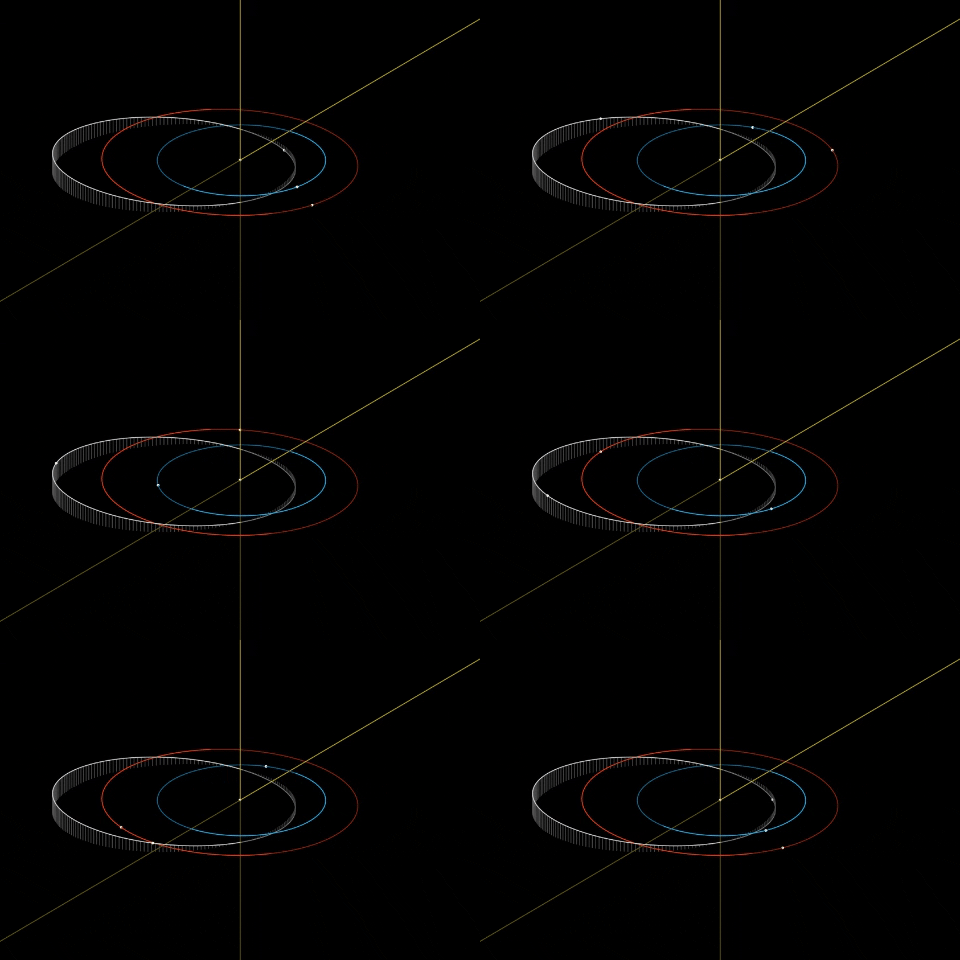
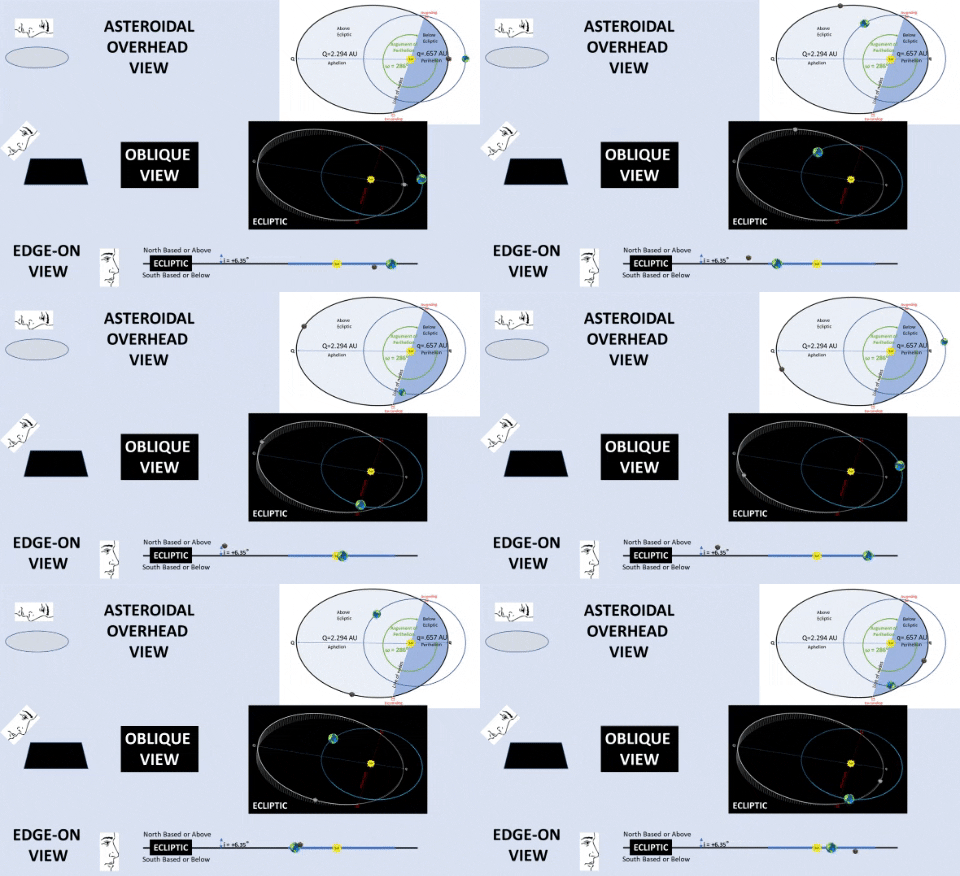
Ceres is the largest of the inner asteroids averaging about 950 kilometres across. Later measures have found the size to be more like of 975 by 909km (2005). Ceres is mostly visible in small binoculars, but still remains star-like in all amateur telescopes. It takes 4 years 7 months or 4.599 yr. to orbit the Sun, whose orbits lies in the main asteroid belt between the orbits of Mars and Jupiter at the mean solar distance of 2.766 AU or roughly 410 million kilometres. Distance also varies throughout the orbit - aphelion to perihelion - by about 66 million kilometres or 0.44 A.U.
Ceres crosses on average about four different constellations each year, but does not necessarily remain aligned to the familiar twelve zodical constellations. This is caused by Ceres having an inclination to the ecliptic of about 10.5° - indicating possible maximum declinations of +34° or -34°.
CERES DATA
Discoverer : Giovanni Piazzi : 01 Jan. 1801Satellites : 0Diameter : 975×909 km.Flattening : 0.0700Polar Tilt : 29.56°Period (P) : 4.599 yearsSynodic Period : 443.5 daysOrbital Velocity 17.88 km.s-1Eccentricity (e) : 0.0792Inclination (i) : 10.587°Mass : 9.5×10²⁰ kg.Mean Density : 2.08 g.cm-3Mean Distance : 2.776 AU or 4.13 ×10⁹ km.Sidereal Rotation : 09 hr. 04.8mMean Sidereal Rotation : 0.3781 d.Maximum Diameter : ″ (arcsec)Minimum Diameter : ″ (arcsec)Maximum Magnitude : +6.8
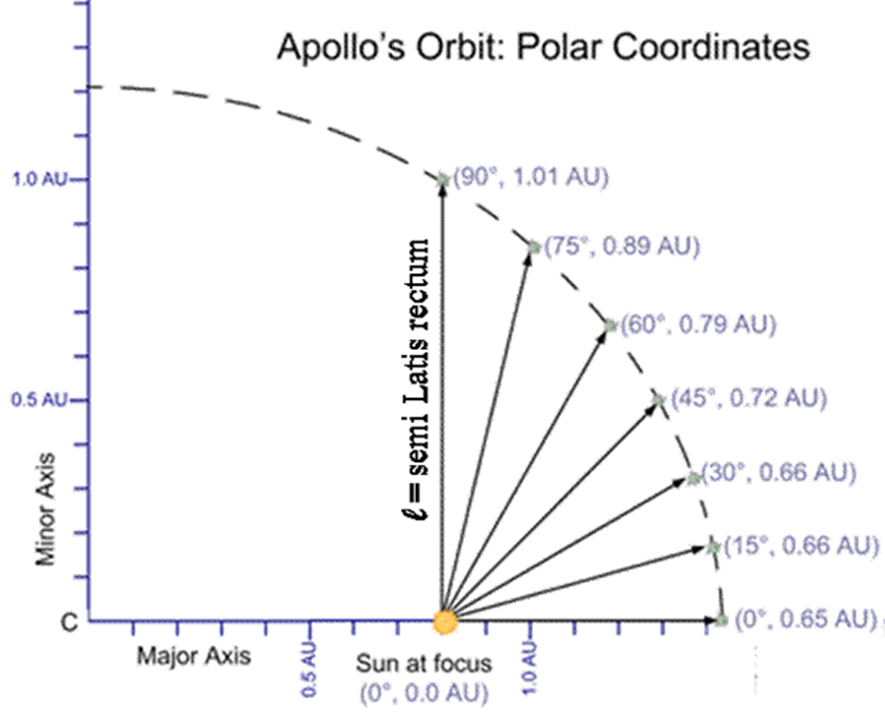
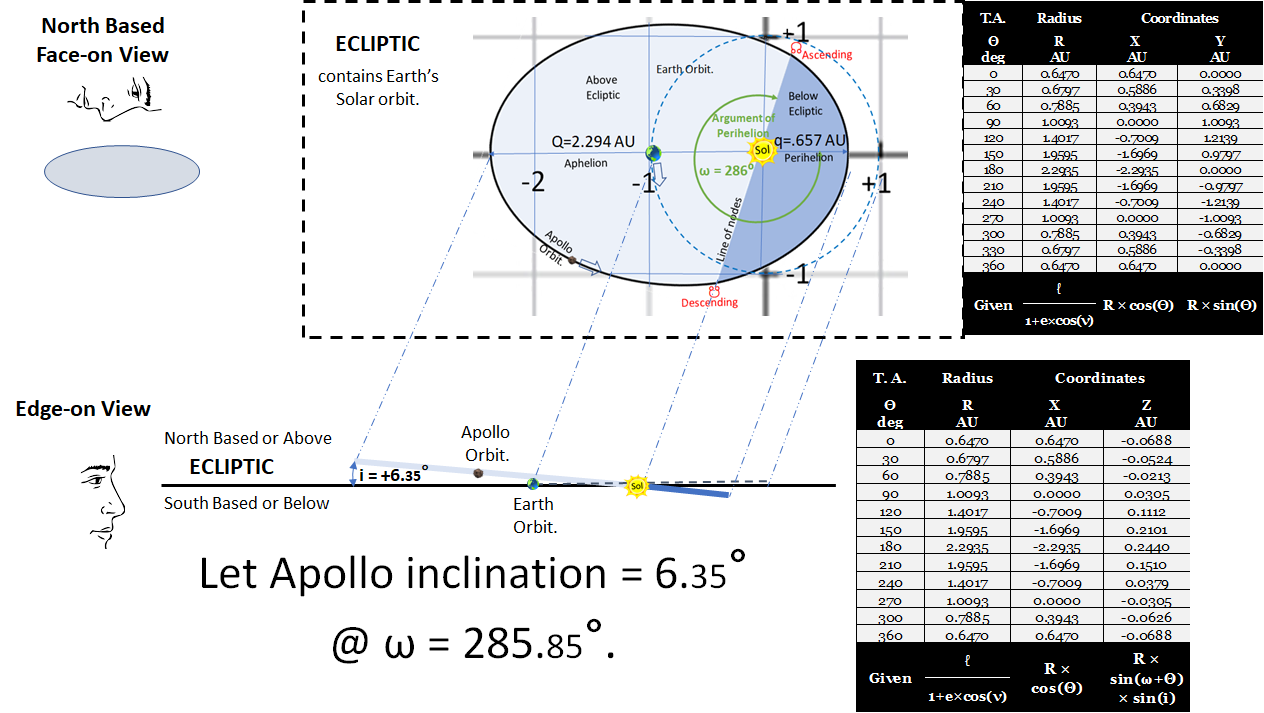
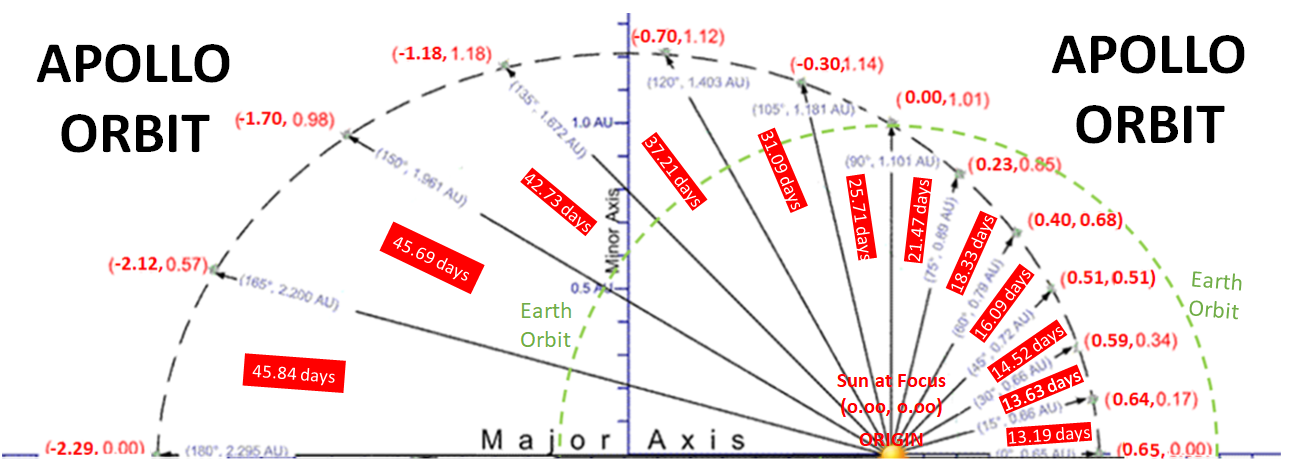
Ceres’ orbit appears slightly elliptical at an eccentricity of 0.0792, whose inclination is 10.59° to the ecliptic. This allows the observable range of possible declinations to vary between +34.1° and -34.1°, placing this minor planet often within constellations away from the zodiac. During 2006, for example, Ceres appears in the southern constellations of Microscopium and Piscis Austrinus, while in 2007, the first discovered minor planet can be found in Cetus for more than half the year.
So far over sixty-three oppositions have been observed between 1830 and 2006, making the true orbit fairly well established. Ceres over the decades calculated positions suffers greatly from the gravitational perturbations of nearby planetary bodies, which slowly change the ephemerides. These perturbations effects are mainly influenced by Jupiter, and to a much lesser extent, by both Mars and Pallas.
During certain oppositions, Ceres may brighten to about 6.8v magnitude, making the planet readily visible in binoculars as a bright star. When approaching its near yearly conjunction with the Sun, the brightness may drop to about 9.5 magnitude.
In 2004, from the same observation made by Hubble to measure Ceres’ diameter, was discovered a very bright white spot on the surface. This spot was likely caused by a cometary collision sometime in the past, whose signature appears to conclude that it is made mainly of frozen water ice. (See Ceres Image above). It is this bright surface feature that causes small fluctuations in light, whose variability was first found by Johann Schröter in 1811. This has lead to the observed rotational period of 09 hours 4.5 minutes (0.3781 dy) and poles being tilted by 29.6°.
CERES : ASTEROID to DWARF PLANET
During mid-August 2006, a sub-committee of the International Astronomical Union (IAU) proposed Ceres be promoted to planet status, decided under new definitions for planets - being massive enough to remain spherical. Ceres in this case is the only known body in the inner asteroid belt that is even close to spherical by its gravity. Had this been adopted both Pluto’s moon Charon and Eris (UB 313 aka Xena) would have been promoted to fully-fledged planets, making twelve (12) planets in our Solar System. This idea however only lasted until 24th August 2006 when the vote was taken in the 26th I.A.U. Conference in Prague, and the idea was rejected.
Instead an additional criteria for planet status was required. Presently, the IAU has classified Ceres as a dwarf planet - though there is an uneasy disquiet among some of the IAU Commission delegates about changing this status .Albedo (geometric) 0.113[4]
MYTHOLOGY
Ceres, in the Roman mythology, is the daughter from the union of Saturn and Rhea, and is also the wife and sister of Jupiter. Ceres’ mythological name is the Greek goddess Demeter, whose convoluted origin comes from the ancient celebrated Sicilian, and later the Roman, goddess of the harvest and grain. She is ritually worshipped for the increasing needs of food supply and towards the labourers in the fields who careful tended to the crops. One of Ceres significant roles in the Roman mythology was with the important relationship of Ceres and her young daughter Proserpina - Queen of the Underworld, whose equivalent story is aligned with the Greek goddess Persephone, the celebrated ancient goddess of Spring. This ancient story goes something like;
Proserpina was an attractive beautiful young woman who was greatly envied by Pluto. She was abducted and taken into Hades, where she was forcefully married Pluto. Jupiter soon saw Ceres reaction of great despair and distress from loss of her daughter. However, his direct concerns was soon heightened when Ceres point-blank refused to come back to Olympus. She began desperately searching the Earth for Proserpina, Ceres then began to lay waste great areas of the Earth - now as deserts, and in spitefully retribution, even stopped the crops of fruits and grain growing wherever she walked. Jupiter soon found a compromise with his brother by persuading Pluto to release Proserpina for half of each each year. So when Proserpina comes back to visit her mother, Ceres and Proserpina disperse seeds on the ground, cause the plants to propagate with fruit, and joyously celebrates by decorating the Earth with colourful flowers. When six-months has elapsed, she returns with the seasonal changes of autumn to Hades and her husband Pluto, where without her graces, all the plants slowly wither and lose their once vibrant colours - at least until she again triumphantly returns during the next Spring.
This popular story has real symbolic meaning regarding the growing of the annual crops - something that was increasingly important at the time to the large growing city population of Rome and surrounding its regions. In later times, the Romans became inordinately dependant on cereal and grain production, especially as most of the grain crops at first came from Sicily. By the 2nd and 1st Centuries B.C. this soon extended with with the importation of grain from Spain and even North Africa. If it were not for these distant regions, Rome would have not been able to support its large population.
Ceres honour for this reason became mainly worshipped by mainly the plebeians, either once every four years, or later annually. Here secret rituals by her followers occurred during the spring festival known as the Cerialia. Both the Romans and Sicilians vigourously venerated her in the hope of continuing bountiful crops and to avoid any possible crop failures during times of severe drought or hardship. Her worship is believed to have reached its pinnacle around 496 BC.
Ceres, by some, is astronomically represented in the sky as the outline of the zodiacal constellation of Virgo, the virgin. Some have also attributed Virgo to the goddess Astraea - the 5th discovered minor planet. Her name is synonymous to the Greek goddess, Demeter.
Ceres is mentioned in the Roman “The Satyricon” by Petronius Arbiter: Chp. 106
“To Ceres, from her harvest,the first fruits compelled to yieldAnd Bacchus with the fruitful vine to crown.”
Discovery of Ceres
Several observers in the 18th Century were first to note of the relationship between the planets and the mean planetary distances, even before “Bode Law” was postulated. Even Johannes Kepler (1571-1630) in 1596 “Misterium Comographicum” had noted the inordinately large gap between Mars and Jupiter, but this was merely commented. The first was the Oxford Professor David Gregory (1659-1708) in his work “Astronomae elementa” (1702), followed by the German popularist Christian Freiherr von Wolff in 1741. This latter claim was examined by Johann Daniel Titus (1729-96), who was first to notice the planetary “gap” missing in the orbital relationships. This was first published in “Comptemplation de la nature” in 1766. Here Titus modified Gregory”s relationship (now known as Bode’s Law) to produce the famous relationship;
d= [ 4 + 3 × ( 2n ) ] / 10
Where; d = Distance in Astronomical Units andn = Orbit of Number of the Orbital Position of any Planet.
Here each more distant planet, has added the geometrically increasing numbers of 0, 3, 6, 12, 24, 48, 96, etc., to the value of 4, and always only doubling the last numbers. From this sequence produces the known planetary distances, which are convert to astronomical units (A.U.) by dividing by ten. When appling this rule, the succession of values follow Table 1.
TABLE 1*******************************
Planet A.U. Calculation
*******************************
Mercury 0.4 4+ 0 = 4
Venus 0.7 4+ 3 = 7
Earth 1.0 4+ 6 = 10
Mars 1.5 4+ 12 = 16
?? ??? 4+ 24 = 28
Jupiter 5.2 4+ 48 = 52
Saturn 9.5 4+ 96 = 100
Uranus 19.2 4+192 = 196
Neptune 29.9 4+384 = 388
*******************************
Clearly the Earth and all then five known planets conveniently fitted this rule, except of course between Mars and Jupiter. After William Herschel discovery of Uranus in 1781, the planetary position automatically fitted so-called Bode’s Law, then the only irresistible conclusion that could be deduced was that there was probably another planet between Mars and Jupiter.
Towards this particular relationship, the missing gap was again further extended in 1772 by the investigations of Johann Elert Bode (1747-1826), who wanted to respond to Gregory’s “nonsense” proposal that the missing object might be just a moon of Mars. In 1776, Bode’s strong objection soon convinced him that another planet existing between the orbits of Mars and Jupiter that also drove him to further speculations into other possible trans-Uranian planets. [By the time of Neptune’s discovery in 1847, the sequence became questioned as the distances did not correspond to the law. Some interpreted this as being evidence of a planetary body beyond Neptune in the depths of the Solar System]
This curious equation came very popular in both the astronomical community and among the general public, as it was believed to have some real cosmic significance. The eventual formation of these “Celestial Police” became the positive reinforcement for some serious search of these missing planetary bodies. von Zack immediately attempted to predicted various theoretical orbits in 1785, then beginning some rudimentary searches during 1787 - without any success. By 1799, von Zack had requested the meeting of some of his prominent German colleagues that soon lead to the formation of the “Celestial police“ Society. At the very first formal meeting, this small observational group began organising its systematic search programme along the ecliptic by hoping to stumble upon this new undiscovered planet.
By September 1799, now only four months prior to Ceres’ discovery, there was a Society meeting at the observatory of the famed German visual observer, Johann Schröter’s. They had already realised that the search looking for these planets was mammoth undertaking, so they decided to align more recruits to help with their searching tasks. One of these observers they desired was Piazzi Giuseppe, who was the head astronomer of the Sicilian Palermo Observatory. They directly considered his nomination as important especially because of the much better observing conditions in Sicily. Piazzi was also the natural choice for this project as he was doing regular observations in the production of an extensive new star catalogue. Within days a letter was dispatched.
It must have been bitterly disappointing to all that this introductory letter about their group had still been in transit to Piazzi at the time of discovery. Although ‘losing their prize’ to someone ouside the group was upsetting, there was still much work to do. Although Ceres had been found on the 1st January 1801, it was soon became clear that it would soon be lost in the solar glare of the subsequent conjunction. At first Piazzi thought the new celestial body was merely some comet, but be the next night he observed that the star had moved and showed no indication of a tail. The timing of the discovery proved hard to ascertain it common motion, especially as the curved arc of its motion happened to coincide near the end of the observed retrograde motion of January 13. Piazzi observed Ceres again on the 11th January, but was unable to do further observations after this date because he become sick and bedridden. His uncertainty soon continued to diminished as Ceres closed on the Sun - but realised the new body’s movement against the background sky seemed far too slow for any comet. Yet without enough supporting observations computation of the orbit was not possible; and so Ceres disappeared in the sun’s rays without knowing where it would appear in the morning sky to be recovered.
Within three months, the new minor planet was again found by one of ‘The Police’. It was rediscovered based only on the seemingly intuitive orbital calculations of the mathematician and astronomer, Karl Gauss (1777-1855). Gauss had amazingly and accurately predicted Ceres’ new position to the extent that it was within the general field of any medium powered eyepiece. He was also first to calculated the orbit of Ceres, doing all the positional reductions himself. Now Ceres could always confidently be followed and recovered after its next and subsequent conjunctions with the Sun.
The reality of their presumed single ‘missing planet’ was soon to posing too many unanswered questions - Ceres seemed much too faint and too small. At the same time, Sir William Herschel also stated that Ceres diameter was merely “ ...at under 100miles” ( >161km), whose conclusion was based on the body always appearing star-like even using high magnifications. This small estimated size was soon confirmed using both orbital calculations and by the apparent magnitude of the minor planet. In fact, Ceres diameter was not really determined or approximated until the 20th Century. In 1994 this diameter was determined from ground radar as 930km, which was only improved in 2004 by the Hubble Space Telescope (HST) as 975x905 km.
After about 1803 AD, this general view had been totally accepted by them - Ceres was simply not big enough to be “planet-sized”. Herschel’s diameter was no better than a poor approximation, but amazingly, this value for the diameter wasn’t really questioned and never changed for many decades.
To solve this apparent dilemma of the missing planetary mass, Heinrich Wilhelm Matthäus Olbers began suggested that Ceres might be among several more of these small bodies. Soon planetary observers were earnestly searching for more of these planetary bodies, soon resulting in the discovery of Juno and Vesta in 1804 and 1807, respectively.
Perhaps the biggest observational evidence for these bodies not being true planets was the discovered by Schröter. In his written letter to Heinrich Olbers, he clearly states that his visual magnitude observations of Ceres and Pallas seemed to show unusually variablity. Here Olbers correctly assumed that; “…these asteroids are irregular rather than round figures.” Since then, nearly all the other minor planets between Mars and Jupiter has confirm this statement as true. Ceres so far seems to be the only one near to being actually spherical! As stated before in the introduction to this page, the variability in this instance is mainly caused by bright white spot on the surface of Ceres.Ceres 2006
*********************************************************
0h UT R.A. Decl. Mag Δ r El. Con
DATE (J2000) V A.U. A.U. o
*********************************************************
--2005--
31 Dec 18 34.9 -25 31 8.7 3.858 2.876 002.8 Sgr--2006--
14 Jan 19 00.0 -25 25 8.9 3.847 2.886 010.5 Sgr 28 Jan 19 24.6 -25 07 9.1 3.808 2.895 019.1 Sgr 11 Feb 19 48.6 -24 39 9.2 3.740 2.904 027.8 Sgr 25 Feb 20 11.7 -24 03 9.2 3.646 2.912 036.6 Cap 11 Mar 20 33.6 -23 22 9.2 3.528 2.920 045.6 Cap
25 Mar 20 54.2 -22 39 9.2 3.389 2.928 054.7 Cap 08 Apr 21 13.2 -22 00 9.2 3.231 2.935 064.1 Cap 22 Apr 21 30.3 -21 27 9.1 3.059 2.942 073.8 Cap 06 May 21 45.1 -21 06 9.0 2.878 2.948 084.0 Cap 20 May 21 57.2 -21 02 8.9 2.694 2.954 094.7 Cap
03 Jun 22 06.2 -21 20 8.7 2.513 2.959 106.1 Aqr 17 Jun 22 11.3 -22 02 8.5 2.345 2.964 118.3 Aqr 01 Jul 22 12.1 -23 10 8.3 2.197 2.969 131.4 Aqr 15 Jul 22 08.3 -24 39 8.0 2.081 2.973 145.1 Aqr 29 Jul 22 00.1 -26 18 7.8 2.008 2.976 158.5 PsA
12 Aug 21 48.7 -27 50 7.6 1.985 2.979 166.2 PsA 26 Aug 21 36.5 -28 57 7.8 2.016 2.982 159.1 PsA 09 Sep 21 26.0 -29 30 8.0 2.097 2.984 145.8 Mic 23 Sep 21 19.2 -29 28 8.3 2.221 2.985 131.8 Mic 07 Oct 21 17.1 -28 55 8.5 2.378 2.986 118.5 Mic
21 Oct 21 19.8 -28 00 8.8 2.557 2.987 105.9 Mic 04 Nov 21 26.8 -26 45 8.9 2.747 2.986 094.1 Cap 18 Nov 21 37.4 -25 16 9.1 2.941 2.986 083.0 PsA 02 Dec 21 50.7 -23 36 9.2 3.130 2.985 072.4 Cap
16 Dec 22 06.1 -21 46 9.3 3.309 2.983 062.4 Aqr
30 Dec 22 23.1 -19 48 9.3 3.472 2.981 052.7 Aqr
*********************************************************
Highlights for Ceres in 2006
Ceres is well placed for southern observers during 2006.
This dwarf planet for the first half of the year is placed
in the southern portions of Sagittarius, Capricornus and
Aquarius, as a morning object, before reaching opposition on
12 August. The current 2006 apparition is unfavourable, where
the brightness will only reach 7.6 magnitude, but at least
will be readily visible in binoculars. Only during the
oppositions of September 2011, January 2008 and August
2020 will Ceres again be this faint. Ie. 7.7, 8.8 and 7.7,
respectively. The 2006 opposition distance will be about
1.98 AU. or 297 million kilometres.
After the beginning of August, as a evening
object, where Ceres will move into the northern portion of
Piscis Austrinus and then into northern Microscopium -
staying there until November. During late September this
now classified dwarf planet reaches its most southerly
declination of -29° 31′, which will not
occur this far south again until early 2015. After the
opposition of the 12 August, the magnitude slowly drops,
decreasing to 9.3 mag. by years end, where it will be
placed in the western sky just after sunset within
the constellation of eastern Aquarius.
Ceres 2007*********************************************************
0h UT R.A. Decl. Mag Δ r El. Con
DATE (J2000) V A.U. A.U. o
*********************************************************
13 Jan 22 41.2 -17 42 9.3 3.614 2.978 043.4 Aqr
27 Jan 23 00.1 -15 31 9.3 3.734 2.975 034.5 Aqr
10 Feb 23 19.5 -13 15 9.2 3.828 2.971 025.9 Aqr
24 Feb 23 39.3 -10 58 9.1 3.894 2.967 017.7 Aqr
10 Mar 23 59.3 -08 40 9.0 3.932 2.962 010.7 Cet
24 Mar 00 19.3 -06 23 9.0 3.942 2.957 007.9 Cet
07 Apr 00 39.4 -04 09 9.0 3.922 2.952 012.1 Cet
21 Apr 00 59.4 -02 01 9.1 3.876 2.946 019.2 Cet
05 May 01 19.1 +00 00 9.2 3.802 2.939 026.9 Cet
19 May 01 38.6 +01 54 9.3 3.704 2.932 034.9 Cet
02 Jun 01 57.7 +03 37 9.3 3.583 2.925 043.0 Psc
16 Jun 02 16.1 +05 09 9.2 3.440 2.917 051.4 Cet
30 Jun 02 33.7 +06 29 9.2 3.280 2.909 060.0 Cet
14 Jul 02 50.1 +07 35 9.1 3.104 2.900 069.0 Cet
28 Jul 03 04.9 +08 26 9.0 2.917 2.891 078.5 Cet
11 Aug 03 17.6 +09 02 8.9 2.723 2.882 088.6 Cet
25 Aug 03 27.4 +09 23 8.7 2.528 2.872 099.4 Tau
08 Sep 03 33.8 +09 29 8.5 2.339 2.863 111.2 Tau
22 Sep 03 35.9 +09 21 8.2 2.165 2.852 124.1 Tau
06 Oct 03 33.1 +09 02 7.9 2.017 2.842 138.2 Tau
20 Oct 03 25.5 +08 38 7.6 1.906 2.831 153.3 Tau
03 Nov 03 14.0 +08 14 7.3 1.843 2.820 167.6 Cet
17 Nov 03 00.9 +08 01 7.3 1.836 2.809 167.4 Cet
01 Dec 02 48.8 +08 06 7.6 1.885 2.798 152.8 Cet
15 Dec 02 40.2 +08 33 7.9 1.983 2.787 137.3 Cet
29 Dec 02 36.3 +09 24 8.1 2.119 2.775 122.6 Cet
*********************************************************
Highlights for Ceres in 2007
During early to mid-2007, Ceres will be poorly placed for observers as it approaches solar conjunction on 22 March. In the second half of 2007, Ceres will appear as morning object, lying near the aequator of the sky at c.+08 degrees declination in the constellations of Cetus and Taurus.
Opposition will occur on 09th November, shining as 7.2 magnitude ‘star’ in eastern Cetus - being easily seen in small binoculars. Distance will then reach a minimum of 1.84 AU. or 275 million kilometres.
Oppositions and Conjuctions: 2006-2020************************
Opposition Conjunction
************************
12 Aug 2006 22 Mar 2007
09 Nov 2007 28 Jun 2008
24 Feb 2009 31 Oct 2009
18 Jun 2010 30 Jan 2011
16 Sep 2011 26 Apr 2012
17 Dec 2012 17 Aug 2013
15 Apr 2014 10 Dec 2014
25 Jul 2015 03 Mar 2016
20 Oct 2016 05 Jun 2017
31 Jan 2018 07 Oct 2018
29 May 2019 14 Jan 2020
28 Aug 2020 07 Apr 2021
*************************
Disclaimer
The user applying this data for any purpose forgoes any liability against the author. None of the information should be used for either legal or medical purposes. Although the data is accurate as possible some errors might be present. The onus of its use is place solely with the user.
posted by JimODell at 3:36 PM
0 comments


.png)