Tuesday, November 27, 2007

FULL MOON AND BEYOND: LAUNCH OMEGA


  LAGRANGE POINTS 4 & 5  
 HABITATS AS SAFE HAVENS 
DISASTER VS. EXTINCTION
FULL MOON
SOLAR ORBIT
FIRST LUNAR CYCLE
DEPLOY RESUPPLY MODULES
SECOND LUNAR CYCLE
THIRD LUNAR CYCLE
SUMMARY


LAGRANGE POINTS 4 & 5
L-4 and L-5 each form
an equilateral triangle with Sol and Terra.
Habitats, Alpha and Omega,
will be nice homes for a relatively few,
but many more will visit.

Alpha and Omega will directly benefit mankind
and will prosper in return.
HABITATS CAN BE SAFE HAVENS.
Alpha (α) and Omega (Ω) are arbitrary designations for the two Lagrange points in Earth's Solar orbit. For two body scenarios where one large body revolves around a much larger body (say Sol and Terra),


Lagrange points have enhanced stability. Joseph-Louis Lagrange (1736-1813) discovered five positions where gravity forces equalize; the two most stable are L-4 and L-5. For the Sol-Terra system, L-4 (α) would lead Terra by 60° in Terra's orbit around Sol. L-5 (Ω) would lag Terra by 60°.  Objects orbiting at these points are more likely to stay; thus, they make excellent "orbital parking spots".
Enhance Safety to Mother Earth and Humanity.  α-Ω Habitats could be safe havens for asteroid resources harvested from interplanetary missions. It would be extremely good judgment to place such resources well away from Mother Earth. Other deep space habitats or even remotely piloted asteroid chunks could arrive from throughout the Solar System; their owner/operators might want to send them to Earth for final processing. However, huge chunks of extraterrestrial material entering orbits around Earth presents some impact risk.

α-Ω Habitats could each host perhaps 100,000 to 1,000,000 people, sufficient population to process enormous quantity of extraneous asteroids and comets as well as to build other habitats and deploy them throughout the Solar System. At Habitats α-Ω, human colonies could process all such payloads at a safe distance from our home planet. At 1.0 AU from Earth, these habitats could safely harvest resources from far corners of the Solar System.
DISASTER EVENT VS. EXTINCTION EVENT
If an asteroid collides with a space borne habitat, worst case would be a disaster with significant loss of life.  If a asteroid collides with Earth, scientific studies of previous such events indicate this would likely be an extinction event with total loss of life on planet Earth. Obviously, one would choose the disaster over the extinction.  Furthermore, if such an extinction occurs (in spite of precautions), human survival might depend on alternate human populations on large terraformed habitats with plentiful amounts of Terran topsoil, flora and fauna.

Asteroid collisions occur naturally, but human error can play a part when we start harvesting asteroids. As we maneuver asteroids back to orbit Earth for much easier processing; it's possible that human error could someday cause an orbiting asteroid to impact Earth.  We don't want such events on our home planet; thus, it makes a lot of sense to send these asteroids to nearby habitats to conduct the processing.

SPACE-BORNE ECONOMICS. As interplanetary vessels prowl the Solar System and collect materials, they will bring them not to Terra Firma (Earth) where they might prove hazardous to the Mother Planet, but to Habitat α-Ω  to be easily processed. A likely economic model could have the habitats paying a delivery fee to relevant interplanetary vessels; thus, detecting and collecting plantesimals will prove to be lucrative. Furthermore, Habitats α-Ω  will process these materials to add considerable value and then sell them to other vessels traveling to other destinations. Thus, living on Alpha/Omega will also prove lucrative.

ON BOARD AGRICULTURE.

Habitats need agriculture.  Thus, they'll likely need to stop by Habitat α-Ω to buy some supplies, such as:

1) Energy Sources. Habitats in Earth Orbit will likely use large external mirrors to reflect sunlight into habitat.

2) Water Sources. Initially from Terran oceans; eventually from space borne comets. Obviously needed to grow crops as well as other life support purposes: drinking, bathing, swimming, even fishing.

3) Seed Sources.  Import large quantities of Terran topsoil to initiate habitat terraforming. Hydroponics might provide some food, but habitat still needs lots of topsoil to plant trees for oxygen, fruit, wood; even for landscaping.
FULL MOON
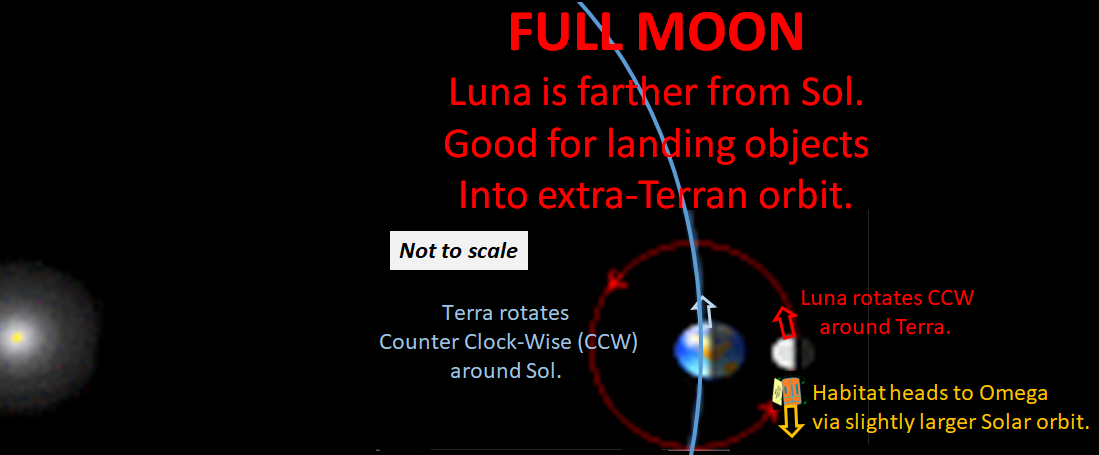
During Luna's orbit about Terra, it will enter the Full Moon phase 
when it is on opposite side of Sol, and we observe a fully illuminated Moon.
Some see a Lunar Eclipse when the Earth's shadow covers the Full Moon.
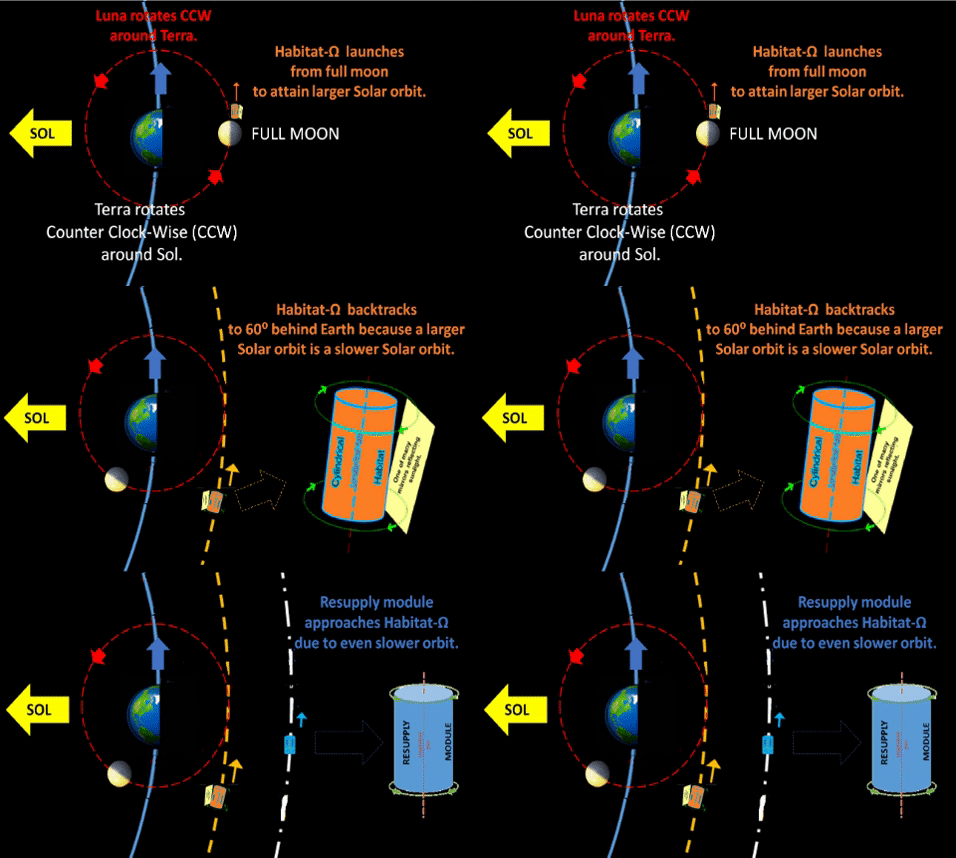
Habitat Omega (Hab-Ω) could launch from aft end of Full Moon for insertion into a Solar orbit with slightly larger orbital radius and slightly slower angular velocity. Thus, a Full Moon launch enables a vehicle to lag Mother Earth in Earth's own orbit.  
If Hab-Ω separates from the Luna-Terra system and continues a tiny daily lag rate of .004°/day; then, it would take 15,000 days (about 41 years) to reach 60° behind Earth's orbital position. Thereafter, Hab-Ω can rejoin the Terran Solar orbit and "park" at the L5 point to maintain a 60° lag from Earth. 
This 40+ years  transit time can be put to good use with lots of construction with materials from following launches from Luna. 

Getting There

Consider likely progress of Hab-Ω 
during initial Lunar cycle

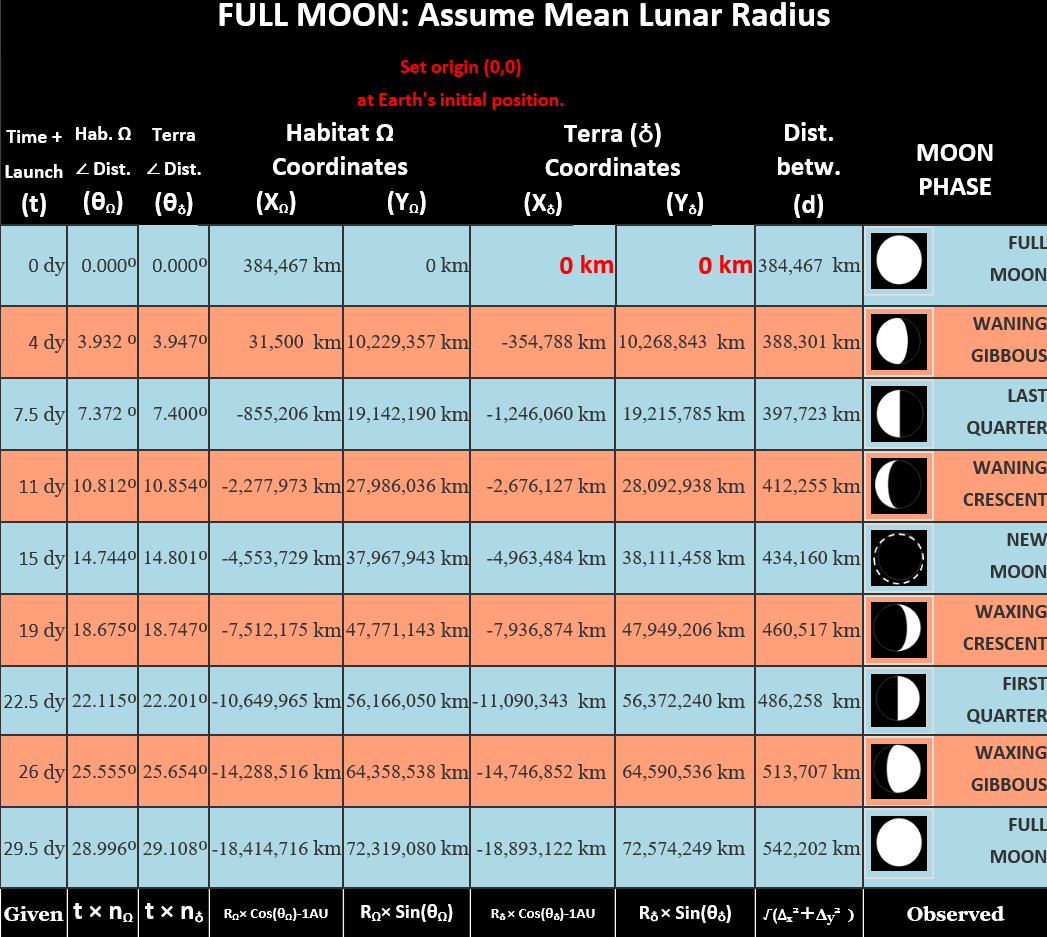
Omega Launch Tables


After Lunar Launch, 

note continual increase of  
linear separation (distance, d)
of Hab-Ω from Terra.
SOLAR ORBIT
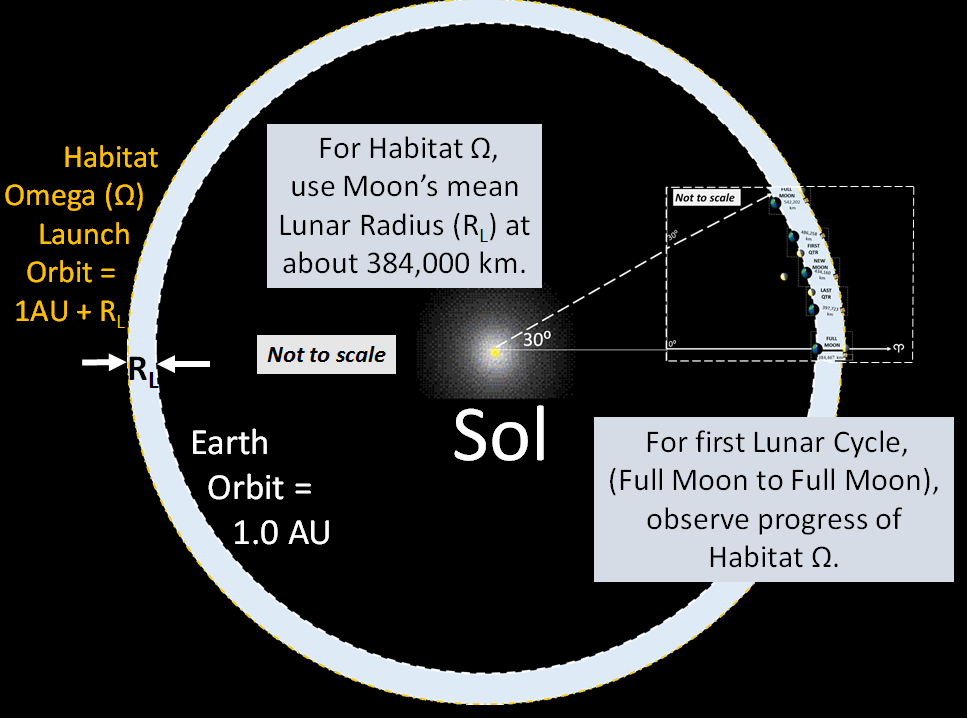
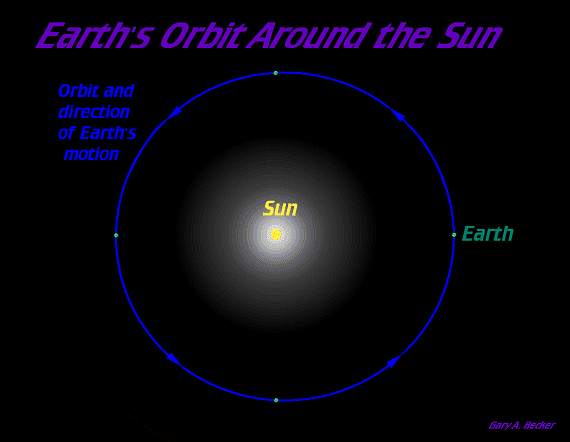
Assume first Full Moon happens exactly when Terra crosses line from Sol to “Point of Aries (♈) as shown to the far right of Sol in the diagram. Further assume mean Lunar radius (RL) of 384,000 km. If Hab-Ω carefully launches from Luna at Full Moon phase, it achieves a Solar Orbit of 1 AU + R.
1 AU + R =  149,597,870.7 km + 384,000 km
1 AU + R =  1 AU + .00257 AU  = 1.00257 AU
For convenience,
let angular velocity (ω) = mean motion (n)
for both Terra and Hab-Ω.
Assume HabΩ  Mean Motion: nΩ = 0.9818o/dy
Assume Earth Mean Motion:  n = 0.9867o/dy
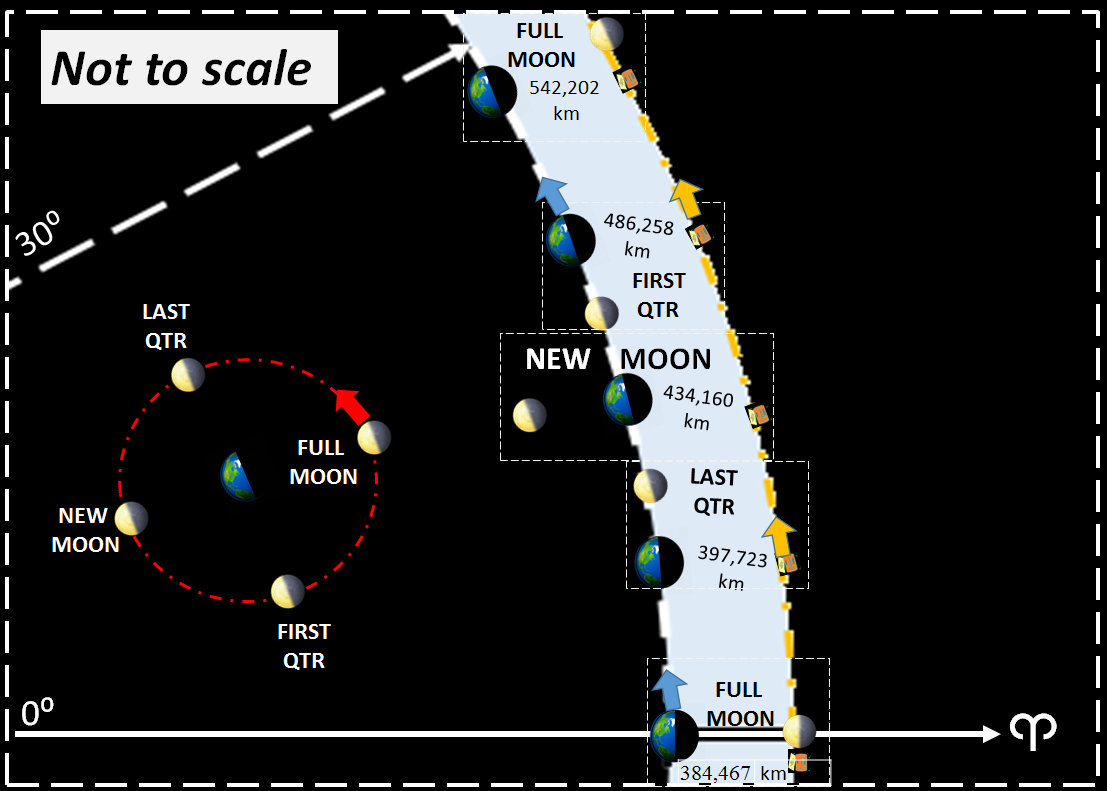
Inset rectangle shows Hab-Ω progress during first Lunar Cycle (Full Moon to Full Moon), a duration of 29.5 days.

Finally, assume that during the approx. 35 year transit time from Lunar launch to L5 (i.e. a lag of 60°), Hab-Ω closely parallels Terran orbit, a near circular orbit with slight eccentricity, e.
FIRST LUNAR CYCLE
During Full Moon (assume Aries), Hab-Ω launches from “aft” side of Luna. 
Assume enough propulsion to barely escape gravity of Terra-Luna system and maintain Solar orbit of 1.00257 AU. Slightly greater Solar radius will cause slower angular velocity and Hab-Ω will gradually lag further and further from Terra.
CONSIDER:  Will Hab-Ω avoid Lunar collision during this critical first Lunar Cycle?  
Omega Launch Table indicates that such collision is unlikely. Immediate Lunar motion is distinctly away from Hab-Ω in its Solar Orbit; thus, collision is unlikely as long as Hab-Ω escapes Luna’s gravity.
Remaining question, will Luna collide with Hab-Ω when it returns to Full Moon position. Again, this is very unlikely. EXAMPLES:
1)  Midway thru 1st lunar cycle (New Moon phase), Hab-Ω has already traveled over 434,000 km from Terra which exceeds max Lunar radius from Terra, 407,000 km.
2) At end of the cycle, Luna is back at Full Moon position and thus near Hab-Ω ‘s Solar radius. At this time, Hab-Ω’s separation from Terra is over 542,000 km, well out of Luna’s reach.
Finally, Hab-Ω must orbit for about 40 years in transition orbit (1.002547 AU from Sol) until it is 60⁰ behind Terra. Then, space tug pushes it into Earth orbit (1.0 AU from Sol) to indefinitely maintain that 60⁰ lag.
DEPLOY RESUPPLY MODULES.
Assume Hab-Ω needs 
resupply modules (Hab-Mod). 
Deployment method might use 
deeper orbits beyond FULL MOON.
TE assumes it to be very impractical to launch entire Hab-Ω with supplies for all 40 years, with all payloads, with all personnel at the very first launch.  Thus, TE suggests additional resupply modules during next few Lunar Cycles.  .

See following diagrams for more details.
SECOND LUNAR CYCLE
Subsequent Full Moons present more opportunities for resupply missions.
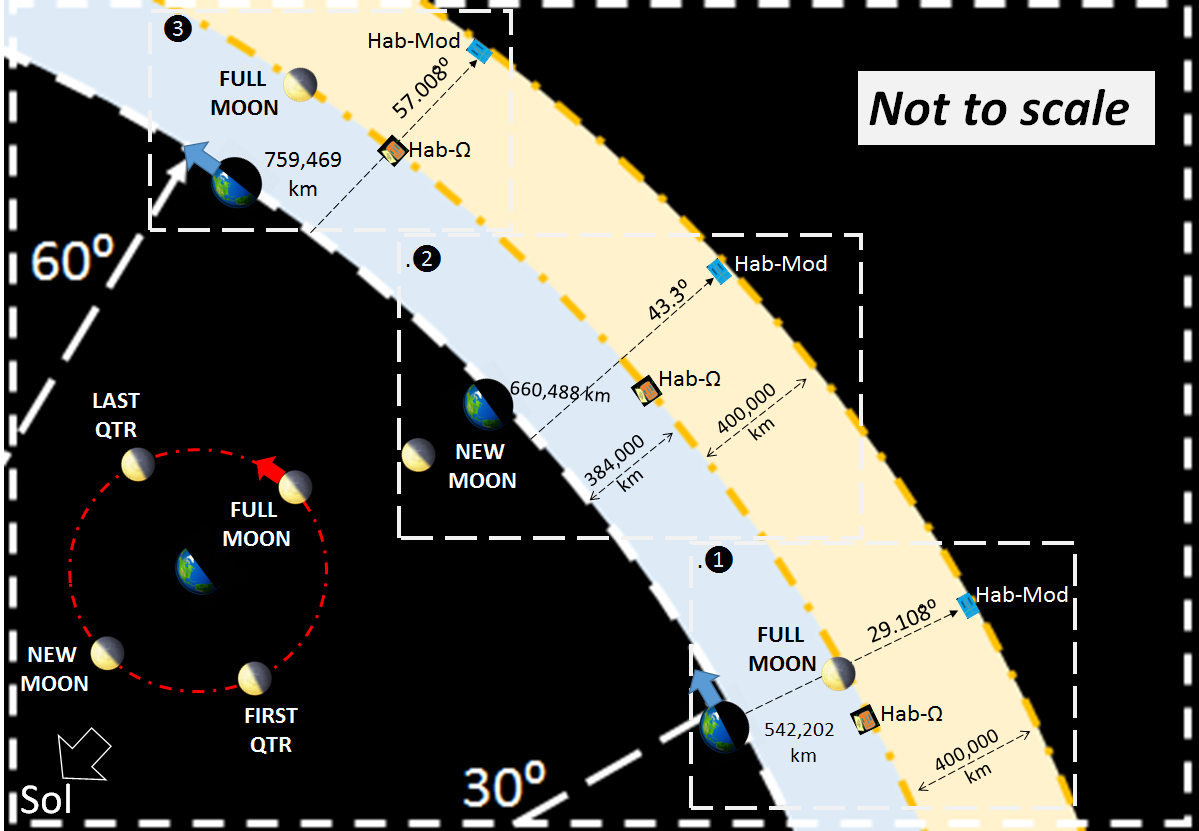
To survive the long voyage of orbiting from Earth to a parking spot 60° (one AU) away, launch additional Habitat-Modules (Hab-Mods) with more supplies and materials.  During second Lunar Cycle, we can demonstrate one such launch.

❶  At start of 2nd Lunar Cycle (Full Moon), Habitat Module (Hab-
Mod) leaves Lunar Orbit for a larger slower orbit to gain a lag rate greater than Habitat-Omega (Hab-Ω) .

❷  Midway through 2nd Lunar Cycle (New Moon), Hab-Mod falls behind Terra.

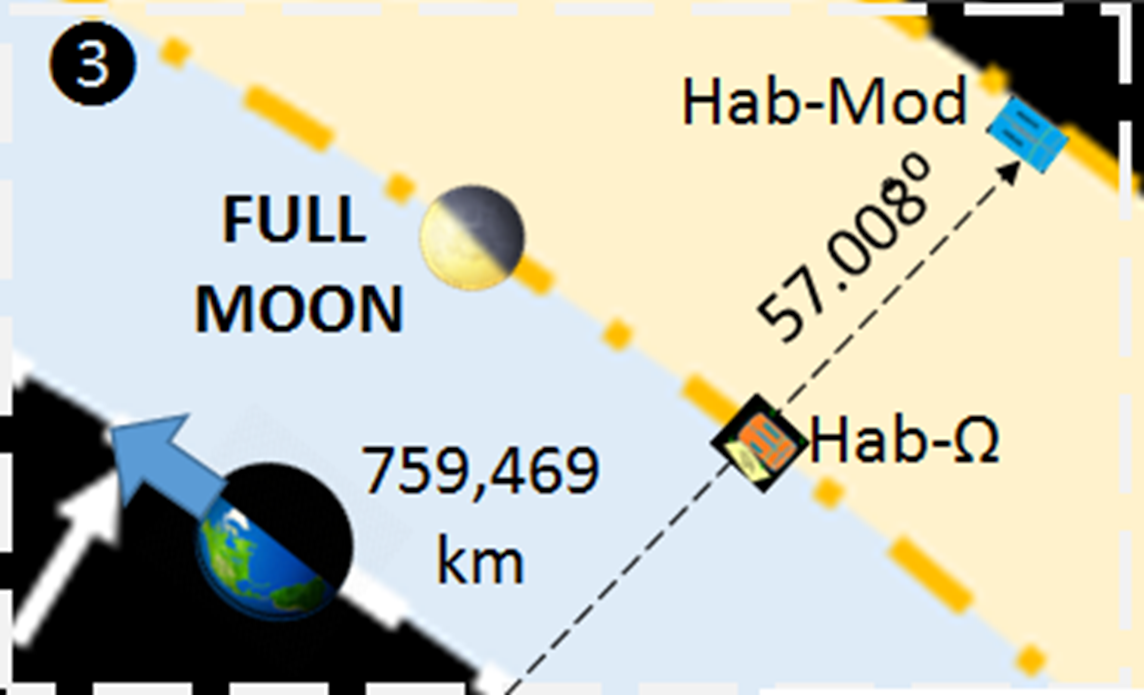
❸  At next Full Moon, Hab-Mod catches up with Hab-Ω and must quickly rendezvous for a permanent rejoin.
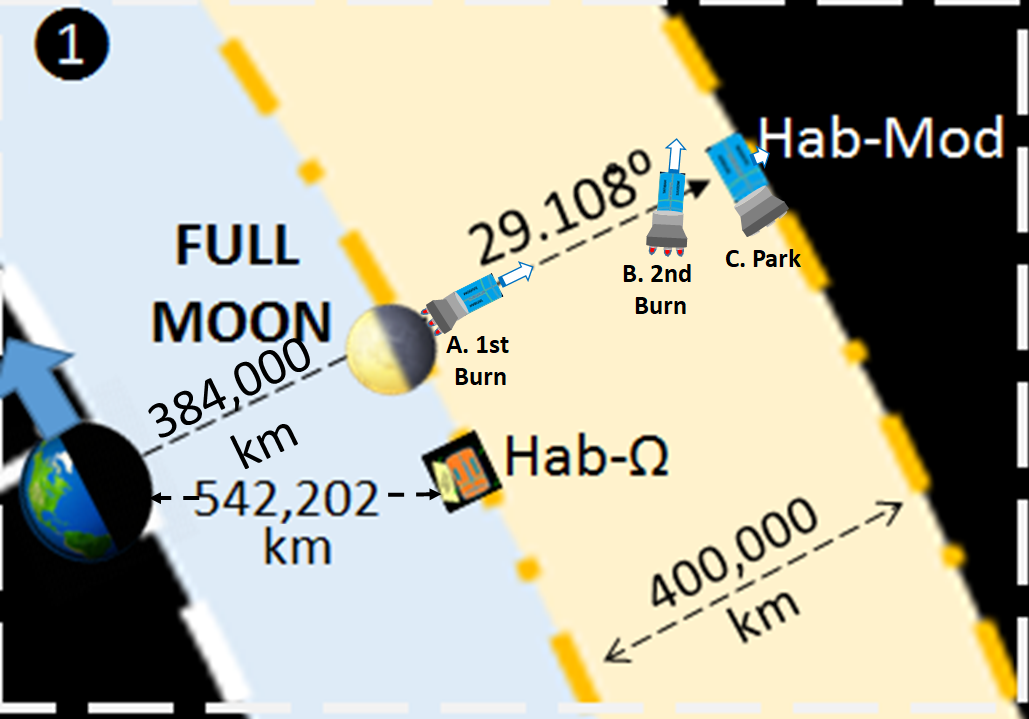
❶ At start of 2nd Lunar Cycle, Thought Experiment (TE) assumes that Terra and Full Moon line up at 29.108⁰ from previously discussed “Line of Aries” when Hab-Ω first launched.

Just prior to this angular distance by Terra-Luna, TE further assumes that the Habitat Module (Hab-Mod), loaded with much needed supplies and materials, launches from Lunar orbit outward toward another Solar Orbit about 400,000 km further out from Sol.  

Finally, TE assumes: 
A. 1st burn to leave Lunar Orbit, 
B. 2nd burn to join new orbit, 
C. Hab-Mod parks as shown in selected orbit.
  Midway through 2nd Lunar Cycle, Luna enters the New Moon Phase as shown. TE assumes Hab-Mod achieves 43.3⁰ as shown. 


With the greatest radius, Hab-Mod has slowest angular velocity of all three Solar orbits: Terra, Hab-Ω, and Hab-Mod. Thus, we see that Hab-Mod has lagged Earth but not yet caught up with Hab-Ω.
❸ At next Full Moon (completion of 2nd Lunar Cycle), TE assumes that Hab-Mod catches up with Hab-Ω; thus, both line up at 57.008 ⁰.

Not shown are the burns which Hab-Mod must do to leave its orbit and join up with Hab-Ω.

CONCLUSION: Wait one month to launch 1st resupply module, which takes another month to catch up with Hab-Ω; thus, 2 month interim.

HYPOTHESIS: Wait 2 months to launch 2nd resupply module, which takes another 2 months to catch up with Hab-Ω; thus, 4 month interim and so on for subsequent modules.
THIRD LUNAR CYCLE
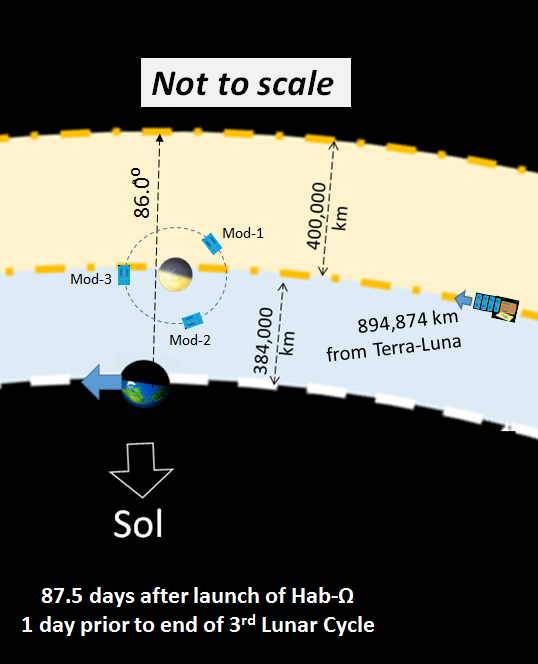
At the end of 3rd Lunar Cycle since launch of Hab-Ω, all 3 resupply modules reach slightly different radii from Sol. As radii increase, their Solar angular velocity decreases as shown.
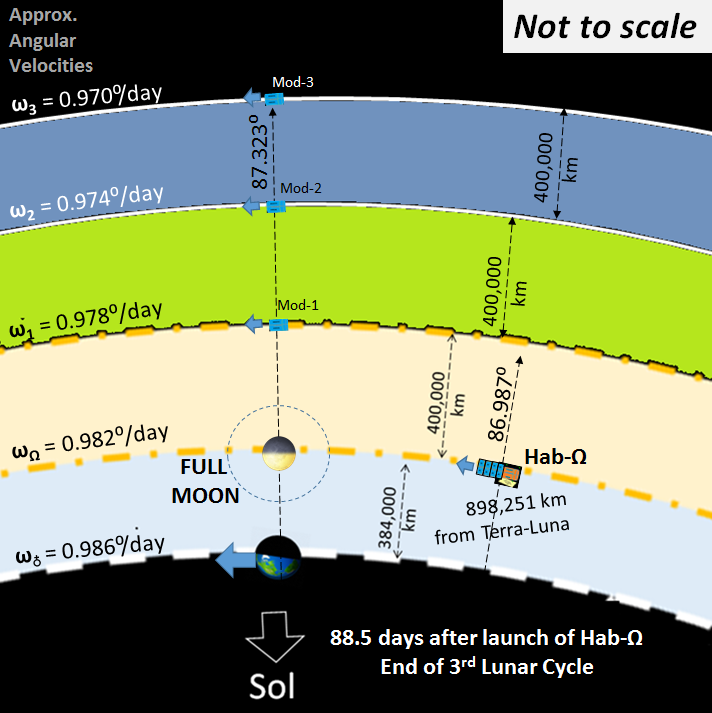
For convenience, TE assumes 400,000 km between orbits as well as .004 deg/day differential between orbits. For example of more precise angular velocities, see associated slide presentation.
FOURTH LUNAR CYCLE
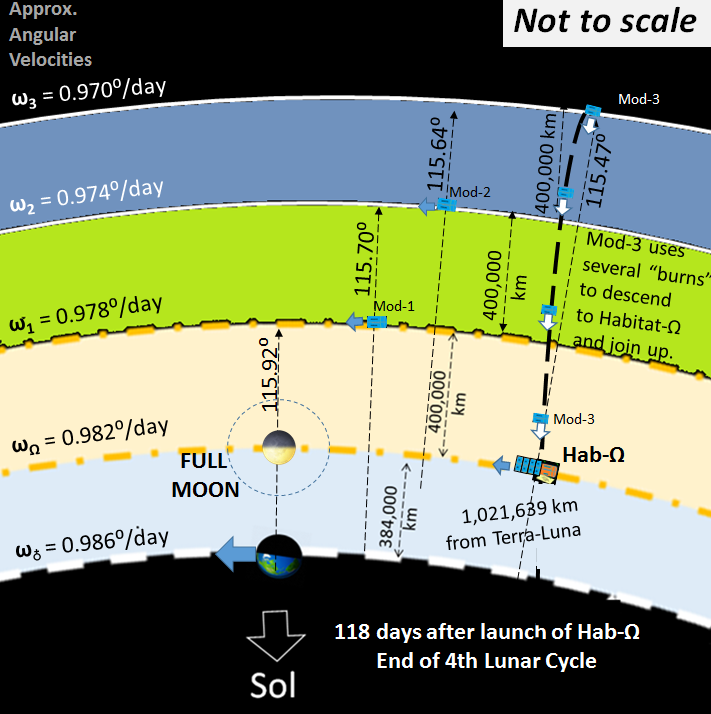
EXAMPLE: At start of 4th cycle (since initial launch of Hab-Ω), all 3 resupply modules launch from Luna to achieve 3 different Solar orbits as shown in previous diagram.
During 4th Lunar cycle, they drift away from Terra and toward Hab-Ω, which continues a slowly increasing lag behind Earth.
At end of 4th Lunar Cycle, Mod-3 will align with Hab-Ω and will use several “burns” to descend to Hab-Ω’s orbit and link up.
FIFTH LUNAR CYCLE
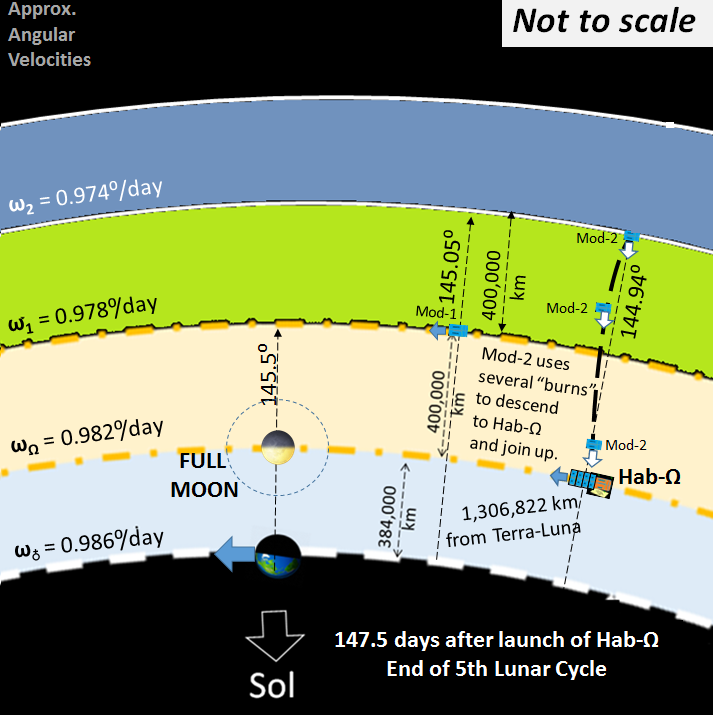
During 5th Lunar Cycle, remaining two resupply modules drift closer toward the Solar angle  of Hab-Ω, still slowly increasing lag from Earth; Mod-2 even approaches the Solar angle of Hab-Ω.


By end of 5th Lunar Cycle, Mod-2 makes its way from a greater Solar radius to link up with Hab-Ω.
SIXTH LUNAR CYCLE
During sixth Lunar Cycle since launch of Hab-Ω, remaining resupply module drifts very close to and almost aligns with the Solar angle of Hab-Ω.


By end of 6th Lunar Cycle, Mod-3 makes its way to link up with Hab-Ω.
SUMMARY
This scenario assumes sufficient propulsion to launch Hab-Ω from Lunar orbit during Full Moon phase to barely escape gravitational pull of the Earth-Moon system and enter a Solar Orbit.  Thus, Hab-Ω's Solar orbit radius would equal Earth's distance from Sol plus Luna's distance from Terra, a slightly greater Solar orbit with same e, eccentricity, as Earth's orbit. Thus, Hab-Ω's orbit parallels Terran orbit. 
This slightly larger orbit enables Hab-Ω to consistently lag the Earth at a very small rate, slowly increasing its angular distance behind Terra. Though this lag rate stays tiny, it will eventually accumulate into the 60° lag to park at the L-5 point; at this rate (about .004°/day) it might take 40+ years to eventually reach its final parking sport, 60° behind Terra.

CONCLUSION:  40+ years is a long time to wait for a parking spot; perhaps, there is a quicker way.

TRANSITION:  Perhaps, Hab-Ω can leverage Earth's elliptical orbit to arrive much sooner than 40+ years. See next chapter, Earth's Ellipticity.
See also: Space Colonies at Lagrange Points.

Thursday, November 22, 2007

New Scientist Extract: Downsize Particle Accelerators


The age of giant particle accelerators may be over

Enormous particle colliders may become obsolete
PHYSICS 24 July 2019

For the best of physics, we've always thought that "size matters"; maybe that's not true anymore. Consider a well known example of "growth physices".  The first particle smashers of the early 1960s were little wider than a dining room table. Sometime later, the Tevatron, a circular collider in the US, had a circumference of 6 kilometers. Today’s largest machine, the Large Hadron Collider (LHC), has one four times as long. Now, we plan to build a collider 100 kms in circumference (about the size of New York City).
These are enormously expensive undertakings. Learning new subatomic secrets has always meant accelerating particles over increasingly longer distances; then, smashing them together. But a new shortcut is emerging, consider plasma  (stuff of stars, collection of charged particles, ions). Inject particles into plasma, and they accelerate a much, much faster.
Such plasma accelerators have been advancing steadily over the past few decades, and while they have yet to pose a serious threat to the dominance of conventional facilities, that might be changing. Several recent developments suggest that plasma accelerators could soon give big beasts like the LHC a run for their money. Ultimately, the hope is that these small machines will let us tackle some of the biggest questions in physics: why our universe is filled with matter and not antimatter, for instance, or what constitutes dark matter. It seems the ironclad rule of particle physics is about to be broken.
Typical technology seems to undergo inevitable miniaturization; HOWEVER,  conventional particle accelerators seem to suffer from an intrinsic growth. Complicated control systems contain numerous metal pipes. which individually kick particles forward by carefully coordinating numerous short and strong electric fields.  To make the overall accelerator more powerful, you need even more pipes.
This physical limit led to circular vs. linear, particle smashers: in a circle, particles can keep orbiting until they reach the desired energy. (Within reason.) HOWEVER, even circular accelerators must be very big; otherwise, particles simply shed their energy as radiation – or else get flung out of the ring as they skid around tight corners. Hence the LHC. Only a circular collider 27 kilometres in circumference could smash opposing beams of protons with enough energy – up to 13,000  GeVs – to produce the famous Higgs boson. Many particle physicists now wonder what's nextmany scientists thought 27 kms was the max,”  

Some researchers pursue a cheaper, smaller alternative.  

Plasmas are the fourth state of matter: an ethereal mix of electrons and the positively charged atomic nuclei, or ions, from which they were stripped. As the electrons and ions move around, tiny electric fields are created and destroyed, making plasma the perfect medium for carrying charged particles.  
Plasma acceleration originated  at the University of California, Los Angeles, (UCLA) The idea was to fire a laser into a gas of atoms, creating a plasma and dividing its electrons from its positively charged ions. In the laser's wake, this division of negative and positive charges would create a greatly enhanced electric field. An properly injected electron would follow the plasma wake to accelerate over a thousand times faster than in a conventional accelerator.
Chandrashekhar Joshi put this into practice, accelerating injected electrons by 7 MeVs in only a few millimeters (mms). Instead of a laser, he used a pulse of electrons from a conventional accelerator to create the plasma, divide it and accelerate it.
In 2005, California's Stanford Linear Accelerator Center (SLAC) used its existing accelerator to turbo-boost electrons by 3 GeVs in about 10 centimeters (cms). In 2007,  it demonstrated 15 times this energy gain in under a meter – nearly 10,000 times the rate of acceleration at the LHC.  
Note a few issues. 
1) Consistency.  Give all particles the same boost. The spread of energies now generated by plasma accelerators is currently 10 times too broad for ready interpretation of particle collisions. 
2) Reliability. Particle accelerators must work 24/7 continuously for weeks at a time. 
Thus, we must link and align a series of laser or electron pulses to reach the highest energies. 

Possible Breakthrough.  AWAKE, an international collaboration at CERN, is experimenting with protons, almost 2,000 times the size of electrons. Send protons into a plasma to generate a huge wake to fling injected electrons forwards in one fell swoop. This eliminates several stages, which can complicate a beam line. 
Plasma accelerators may have immediate practical benefits. With no need for collisions, compact accelerators could make advanced types of radiation therapy for cancer more widely available. They could also probe cutting-edge materials, or enable security staff to check for hidden explosives. In fact, plasma accelerator spin-offs like these could be just five or 10 years away.
Using recent laser technology, Berkeley Lab recently used a laser pulse with a power of 850 trillion watts to achieve electron energies of nearly 8 GeVs over 20 c,s in a plasma accelerator.

Saturday, November 10, 2007

Quick Look Tables

To summarize previous chapters, g-force acceleration can take us to planets in days; even the most distant destinations within the Kuiper Belt will take at most weeks.


Interplanetary Flight Profile
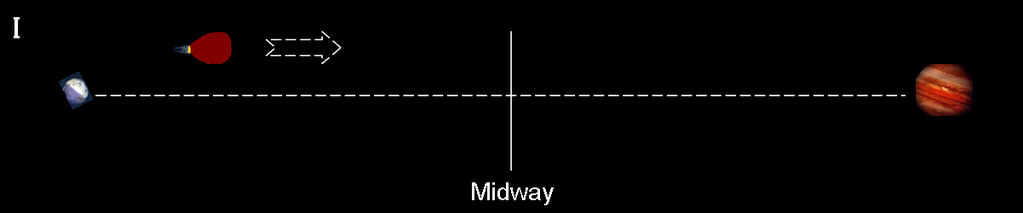
PHASE I. Departing Earth,our notional spaceship constantly accelerates at g (10 m/s2) to simulate gravity and travel much quicker then constant velocity vehicles. After only 3.16 days, it reaches midway (2.5 AU) of our 5 AU journey.
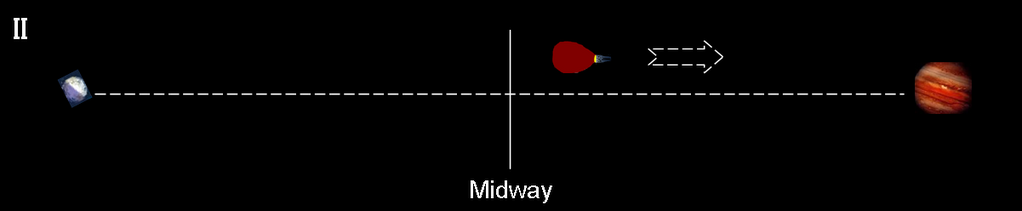
PHASE II. Midway between Earth and Jupiter (i.e., d/2 = 2.5 AU), spaceship velocity exceeds 2,700 km/sec. To decrease this speed and still simulate gravity,spaceship reverses fuel exhaust vector to decelerate at g for remaining 3.16 days of travel.
g = 0.5 AU/dy2
g = 10 m/sec2
Distance Acceleration Time Max Velocity Deceleration Time Accel + Decel
to Earth Dept to Midway (at midway)Midway to Dest Travel Time
(AU) (days) (km / sec) (days) days)
NEO

1

1.41

1,218

1.41

2.83

Mars

2

2.00

1,728

2.00

4.00

Jupiter

5

3.16

2,730

3.16

6.32

Saturn

10.0

4.47

3.864

4.47

8.94

Uranus

20.0

6.32

5,464

6.32

12.64

Neptune

30.0

7.75

6.693

7.75

15.50

Kuiper Belt

45

9.49

8,200

9.49

18.97

Earth's escape velocity,
e = 11 km/sec
d
tACCEL = d
g
g = 864km/sec / day
VMax = tACCEL*g
tDECEL = d
g
tTTL = 2 *d
g

Traditional Momentum Exchange (Newtonian)


vfuel : 10%c to 90%c

300 * mfuel * vfuel/ Vship = Mship

mfuel vfuel Vship Mship
gram dec. c m/s mT

1

0.1

10

3

1

0.2

10

6

1

0.3

10

9

1

0.4

10

12

1

0.5

10

15

1

0.6

10

18

1

0.7

10

21

1

0.8

10

24

1

0.9

10

27

Const. IV Const. DV
Mship: 3 to 27 metric Tonnes (mTs) {traditional momentum model}

k * mfuel * vfuel/ Vship = Mship

Definitions
  • mfuel : mass of fuel consumed for each second of flight (grams)
  • vfuel : velocity of fuel particles as they exit spacecraft (decimal c, light speed). Assume c = 300,000,000 m/s.
  • Vship : velocity increase of spacecraft during one second of flight (m/sec)
  • Mship : mass of spacecraft which can be propelled by momentum of fuel particles (metric Tonnes)
  • k : conversion constant to account for mix of units in both velocity and mass. In this case, k= 300.


Relativistic Momentum Exchange (Einsteinian)


vfuel : 10%c to 90%c

300 * mf-LT * vfuel/ Vship = Mship

mfuel =1.0 gmc=300,000,000 m/sVship= 10 m/s
mf-LT vfuel Mship
gram dec. c mT

1.00

0.1

3

1.02

0.2

6

1.05

0.3

9

1.09

0.4

13

1.16

0.5

17

1.25

0.6

22

1.40

0.7

29

1.67

0.8

40

2.29

0.9

62

mfuel/(1-v2fuel)1/2 IV DV
Mship: 3 to 62 metric Tonnes (mTs) {relativistic momentum model}

mf-LT= mfuel/(1-v2fuel)1/2


k * mf-LT * vfuel/ Vship = Mship

Definitions
  • mfuel : mass of fuel consumed for each second of flight (grams). Assume a constant 1.0 grams for this table.
  • mf-LT : Uses Lorentz Transform (LT) to determine increased mass of fuel after being accelerated to vfuel, a significant fraction of light speed.
  • vfuel : velocity of fuel particles as they exit spacecraft (decimal c, light speed). Round c to 300,000,000 m/s.
  • Vship : velocity increase of spacecraft during one second of flight (m/sec) . Assume a constant 10 m/s.
  • Mship : mass of spacecraft which can be propelled by momentum of fuel particles (metric Tonnes)
  • k : conversion constant to account for mix of units in both velocity and mass. In this case, k= 300.


Daily Fuel Flow

vfuel : 10%c to 90%c

ffday / Mship=%TOGW / day

mfuel = 1.0 gmvfuel Vship= 10 m/s ffday=86.4 kg
mf-LT vfuel Mship %TOGW /day
gram decimal c mT % / day
1.00 0.1 3 2.87%
1.02 0.2 6 1.41%
1.05 0.3 9 0.92%
1.09 0.4 13 0.66%
1.16 0.5 17 0.50%
1.25 0.6 22 0.38%
1.40 0.7 29 0.29%
1.67 0.8 40 0.22%
2.29 0.9 62 0.14%
mfuel/(1-v2fuel)1/2 IV DV ffday/Mship
%TOGW: 2.8% to 0.14% (less is better!!)

mf-LT= mfuel/(1-v2fuel)1/2


k * mf-LT * vfuel/ Vship = Mship

Definitions
  • mfuel : mass of fuel consumed for each second of flight (grams) Remains a constant 1.0 grams for this table.
  • ffday: amount of fuel consumed per day of flight. Since 1 day = 86,400 secs, this amount is 86,400 times fuel per second. Since we're assuming 1.0 gram per sec, ffday turns out to be 86.4 kgm for this table.
  • mf-LT : increased mass of fuel after being accelerated to vfuel, a significant fraction of light speed.
  • vfuel : velocity of fuel particles as they exit spacecraft (decimal c, light speed). Assume c = 300,000,000 m/s.
  • Vship : velocity increase of spacecraft during one second of flight (m/sec)
  • Mship : mass of spacecraft which can be propelled by momentum of fuel particles (metric Tonnes)
  • %TOGW: Percent Take off Gross Weight is the amount of ship's mass needed to convert to energy (i.e., must be in form of fuel) to propel the ship for the entire trip.
  • %TOGW/day: Amount of ship's mass needed to convert to energy to propel ship for that day; hence, %TOGW = ffday / Mship .
  • k : conversion constant to account for mix of units in both velocity and mass. In this case, k= 300.


Ranges and Efficiencies


vfuel : 10%c to 90%c

Theoretical Range: Rtheo=100% /%TOGW / Day

Feasible Range: Rfeas=50% /%TOGW / Day

Practical Range: Rprac=25% /%TOGW / Day

Example: k * mfuel * vfuel / Vship = Mship
k = 300 mfuel=1.0 gm vfuel= .1c Vship= 10 m/s Mship= 3 mT
c=300,000,000 m/s ffday =86,400 * mfuel
vfuel %TOGW / day RtheoRfeasRprac
dec. c % / day Days Days Days
0.1 2.87% 35 17 9
0.2 1.41% 71 35 18
0.3 0.92% 109 54 27
0.4 0.66% 152 76 38
0.5 0.50% 200 100 50
0.6 0.38% 263 132 66
0.7 0.29% 345 172 86
0.8 0.22% 455 227 114
0.9 0.14% 714 357 179
IV (increments) ffday/Mship 100%/%TOGW / day 50%/%TOGW / day 25%/%TOGW / day
Rprac: 9 to 179 days (more is definitely better!!!)

mf-LT= mfuel/(1-v2fuel)1/2


k * mf-LT * vfuel/ Vship = Mship

Definitions

  • mfuel : mass of fuel consumed for each second of flight (grams) Remains a constant 1.0 grams for this table.
  • mf-LT : increased mass of fuel after being accelerated to vfuel, a significant fraction of light speed.
  • vfuel : velocity of fuel particles as they exit spacecraft (decimal c, light speed). Assume c = 300,000,000 m/s.
  • Vship : velocity increase of spacecraft during one second of flight (m/sec)
  • Mship : mass of spacecraft which can be propelled by momentum of fuel particles (metric Tonnes)
  • k: conversion constant. In this case, k= 300.
  • ff day: amount of fuel consumed per day of flight.
  • %TOGW/day: Amount of ship's mass needed to convert to energy to propel ship for that day; hence, %TOGW / day = ffday / Mship
  • Rtheo : Theoretical Range. Number of days of propulsion available if we convert entire mass of spaceship into energy. While impractical for spacecraft with payloads and reuseable infrastructure, it might be an option for refueling missions where most mass was fuel.
  • Rfeas : Feasible Range. Most spaceships have design limits. For simplicity, we'll assume that our notional spacecraft has fuel tanks such that half its mass can be in fuel.
  • Rprac : Practical Range. By nature, human designed devices tend to start out with large inefficiencies and continually improve. Furthermore, even perfectly designed propulsion systems will have inherent sources of inefficiency. Onboard energy will be required for many nonpropulsion functions: life support, navigation, communication, auxiliary power for the propulsion system (i.e., accelerator magnets will need a lot of energy even with superconductors). For simplicity, we'll assume that only only half the fuel goes for propulsion. If fuel is 50% of ship's mass, then 25% of total mass can apply toward propulsion.


Ranges and Distances


vfuel : 10%c to 90%c

Maximum Distance: Dmax= g * R2prac/2

Middle Distance: Dmid= g * (0.5 * Rprac)2/2

Practical Distance: Dprac=2 * Dmid

Example: k * mfuel * vfuel / Vship = Mship
k = 300 mfuel=1.0 gm vfuel= .1c Vship= 10 m/s Mship= 3 mT
c=300,000,000 m/s ffday = 86,400 * mfuel g = .5 AU/day2 t = Rprac t= 0.5 * Rprac
vfuel %TOGW / day Rprac Dmax Dmid Dprac
dec. c % / day Days AUs AUs AUs
0.1 2.87% 8.71 19 5 9
0.2 1.41% 17.73 79 20 39
0.3 0.92% 27.17 185 46 92
0.4 0.66% 37.88 359 90 179
0.5 0.50% 50.00 625 156 312
0.6 0.38% 65.79 1,082 271 541
0.7 0.29% 86.21 1,858 464 929
0.8 0.22% 113.64 3,228 807 1,614
0.9 0.14% 178.57 7,972 1,993 3,986
IV (increments) ffday/Mship 25%/%TOGW / day g * t2 / 2 g * t2 / 2 2 * Dmid
(Range as Practical Distance) Dprac: 9 to 3,986 AUs

mf-LT= mfuel/(1-v2fuel)1/2


k * mf-LT * vfuel/ Vship = Mship

Definitions

  • mfuel : mass of fuel consumed for each second of flight (grams) Remains a constant 1.0 grams for this table.
  • mf-LT : increased mass of fuel after being accelerated to vfuel, a significant fraction of light speed.
  • vfuel : velocity of fuel particles as they exit spacecraft (decimal c, light speed). Assume c = 300,000,000 m/s.
  • Vship : velocity increase of spacecraft during one second of flight (m/sec)
  • Mship : mass of spacecraft which can be propelled by momentum of fuel particles (metric Tonnes)
  • k: conversion constant. In this case, k= 300.
  • ff day: amount of fuel consumed per day of flight.
  • %TOGW/day: Amount of ship's mass needed to convert to energy to propel ship for that day; hence, %TOGW / day = ffday / Mship
  • Rprac : Practical Range. Even perfectly designed propulsion systems have inherent sources of inefficiency. If fuel is 50% of ship's mass, then 25% of total mass can apply toward propulsion. This gives us a practical limit of total time of powered spaceflight (in days).
  • g, acceleration due to near Earth gravity, is 9.8 m/sec/sec which we commonly round to 10 m/s2. Instead of meters and seconds, let's use roughly equivalent term with AUs and days; this turns out to be 0.5 AU/day2.
  • Dmax : Maximum acheivable distance. To determine distance flown during constant acceleration, use well known formula d = 0.5 g * t2. If spaceship accelerates for the whole flight; then time, t, equals practical range, Rprac.
  • Dmid : Middle distance. Since constant acceleration will produce some very high speeds, spacecraft must SLOWDOWN!!!! prior to destination. It makes great sense to do this at midway between departure and destination. Using this constraint to determine half of the max practical distance; change time, t, to one half of practical range: Rprac/2.
  • Dprac : Practical distance. Since Dmid is half the possible distance from practical range, we can determine total practical distance by doubling Dmid. Thus, a practical flight profile would involve accelerating to midpoint then decelerating to destination.


Ranges and Planets


vfuel : 10%c to 90%c

Destination CoHabitat Mars Jupiter Saturn Uranus Neptune
tmid=(2*(Dmid)/g)1/2 tmid=SQRT(d/g)

d = Typical Dist. (AUs)

1 2 5 10 20 30
taccel = tmid = tdecel t = taccel + tdecel

t= 2 * tmid (days)

2.83 4.00 6.32 8.94 12.65 15.49
Dmid = d/2
c=300,000 km/sec 
AU=150,000,000km

t2-way= 2 * t (days)

5.66 8.00 12.65 17.89 25.30 30.98
vfuel %TOGW / day Rprac Total Two Way %TOGW Needed To Travel
dec. c % / day Days %TOGW %TOGW %TOGW %TOGW %TOGW %TOGW
0.1 2.87% 8.71 16.24% 22.96% OUT OF RANGE OUT OF RANGE OUT OF RANGE OUT OF RANGE
0.2 1.41% 17.73 7.98% 11.28% 17.84% OUT OF RANGE OUT OF RANGE OUT OF RANGE
0.3 0.92% 27.17 5.20% 7.36% 11.64% 16.46% 23.27% OUT OF RANGE
0.4 0.66% 37.88 3.73% 5.28% 8.35% 11.81% 16.70% 20.45%
0.5 0.50% 50.00 2.83% 4.00% 6.32% 8.94% 12.65% 15.49%
0.6 0.38% 65.79 2.15% 3.04% 4.81% 6.80% 9.61% 11.77%
0.7 0.29% 86.21 1.64% 2.32% 3.67% 5.19% 7.34% 8.99%
0.8 0.22% 113.64 1.24% 1.76% 2.78% 3.94% 5.57% 6.82%
0.9 0.14% 178.57 0.79% 1.12% 1.77% 2.50% 3.54% 4.34%
IV (increments) ffday
Mship
25%

%TOGW/day
= t2-way* (%TOGW/day)
25% is max practical limit.
(Clearly, as fuel particle's exhaust speed, vfuel, increases, the spaceship's two way practical range correspondingly increases. While a vfuel of one tenth light speed, c, might get us to Mars, we need nearly four tenths c to reach Neptune.)

mf-LT= mfuel/(1-v2fuel)1/2


k * mf-LT * vfuel/ Vship = Mship

Definitions

  • mfuel : mass of fuel consumed for each second of flight.
  • vfuel : velocity of fuel particles as they exit spacecraft (decimal c, light speed). Assume c = 300,000,000 m/s.
  • mf-LT.: relativistically increased mass of mfuel after being accelerated to vfuel .
  • Vship : velocity increase of spacecraft during one second of flight (m/sec)
  • Mship : mass of spacecraft which can be propelled by momentum of fractional light speed, fuel particles.
  • k: conversion constant. In this case, k= 300.
  • ff day = (mfuel * 86,400): daily quanity of fuel.
  • %TOGW/day: Amount of ship's mass needed to convert to energy to propel ship for that day; hence, %TOGW / day = ffday / Mship
  • Rprac : Practical Range. Even perfectly designed propulsion systems have inherent sources of inefficiency. If fuel is 50% of ship's mass, then 25% of total mass can apply toward propulsion.
  • g, acceleration due near Earth gravity, equals 9.8 m/sec/sec which we've rounded to 10 m/s2. Instead of meters and seconds, we've opted to use roughly equivalent term using AUs and days; this turns out to be 0.5 AU/day2.
  • CoHabitat : (Co-Orbiting Habitat) New concept which will require elaboration in another place. Expected points:
    • Definition: Large (O'Neill Habitat-3 size) habitat made of asteroid materials which occupies Terran orbit and either leads or lags Earth by 60o.
    • PURPOSE: Receive and process asteroidal materials for Earth but mainly other habitats. (Much safer for Earth, to have this done 1 AU away.)
    • To visualize cohabitat's placement in Terran orbit, consider that Earth, Sol, and the habitat will be at the three verticies of an equilateral triangle where all sides = 1 AU.
    • To construct diagram, copy circle which represents Terran orbit about Sol, and center it about Earth. Intersections between Terran orbit about Sol and the Terran centered circle will be the two places 60o away from Earth.
    • OUT OF RANGE :
    • d
    • dmid
    • tmid
    • taccel
    • tdecel
    • t
    • t2-way


    Kuiper Belt and Beyond


    vfuel : 10%c to 90%c

    Destination Kuiper Belt and Beyond >>>>> >>>>>
    tmid=(2*(Dmid)/g)1/2 tmid=SQRT(d/g) d = Typical Dist. (AUs) 50 100 150 200 250 300
    taccel = tmid = tdecel t = taccel + tdecel t= 2 * tmid(days) 20.00 28.28 34.64 40.00 44.72 48.99
    Dmid = d/2 c=300,000 km/sec

    AU=150,000,000km
    t2-way= 2 * t (days) 40.00 56.57 69.28 80.00 89.44 97.98
    vfuel %TOGW / day Rprac Total Two Way %TOGW Needed To Travel
    dec. c % / day Days %TOGW %TOGW %TOGW %TOGW %TOGW %TOGW
    0.1 2.87% 8.71 OUT OF RANGE OUT OF RANGE OUT OF RANGE OUT OF RANGE OUT OF RANGE OUT OF RANGE
    0.2 1.41% 17.73 OUT OF RANGE OUT OF RANGE OUT OF RANGE OUT OF RANGE OUT OF RANGE OUT OF RANGE
    0.3 0.92% 27.17 OUT OF RANGE OUT OF RANGE OUT OF RANGE OUT OF RANGE OUT OF RANGE OUT OF RANGE
    0.4 0.66% 37.88 OUT OF RANGE OUT OF RANGE OUT OF RANGE OUT OF RANGE OUT OF RANGE OUT OF RANGE
    0.5 0.50% 50.00 20.00% OUT OF RANGE OUT OF RANGE OUT OF RANGE OUT OF RANGE OUT OF RANGE
    0.6 0.38% 65.79 15.20% 21.50% OUT OF RANGE OUT OF RANGE OUT OF RANGE OUT OF RANGE
    0.7 0.29% 86.21 11.60% 16.40% 20.09% 23.20% OUT OF RANGE OUT OF RANGE
    0.8 0.22% 113.64 8.80% 12.45% 15.24% 17.60% 19.68% 21.56%
    0.9 0.14% 178.57 5.60% 7.92% 9.70% 11.20% 12.52% 13.72%
    IV (increments)
    ffday 
    Mship
    25% 
    %TOGW/day
    = t2-way* (%TOGW/day)
    25% is max practical limit.
    (As two way travel time, t2-way, increases to much further distances in our Solar System, we see even more limitations. We now see that we have to investigate increasing fuel particle's exhaust speed, vfuel, beyond 90% c.)

    mf-LT= mfuel/(1-v2fuel)1/2


    k * mf-LT * vfuel/ Vship = Mship

    Definitions

    • mfuel : mass of fuel consumed for each second of flight.
    • vfuel : velocity of fuel particles as they exit spacecraft (decimal c, light speed). Assume c = 300,000,000 m/s.
    • mf-LT.: relativistically increased mass of mfuel after being accelerated to vfuel.
    • Vship : velocity increase of spacecraft during one second of flight (m/sec)
    • Mship : mass of spacecraft which can be propelled by momentum of fractional light speed, fuel particles.
    • k: conversion constant. In this case, k= 300.
    • ff day= (mfuel * 86,400): daily quanity of fuel.
    • %TOGW/day: Amount of ship's mass needed to convert to energy to propel ship for that day; hence, %TOGW / day = ffday / Mship
    • Rprac : Practical Range. Even perfectly designed propulsion systems have inherent sources of inefficiency. If fuel is 50% of ship's mass, then 25% of total mass can apply toward propulsion.
    • g, acceleration due near Earth gravity, equals 9.8 m/sec/sec which we've rounded to 10 m/s2. Instead of meters and seconds, we've opted to use roughly equivalent term using AUs and days; this turns out to be 0.5 AU/day2. .
    • CoHabitat :

    • OUT OF RANGE : This arbitrary range limit is based on two considerations:

    1) Fuel supply is finite and must be a portion of a ship which must devote some mass to infrastructure and payload.

      2) Efficiency in converting fuel to propulsion directed energy will always be less then 100% for vessels which need energy for other things (i.e., life support, communication, auxiliary power for propulsion system, etc.)

      For convenience, we've chosen fuel to be 50% of ship's mass and efficiency to also be 50%. These optimistic estimates combine for a total of 25% of ship's mass to convert to propulsion energy. We could be much more optimistic and use 90% for each to give us 81% of ship's mass for propulsion. On the other hand, we could be much less and estimate 20% of ship's mass for fuel with a 25% efficiency; this would give us an effective 5% of ship's mass for propulsion. Of course, the possible combinations are numerous and will need actual experimentation for better estimates which will be eventually confirmed with actual operational experience.

      • d
      • dmid
      • tmid
      • taccel
      • tdecel
      • t
      • t2-way