Sunday, May 20, 2007

REFERENCE: Momentum Basics

LIST OF TABLES

Momentum Basics

Momentum is mass times velocity. It typically uses symbol: "p".
p = m * v
p = (2.0 kg)(4.0 m/s)
p = 8.0 kg-m/s

Thus, we calculate this object's momentum to be 8.0 kg-m/s. Momentum's dimensions are kg-m/s, pronounced: 'kilogram meter per second'.

Like velocity, momentum is a vector; it has a magnitude as well as a direction. In fact, they both have the same direction. That is, if an object has a velocity due north, then its momentum will also be due north. However, momentum is both mass times velocity.

Momentum is directly proportional to velocity. Change the velocity of an object by a factor of 1/4, then momentum would also change by 1/4.
Momentum is also directly proportional to mass. With constant velocity, momentum varies with the mass. Example: triple the mass of an object, then the momentum also triples.
Momentum is a conserved quantity. Within a closed system of interacting objects, total momentum of entire system maintains a constant. When object A collides with object B in an isolated system, the total momentum of the two objects before the collision is the same as the total momentum after the collision. Any momentum lost by object A goes to object B.
Thus, total momentum of a system of objects is "conserved"; total amount of mass times velocity is static. To further understand momentum conservation, consider Newton's Law of Momentum Conservation. When two objects collide, the forces acting between the two objects are equal in magnitude and opposite in direction. In equation form, m*v = -M * V.
The forces between the two objects are equal in magnitude and opposite in direction, which leads to Newton's Law of Momentum Conservation. In a collision, the momentum change of object A is equal and opposite to the momentum change of object B. That is, the momentum lost by object A is equal to the momentum gained by object B. In a collision between two objects, one object slows down and loses momentum while the other object speeds up and gains momentum. If object A loses 75 units of momentum, then object B gains 75 units of momentum. Yet, the total momentum of the two objects (object A plus object B) is the same before the collision as it is after the collision; the total momentum of the system (the collection of two objects) is conserved.
For any collision occurring in an isolated system, momentum is conserved - the total amount of momentum of the collection of objects in the system is the same before the collision as after the collision.
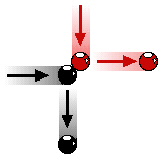
Momentum can be readily observed by watching billiard balls collide.


Similarly, high velocity gas goes in one direction, and rocket goes in opposite direction. Action causes reaction.
Recall momentum exchange: M * V = m * v
Rocket and jets propel themselves due to momentum transfer where high speed exhaust particles move a much larger vehicle in the opposite direction to a much slower but still useful speed. This momentum exchange between fast moving fuel particles and a slow moving spaceship can be expressed:
Mship * Vship = mfuel * vfuel
First, we choose to increase the speed of a large space vessel by 10 m/s in one second. Thus, set Vship be a constant 10 m/s. This relates to the approximate value of g = 10 m/s2 acceleration due to gravity near Earth’s surface. Thus, assume our notional spaceship can expel enough high speed particles to increase velocity an additional 10 m/s for every second of spaceflight. The resultant force will simulate Earth-like gravity for ship and contents.
2nd, we further choose to expend one gram of particles in one second. I.e., set mfuel to be a constant 1.0 gram for convenience.
3rd, our thot experiment uses an onboard particle accelerator to give these fuel particles extremely high speeds. Since current devices easily accelerate particles to 99% of light speed, our thought experiment will compare sustainable fuel exhaust velocity, vfuel, to light speed, c. Furthermore, we now choose to name vExh to more clearly indicate exhaust velocity of particles exiting vessel. Finally, we choose to independently vary vExh by incrementally increasing from row to row in the following tables. Thus, vExh is our Independent Variable (IV).
4th, solve for the remaining term, Mship, mass of ship, to determine how much ship can be propelled 10 m/s by a certain amount of fuel mass exiting vehicle at high speed in opposite direction of travel. Since Mship depends on the value of vExh, Mship is our Dependent Variable (DV).
Mship = mfuel * vExh / Vship
(Note: Following tables will consider only Newtonian concepts and will disregard relativistic mass increase for now. Relativistic mass growth will be considered later.)


Mship = mfuel * vExh / Vship
Mship
Vship
mfuel
vExh
Ship's Mass
ship's vel
fuel mass
exhaust vel
Grams
m/s
grams
m/s
1,000,000
10.0
1.0
10,000,000
2,000,000
10.0
1.0
20,000,000
3,000,000
10.0
1.0
30,000,000
DV
Const.
Const.
IV
Grams and m/s are consistently used on both sides of equation.

While above calculations are straight forward, two terms have a lot of digits which might prove inconvenient. We can streamline this process through a conversion contant.


TABLE-2. Express vExh as dc * c; decimal c times light speed
For convenience, use a mix different velocity units. In particular, we'd like to continue expressing ship's velocity increase ,Vship, as 10 meters per second; but we'd like to change vExh from m/s to decimal light speed, dc c, where dc is decimal component of particle exhaust speed expressed in terms of light speed.
Recall light speed is approximately 300 million meters per second, c = 300,000,000 m/s.
Thus, Table-1 proposes example value for vExh of .1 c, 30,000,000 m/s = 10% c. (Note: Disregard relativity effects for now; we'll discuss that later).
vExh as decimal c
Mship = mfuel * K2 * vExh/ Vship
K1 = 300,000,000
Mship
V ship
m fuel
vExh
Ship's Mass
ship's vel
fuel mass
exhaust vel
Grams
m/s
grams
dc c
3,000,000
10.0
1.0
.1 c
6,000,000
10.0
1.0
.2 c
9,000,000
10.0
1.0
.3 c
12,000,000
10.0
1.0
.4 c
DV
Const.
Const.
IV


Consistent values requires conversion constant. Note that VExh has equivalent values in last row of Table 1. and first row of Table 2. For consistent Mship, determine conversion constant K2 such VExh can be expressed as decimal light speed.


TABLE-3. Convert Mship to metric Tonnes (mT) By definition: 1 mT = 1,000,000 gms; thus, example value of MShip=3,000,000 gms = 3 mT.
K3=Mship * Vship

mfuel * vExh
= 3mT * 10m/s

1 gm * .1c
= 3

c
Thus, k3 = 3/c, given following set of dimensions:
  • mfuel as grams (gm)
  • vfuel as dc c
  • Mship as metric Tonnes (mT)
  • Vship as meters per second (m/s)


    Mship = K3 * mfuel * vExh / Vship
    Mship in mT


    K3 = 3/c
    Mship
    Vship
    mfuel
    vExh
    Ship's Mass
    ship's vel
    fuel mass
    exhaust vel
    metric tons
    m/s
    grams
    dc c
    3.0
    10.0
    1.0
    .10 c
    4.5
    10.0
    1.0
    .15 c
    6.0
    10.0
    1.0
    .20 c
    7.5
    10.0
    1.0
    .25 c
    9.0
    10.0
    1.0
    .30 c
    10.5
    10.0
    1.0
    .35 c
    12.5
    10.0
    1.0
    .40 c
    13.5
    10.0
    1.0
    .45 c
    DV
    Const.
    Const.
    IV


    TABLE-4. Convert to Rates
    Changing to mixed units affects the terms: vExh and Mship; thus, unaffected terms (Vship and mfuel) keep the same dimensions. However, those terms (Vship and mfuel) can be usefully converted to rates.
    Start with the original ship-fuel momentum equation:
    Mship * Vship= mfuel * vExh

    and divide both sides by one second:
    Mship * Vship

    1 second
    = mfuel * vExh

    1 second
    Next, we'll arbitrarily rearrange as follows:
    Mship * Vship

    1 sec
    = mfuel

    1 sec
    * vExh
    Since definition of acceleration is velocity increase per time, Vship per second is an acceleration. We've chosen Vship to be 10 m/s, same value as g, acceleration due to Earth's surface gravity. Thus, we can rearrange equation as follows:
    Mship * g = (mfuel/1 sec) * vExh
    Further, we can introduce new term, fuel flow per sec (ffsec), and substitute for the expression: mfuel /sec. Thus, far we've arbitrarily chosen the value of 1 gram per second for convenience, but we will eventually use this term for any value.
    Mship * g = ffsec * vExh


    Mship * 
    Vship
    1 sec
    =300 * vExh
    mfuel
    1 sec
    Using previous logic:
    • restate Vship/sec as g, gravity caused acceleration.
    • restate mfuel/sec as ffsec, fuel flow per second;
    • restate vExh as dcc, decimal light speed.
    • rearrange:
    Mship = k * ffsec * dc c

    g
    Mship = K * ffsec * vExh / g
    K = 30 g/c
    M ship
    g
    ffsec
    vExh
    Ship's Mass
    Gravity
    fuel flow
    exhaust vel
    metric tons
    m/s2
    gm/sec
    dc c
    6.0
    10.0
    1.0
    .20 c
    7.5
    10.0
    1.0
    .25 c
    9.0
    10.0
    1.0
    .30 c
    10.5
    10.0
    1.0
    .35 c
    12.0
    10.0
    1.0
    .40 c
    13.5
    10.0
    1.0
    .45 c
    15.0
    10.0
    1.0
    .50 c
    16.5
    10.0
    1.0
    .55 c
    DV
    Const.
    Const.
    IV

    k =Mship * g


    ffsec * dcc
    = 3 mT * g


    1 gm/sec * .1c
    = 30 g


    c
    Thus, we've taken the Momentum Conservation equation and applied it for a duration of one second. For space travel to become routine, technology will have to accomplish two things:
    1. Micro-scale. Spread the amount of fuel ejected in a smooth continuous manner throughout the entire second.
    2. Macro-scale. Reliably repeat above item for each of the 86,400 seconds during each day of space flight.
    Both above items are easily done now in various modes of transportation, but can they be done for particles accelerated to large portions of c, speed of light???


    Summary


    Consistent Units
    Give terms following values:
    • mfuel = 1.0 gram
    • Vship = 10 meters / second
    • vExh= 30,000,000 m/s
    Then
    Mship = (1.0 gm * 30,000,000 m/s) / (10 m/s)
    Mship= 3,000,000 gm
    Basic Momentum
    M = mfuel * vExh/ Vship
    Mship
    mfuel
    Vship
    vfuel
    gm
    gm
    m/sec
    m/s
    3,000,000
    1.0
    10
    30,000,000


    Mixed Units


    Conversion Constant: 300
    Mship = (300)(mfuel * vExh / Vship)
    Mship
    mfuel
    Vship
    vExh
    mT
    gm
    m/sec
    dc c
    3
    1.0
    10
    .1 c
    6
    1.0
    10
    .2 c

    1,000,000 gms = 1,000 kgms = 1.0 metric Tonnes = 1 mT
    Thus, Mship = 3,000,000 gm = 3.0 mT

    300,000,000 meters /sec = light speed = c
    Thus, VExh= 30,000,000 m/s = .1c

    It’s more convenient to express Mship in mT and vExhin decimal c.

    To do this, introduce a conversion constant, k3, as follows:
    Mship = k3 * mfuel * vExh / Vship
    where k3 = 300

    Rates
    Convert to ffsec
    Fuel Flow/sec
     
    g
    ffsec
    vExh
    Mship
    con
    con
    IV
    DV
    m/s2
    gm/sec
    dc c
    mT
    10
    1
    0.1 c
    3
    10
    1
    0.2 c
    6
    10
    1
    0.3 c
    9
    Particle velocity, vExh, of .1 c contributes sufficient momentum so that one gram of exhaust particles can propel a 3 ton vessel to an additional 10 m/sec.

    Since momentum is directly proportional to velocity, increasing vExh another .1 c will propel another 3mT of ship's mass.
    Recall: mfuel * vExh = Mship * Vship.

    Divide both sides by one sec:mfuel * vExh

    1 sec
    = MShip * vShip

    1 sec
    Rearrange:mfuel

    1 sec
    * vExh = MShip * vShip

    1 sec
    Recall that we set Vship equal to 10 m/s; thus, Vship/ 1sec = 10m/s/s = g, acceleration due to gravity near Earth’s surface.
    Introduce new term, fuel flow per second: ffsec = mfuel/sec.
    Thus, we substitute to get: ffsec* vExh = Mship * g
    To continue expressing vExh as decimal c and Mship in metric Tonnes, we'll introduce conversion constant, k = 300/c. Thus, k * vExh = 300 * dc.

    Mship= 300 * ffsec * dc

    g


    Further Study, Related Concepts: Impulse and Specific Impulse


    ImpulseThe Physics Classroom In physics, the quantity Force*time is known as the impulse. And since the quantity m*v is the momentum, the quantity m*"Delta "v must be the change in ...www.physicsclassroom.com/Class/momentum/U4L1b.html - 48k - Cached - Similar pages Physics - Impulse - Martin Baker Physics - Impulse. Impulse is the integral of force over time, it is measured in Newton-seconds. For instance a force of one Newton applied over one second ...www.euclideanspace.com/physics/dynamics/collision/impulse/index.htm - 26k - Cached - Similar pages SparkNotes: SAT Physics: Impulse SAT II Physics may also present you with a force vs. time graph, and ask you to calculate the impulse. There is a single, simple rule to bear in mind for ...www.sparknotes.com/testprep/books/sat2/physics/chapter9section2.rhtml - 32k - Cached - Similar pages Impulse -- from Eric Weisstein's World of Physics An impulse is an instantaneous change in momentum. which can be found by integrating a force F over a characteristic time , giving ...scienceworld.wolfram.com/physics/Impulse.html - 12k - Cached - Similar pages Impulse In everyday language, an impulse is something you have - "I just had an impulse, so I bought a new coat." In physics, an impulse is something else (you ...www.batesville.k12.in.us/physics/PHYNET/Mechanics/Momentum/impulse.htm - 6k - Cached - Similar pages Momentum Lesson 1: The Impulse Momentum Change Theorem ... Momentum is a physics term; it refers to the quantity of motion that an object has. ...www.glenbrook.k12.il.us/GBSSCI/PHYS/CLASS/momentum/u4l1a.html - 15k - Cached - Similar pages Physics Zone: Impulse (When Push Comes to Shove) The product of average net force and change in time is called Impulse. The formula for it actually comes from a little manipulation of Newton's Second Law. ...regentsprep.org/Regents/physics/phys01/impulse/default.htm - 3k - Cached - Similar pages Physics Help: Impulse Impulse is change in momentum and results from force acting over a period of time. ... Impulse in Physics Problems. Impulse and Momentum ...www.physics247.com/physics-help/impulse.shtml - 11k - Cached - Similar pages Impulse Physics Hive Assault: Impulse Physics. Dynamic Animation Calculations in Hive Assault Real-time Calculation of Bone Impulse Reactions from Weapons ...www.owlnet.rice.edu/~comp460/PRSite/tech/impulse.htm - 9k - Cached - Similar pages FHSST Physics Momentum:Impulse - Wikibooks, collection of open ... FHSST Physics Momentum:Impulse ... [edit] Worked Example 36 Impulse and Change in momentum. Question: A 150 N resultant force acts on a 300 kg object. ...en.wikibooks.org/wiki/FHSST_Physics_Momentum:Impulse - 28k - Cached - Similar pages


    Specific Impulse
    Specific impulse - Wikipedia, the free encyclopedia Specific impulse (usually abbreviated Isp) is a way to describe the efficiency of rocket and jet engines. It represents the impulse (change in momentum) per ...en.wikipedia.org/wiki/Specific_impulse - 33k - Cached - Similar pages Variable specific impulse magnetoplasma rocket - Wikipedia, the ... The variable specific impulse magnetoplasma rocket (VASIMR) is a hypothetical form of spacecraft propulsion that uses radio waves and magnetic fields to ...en.wikipedia.org/wiki/Variable_specific_impulse_magnetoplasma_rocket - 20k - Cached - Similar pages[ More results from en.wikipedia.org ] Specific Impulse We can divide this equation by the weight of the propellants to define the specific impulse. The word "specific" just means "divided by weight". ...www.grc.nasa.gov/WWW/K-12/airplane/specimp.html - 13k - Cached - Similar pages What is specific impulse? Specific impulse is the change in momentum per unit mass for rocket fuels, or rather how much more push accumulates as you use that fuel. ...www.qrg.northwestern.edu/projects/vss/docs/Propulsion/3-what-is-specific-impulse.html - 5k - Cached - Similar pages How do you calculate specific impulse? To calculate the specific impulse, we first need to calculate the exhaust velocity. Since the real exhaust velocity is exceeding complex to calculate, ...www.qrg.northwestern.edu/projects/vss/docs/Propulsion/3-how-you-calculate-specific-impulse.html - 7k - Cached - Similar pages Rocket Engine Specific Impulse Program Specific Impulse (Isp) is a measure of the “fuel efficiency” of a rocket. The necessary thermodynamic calculations for Isp are performed by a package of ...www.dunnspace.com/isp.htm - 183k - Cached - Similar pages
    Specific Impulse Inc. Information Architecture, Web Development ... Specific Impulse: Information Architecture, Web Site Design, and Intranet and Web Site Management Solutions.www.si9.com/ - 22k - Cached - Similar pages NASA Tech Briefs - Variable-Specific-Impulse Magnetoplasma Rocket NASA Tech Briefs, This rocket is expected to enable long-term human exploration of outer space. Johnson Space Center has been leading the development of a ...www.techbriefs.com/content/view/1768/32/ - 41k - Cached - Similar pages PROPELLANTS Chemical propellants in common use deliver specific impulse values ranging from about 175 up to ... Specific impulse of some typical chemical propellants 1 ...www.hq.nasa.gov/office/pao/History/conghand/propelnt.htm - 16k - Cached - Similar pages
    Peripheral Energy Requirements
    While this seems like a great way to quickly increase inflight performance, this comes at the cost of enormous energy. It's a fact of nature; it's not necessarily free. Consider a gasoline powered automobile. The fuel converts to energy, but not all the energy rotates the wheels; a significant portion of the energy from the exploding gasoline pushes the pistons and rotates the drive shafe. Eventually, some of the gas's energy results in rotary motion pushing the wheels which touch the road and propel the auto forward. Furthermore, some energy must be diverted for peripheral uses: radio, air conditioning, etc.. However, the essential diversion of energy goes to the auto's generator (or alternator) which converts motion into electricity to the spark plugs which explode subsequent gasoline vapors to produce more motion and so on. We can call this an energy cycle.In like manner, our spaceship's propulsion system must have a similar energy cycle. It must be designed so the system diverts some energy from the accelerator's output to create more plasma and charge the magnets to propel more ions to keep the cycle continuing.Thus far, we've taken the Momentum Conservation equation and applied it for a duration of one second. For space travel to become routine, technology will have to accomplish two things: Micro-scale. Spread the amount of fuel ejected in a smooth continuous manner throughout the entire second. Macro-scale. Reliably repeat above item for each of the 86,400 seconds during each day of space flight. Both above items are easily done now in various modes of transportation, (for example, the typical plane, train, and automobile have done this for many years). However, can micro/macro scale energy conversion be done for exhaust particles accelerated to large portions of c, speed of light??? Note: for current state of nuclear propulsion, see excellent book,Nuclear Space Power and Propulsion Systems (Progress in Astronautics and Aeronautics) by Claudio Bruno(Editor) --------------------------------------------------------------------------------On the other hand, thought experiment further assumes onboard fuel is consumed at fuel's original size. Thus, inflight gross weight of the vehicle will be ever decreasing due to continuous fuel consumption which will be computed by time, t, times original fuel flow, ffsec.

    Saturday, May 19, 2007

    Vol 1. Tables, A Summary

    Table 1. Momentum Exchange.

    Recall momentum exchange: M * V = m * v

    Apply to fast moving fuel particles and a slow moving spaceship: Mship * Vship = mfuel * vfuel

    Rearrange to solve for spaceship size: Mship = mfuel * vfuel / Vship


    Per above text, give terms following values:

    • mfuel = 1.0 gram
    • Vship = 10 meters / second
    • vfuel = one tenth light speed = 30,000,000 m/s
    • Mship = (1.0 gm * 30,000,000 m/s) / (10 m/s)

    Basic Momentum
    Mship = mfuel * vfuel / Vship

    Mship

    mfuel

    Vship

    vfuel

    gm

    gm

    m/sec

    m/s

    3,000,000

    1.0

    10

    30,000,000


    Conversion Constant: 300/c
    Mship = (300/c)(mfuel * vfuel / Vship)

    Mship

    mfuel

    Vship

    vfuel

    mT

    gm

    m/sec

    dec. c

    3

    1.0

    10

    .1 c

    6

    1.0

    10

    .2 c

    1,000,000 gms = 1,000 kgms = 1.0 metric Tonnes = 1 mT
    Thus, Mship = 3,000,000 gm = 3.0 mT

    300,000,000 meters /sec = light speed = c
    Thus, Vfuel = 30,000,000 m/s = .1c

    It’s more convenient to express Mship in mT and vfuel in decimal c.

    To do this, introduce a conversion constant, k1, as follows:
    Mship = k1 * mfuel * vfuel / Vship
    where k1 = 300/c


    Reconsider: mfuel * vfuel = Mship * Vship. Divide both sides of original equation by one sec. (mfuel * vfuel)/1sec = (Mship * Vship)/1sec

    Rearrange: (mfuel /1sec) * vfuel = Mship * (Vship/1sec)

    Recall that we set Vship equal to 10 m/s; thus, Vship/ 1sec = 10m/s/s = g, acceleration due to gravity near Earth’s surface.

    We introduce new term, ff (fuel flow), which we define as mfuel/1sec.

    Thus, we’ll set ff equal to 1.0 gm/sec.
    ff * vfuel = Mship * g

    To continue expressing vfuel as decimal c and Mship in metric Tonnes, we'll continue use of conversion constant, k1 = 300/c.

    This gives equation at top of table: Mship = 300/c (ff * vfuel / g)


    g

    ff

    vfuel

    Mship

    con

    con

    IV

    DV

    m/s/s

    gm/sec

    dec. c

    mT

    10

    1

    0.1

    3

    10

    1

    0.2

    6

    10

    1

    0.3

    9

    For perspective, note that Vfuel of .1 c means the particles are exiting at one tenth the speed of light, 30,000,000 m/s.

    Momentum exchange allows one gram of high speed particles to propel a 3 ton vessel for an additional 10 m/s.

    CYCLOTRON IN SPACESHIP
    Perhaps a particle accelerator can propel a spaceship by emitting a stream of very high speed particles.

    (For more "Momentum" details.)


    Table-2. Lorentz Transform.

    To quantify mass increases due to relativistic (near light speed) velocities of exhaust particles, use the Lorentz Transform (LT). This mass increase also contributes to the momentum exchange which propels the ship.

    • Original fuel flow (ff). Convert one gram of matter to plasma every second; accelerate all those particles to near light speed; and expel them from the spacecraft. (See T-1. Momentum Exchange.)


    • Relativistic fuel flow (ffLT). Use LT to adjust original fuel flow to account for relativistic mass increase. (See following table.)


    At very high speed, particles will increase mass due to relativity.
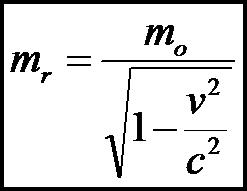
    Confirmed by numerous scientific observations, Lorentz Transform (LT) describes how mass increases with speed. Original mass (mo), or mass at rest, can be considered the input mass input as plasma into the heart of the cyclotron. We'll consider mo to be a constant one gram (1 gm); thus, we can observe effects of high speed


    gffffLTvfuelMship
    conconDVIVDV
    m/s/sgm/secgm/secdec. cmT
    1011.0050.13.02
    1011.0210.26.12
    1011.0480.39.43
    1011.0910.413.09
    *ffFuel flow is consumed at non-relativistic rate
    **ffLTFuel flow is expelled at relativistic rate which affects momentum and propulsion.

    Transition from mr equation to ffLT equation


    Terms in mr equation

    • mo, original mass
    • c, light speed, is a constant.
    • v, velocity achieved by particles at time of exhaust from spaceship.
    • mr, relativistic mass, which increases as v increases.

    Rearrange Some Expressions

    • Express v as decimal c, then
      mr = mo /SQRT(1-v2/ c2)
      reduces to
      mr = mo/SQRT(1-v2ratio).


    • Divide both sides by one second.
      mr/1sec = (mo/1sec) /SQRT(1-v2 fuel).


    Terms in mr equation

    • mo/sec becomes ff (fuel flow), grams per second. This is used to determine fuel consumption.
    • mr/sec becomes ffLT, fuel flow's mass increased by relativistic velocity. This is used to determine momentum exchange.


    (For more LT details.)


    Table-3. Percent Take Off Gross Weight (%TOGW).


        Daily Fuel Flow (ffDay)
        gffffLTvfuelMshipffday
        conconDVIVDV86.4 ff
        m/s/sgm/secgm/secdec. cmTkgm/day
        1011.0050.13.0286.4
        1011.0210.26.1286.4
        1011.0480.39.4386.4
        1011.0910.413.0986.4
        1011.1550.517.3286.4
        While ff units are grams per second, ffday are kgm/day.

        Note that ship size (Mship) grows as output particle speed (vfuel) increases; however, daily fuel flow (ffday) stays constant.

        Determining fuel flow per day (ffday) is straightforward. We arbitrarily chose fuel consumption to be 1.0 gram per second. Since there are 86,400 secs/day, daily fuel flow must be 86,400 times this amount. (86,400 sec/day =60 secs/min * 60 mins/hr * 24 hrs/day).

        86,400 grams per day can be expressed as 86.4 kgm/day.

        For convenience, express ffDay in kilograms. We can then use conversion constant = 86.4; and we now see that 86.4 kgms can theoretically propel a multiton spaceship for an entire day of spaceflight.

        It's very likely that our actual fuel flow will never be exactly 1.0 gram per second; however, we can always convert gm/sec to kgm/day by multiplying by 86.4. Conversely, we'll be able to do reverse conversion of kgm/day to gm/sec by dividing by 86.4.

        Finally, fuel quantity consumed differs from fuel quantity in momentum exchange which propels the ship. The propulsion particles are energized to significant fractions of light speed, c; thus, these particles have increased mass which is quantified by the term, ffLT. Consumed particles (changed to plasma ions) are at rest with relation to spaceship; thus, weight decreases by original mass consumed, mo, NOT mass expelled, ffLT.


        Small Part of Ship's Mass Converts to Energy

        %TOGWday=ffday
        Mship


        1 kgm= 1,000 gms

        1 mT = 1,000 kgms
        = 1,000,000 gms

        g

        ff

        ffLT

        vfuel

        Mship

        ffday

        %TOGWday

        con

        con

        DV

        IV

        DV

        86.4 ff

        DV

        m/s/s

        gm/sec

        gm/sec

        dec. c

        mT

        kgm/day

        %/day

        10

        1

        1.005

        0.1

        3.02

        86.4

        2.87%

        10

        1

        1.021

        0.2

        6.12

        86.4

        1.41%

        10

        1

        1.048

        0.3

        9.43

        86.4

        0.92%

        10

        1

        1.091

        0.4

        13.09

        86.4

        0.66%

        10

        1

        1.155

        0.5

        17.32

        86.4

        0.50%

        10

        1

        1.250

        0.6

        22.50

        86.4

        0.38%

        When we've determined how much mass is required to move a space ship, we can convert this to percentage of spacecraft mass per day.

        As propulsion particle speed, vfuel, independently varies in increments of .1 c, we can observe how this increases the dependent variable, Mship.

        1 gram at .1c, one tenth light speed, propels 3.02 tons of vessel for one second. Doubling this gram's exhaust speed to .2c approximately doubles vessel size (6.12 tons). The slight differential over exactly double is due to relativistic mass increase.

        Converting the ratio of 86.4 kgm by ship size gives the percent value of %TOGW per day. This tells how much of ship's mass must convert to energy to maintain accelerated space flight. Note this percentage decreases as propulsion particle speed increases.

        CONCLUSION: Faster is Better. The greater the propulsion particle speed, the more mass that can be used as payload vs. fuel. Paradoxically, this means we must inject energy into the particles inside the ship; so, where do we get the energy to do that???

        Note: Determine equation for %TOGW which strictly depends on vfuel and not directly on Mship


        Table-4. Spaceship Range (in days of flight).
        When we've determined %TOGW, we can then determine how many days of flight can be sustained. This range will depend on vfuel, speed of propulsion particles.

        Hold Ship Size Constant

        g

        *ff

        **ffLT

        vfuel

        Mship

        ***ffday

        %TOGWday

        ....m/s/s....

        ..kgm/sec..

        kgm/sec

        ..dec..c..

        .......mT.......

        mT/day

        %/day

        10

        33.2

        33.333

        0.1

        100,000

        2,866

        2.87%

        10

        16.3

        16.667

        0.2

        100,000

        1,411

        1.41%

        10

        10.6

        11.111

        0.3

        100,000

        916

        0.92%

        10

        7.6

        8.333

        0.4

        100,000

        660

        0.66%

        10

        5.8

        6.667

        0.5

        100,000

        499

        0.50%

        10

        4.4

        5.556

        0.6

        100,000

        384

        0.38%

        10

        3.4

        4.762

        0.7

        100,000

        294

        0.29%

        con

        IV

        Size of typical aircraft carrier.

        • Determine equation for %TOGW to strictly depend on vfuel.
        • With %TOGW, determine how many days of flight can be sustained.
        • Thus, range will depend on vfuel, speed of propulsion particles.

        Academically, it makes senses to see how much ship can be be propelled by one gram of particles ejected at very high speeds.

        Above tables show that one gram at .1 c can propel 3 mT, one gram at .2 c can propel slightly more then 6 mT, and so on. That’s an impressive fuel/mass ratio, but note following two things. 3 metric Tonnes is about the mass of my Ford Explorer; our spaceship will have to be much bigger. If we increased fuel consumption to 1 kgm per second, that could propel 3,000 mT to accelerate another 10 m/s during one second. 3,000 mT is much better then just 3 mT, but it still may not be enough to launch a scientific expedition.

        Furthermore, using fuel flow to determine ship size is really putting cart before the horse. It would be more appropriate to use ship size determine required fuel flow. Therefore, let’s readjust terms so that we keep ship size constant (though substantial) and determine required fuel flows needed at incremental propulsion particle speeds. Thus, we’ll arbitrarily pick a nice round number, 100,000 mT as the mass of our ship, determine required fuel flow as we uniformly increase particle propulsion speed as shown by the table

              Table-4. Spaceship Range (in days of flight).

              g

              ff

              vfuel

              Mship

              ffday

              %TOGWday

              ***Range

              con

              DV

              IV

              con

              DV

              DV

              DV

              m/s/s

              kgm/sec

              dec c

              mT

              mT/day

              %/day

              days burn

              10

              33.2

              0.1

              100,000

              2,866

              2.87%

              8.7

              10

              16.3

              0.2

              100,000

              1,411

              1.41%

              17.7

              10

              10.6

              0.3

              100,000

              916

              0.92%

              27.3

              10

              7.6

              0.4

              100,000

              660

              0.66%

              37.9

              10

              5.8

              0.5

              100,000

              499

              0.50%

              50.1

              10

              4.4

              0.6

              100,000

              384

              0.38%

              65.1

              10

              3.4

              0.7

              100,000

              294

              0.29%

              85.1

              10

              2.5

              0.8

              100,000

              216

              0.22%

              115.7

              ***Assumptions about range of spaceship
              CapfuelCapacity of fuel likely limited to one half mass of Mship
              EfffuelEfficiency of fuel is 50% due to auxilliary energy requirements.
              DisregardExponential function which considers declining fuel consumption due to decreasing mass of Mship.


            Table-5. Acceleration Basics

            Basic Acceleration
            t g vfin vave d
            (sec) 10m/s/s m/s m/s m

            1

            10

            10

            5

            5

            2

            10

            20

            10

            20

            86,400

            10

            864,000

            432,000

            37,324,800,000

            Incr. Con t * g vfin / 2 t * vave

            Force of gravity will accelerate a free falling object (near Earth's surface) 10 m/s for every second of free fall. After one second, object is falling 10 m/s. After two seconds, object is falling 20 m/s. If spaceship self propels at force of gravity for one entire day (86,400 seconds), it will have achieved final velocity of 864,000 m/s.

            If spaceship (or falling object) starts with initial velocity of 0 m/s (zero) and maintains constant acceleration throughout duration, then average velocity equals one half of final velocity (vave = .5 vfin). Thus, after one day of g-force accelerated flight, our space ship has averaged 432,000 m/s.

            Distance traveled equals time times average velocity (d = t * vave). Thus, our spaceship has traveled a very large distance of 432,000 m/s times 86,400 seconds.


            If units of meters and seconds give us huge numbers inconvenient for long durations of acceleration, let's try days and AUs.


            Seconds to days. Simple arithmetic: 60 sec/min * 60 min/hr *24 hr/day = 86,400 sec/day.

            Meters to AUs. Accelerating for one second at g will move an object 5 meters, accelerating for one day at g will move an object how far?? Basic acceleration calculations give us about 37.5 billion meters (= 37.5 million kms) distance for one day of g-force acceleration.

            Since 1 AU equals 150 million kms, one day acceleration distance equals 1/4 AU.


            Convert to Daily
            86,400 seconds = 1 day
            37,324,800,000 m = .25 AU
            t g vfin vave d
            (day) AU/dy/dy AU/dy AU/dy AU

            1

            0.5

            0.5

            0.25

            0.25

            Given vfin / t 2 * vave d / t Incr.
            10 m/s/s = g = 0.5 AU/day/day
            d = 0.5 * g * t**2

            • d = t * vave
            • d = t * vfin / 2
            • d = t * g * t / 2
            • d = 0.5 g * t**2

            We now have values t and d in days and AUs for one day's g-force acceleration. What about correspondings values for Vave, Vfin, and g?

            Vave = distance/time = d/t = .25 AU /1 day = .25 AU/dy

            Vfin = twice average speed = 2 * Vave = 2 *

            .25 AU/dy = .5 AU/dy

            g = velocity increase per duration = Vfin/t = (.5 AU/dy) / (1 day) = .5 AU/dy/dy


            Using the constant, g (= .5 AU/dy/dy), we can determine all inflight speeds, times, and distances with the variables: time and distance (t & d).


            Thus, we've chosen to independently vary t in one day increments and observe resulting distances after g-force acceleration from an initial speed of zero.

            d = 0.5 * g * t**2


            On the other hand, we can rearrange this equation to make distance the Independent Variable (IV) and time the Dependent Variable (DV).

            t = SQRT(2*d/g)


            Daily Acceleration

            tgvfinvaved
            (day)0.5 AU/dy/dyAU/dyAU/dyAU

            1

            0.5

            0.5

            0.25

            0.25

            2

            0.5

            1

            0.5

            1

            3

            0.5

            1.5

            0.75

            2.25

            4

            0.5

            2

            1

            4

            Incr.Cont * gt*g / 20.5g*t**2


            Table-6. Enroute to Mars: Distances and Flight Times.

            Recall our thot experiment has spaceships which use particle accelerators to constantly accelerate throughout their spaceflights anywhere in our Solar System.

            Our notional spaceships can easily reach the orbit of Mars within a few days.

            The table shows several approximate distances which vary from .5 AU (absolute closest with Mars and Earth on same side of Sun) to 2.5 AU (Mars and Earth separated by Sun). (See orbit diagram.)

            However, constant g-force acceleration achieves very high velocities, and the spacecraft must slow down before it reaches Mars so that it can start orbiting. On the other hand, we want to maintain g-force for as much of the flight as possible so the occupants can enjoy as close to Earth like conditions as possible.

            Useful flights must adopt a flight profile as follows:
            1. Accelerate from rest to the midpoint between departure and destination. Occupants feel simulated gravity due to force from constant acceleration; this enables comfort and optimal productivity.
            2. Decelerate from midway to destination by using same g-force in opposite direction. I conjecture this would be achieved by turning the space vessel 180 degrees and pointing stream of accelerated particles toward the destination.

            Examining table, we can see that only one half day of g-force acceleration would bring the ship to 432 km/sec, much higher then Mars's escape velocity of 5 km/sec (ship would have to be slight slower to orbit around Mars) .

            Using acceleration/deceleration profile, we can then determine flight times for various distances.

            Possible Acceleration/Deceleration profiles: Earth to Mars
            EarthMarsg = 10 m/s/s = 0.5 AU/day/day
            mean distance from Sol11.52After 1 day, Vfin = 864 km/sec
            escape velocity (km/sec)11.185.02g = 0.5AU/dy / dy = 864km/sec / day
            Profile to Midpoint (Acceleration)Final V at MidpointProfile fm Midpoint (Deceleration)Totals
            Dist (AU)Time (day)Velocity (km/sec)Dist (AU)Time (day)Total Dist (AU)Total Time (Day)
            d1t1VMidd2t2DT
            0.250.504320.250.500.51.00
            0.500.716110.500.711.01.41
            0.750.877480.750.871.51.73
            1.001.008641.001.002.02.00
            1.251.129661.251.122.52.24
            D / 2SQRT(2*d1/g)864 * t1d2 = d1SQRT(2*d2/g)Givent1 + t2


            1. Even the shortest flight (.5 AU when Mars and Earth are at their closest) for a constant g-force accelerating spacecraft achieves an enormous speed at the midpoint of the flight. Since spacecraft needs the force from constant acceleration to simulate Earth gravity, then the spacecraft must reverse direction of propulsion flow of particles to apply same force in opposite direction. This would continue gravity conditions for second half of flight and would decelerate the spacecraft.

            2. For example, a vessel would have to start from Earth at least as fast as the indicated escape velocity, 11.2 km/sec. After accelerating for one day, the ship will have achieved 864 km/sec, 77 times greater. To operate in the Martian planetary system, the spacecraft must reduce speed to about 5 km/sec, less then 1% of VMid . For convenience, next table will approximate departure and destination velocities as zero.

            3. Finally, we can simply the table by changing relevant equations as follows:

            D/2 = d1 = d2

            T = t1 + t2 = SQRT(2d1/g) + SQRT(2d2/g)

            T = SQRT(2 * D/2 /g) + SQRT(2 * D/2 /g) = 2 * SQRT(D/g)


            Table-7. To the Planets.


            Solar System DestinationMarsJupiterSaturnUranusNeptuneKuiper Belt
            Typical Distance from Earth (AU)1510203040
            Flight Time (Days) = 2 * SQRT(D/g)2.836.328.9412.6515.4917.89


            Solar System DestinationMarsJupiterSaturnUranusNeptuneKuiper Belt
            Typical Distance from Earth (AU)1510203040
            2 way Flight Time (Days) = 4 * SQRT(D/g) = t5.6612.6517.8925.3030.9835.78
            %TOGWDay**Range (Days)vfuel (dec. c)%TOGW%TOGW%TOGW%TOGW%TOGW%TOGW
            2.87%8.70.1016.21%36.25%51.26%72.49%88.79%102.52%
            1.41%17.70.207.98%17.85%25.24%35.69%43.72%50.48%
            0.92%27.30.305.18%11.58%16.38%23.17%28.37%32.76%
            0.66%37.90.403.73%8.35%11.80%16.69%20.45%23.61%
            0.50%50.10.502.82%6.31%8.92%12.62%15.46%17.85%
            0.38%65.10.602.17%4.86%6.87%9.71%11.90%13.74%

            Increment

            g = 0.5 AU/dy/dy**Range Limit-1: Assume fuel is limited to one half mass of spaceship. This limits %TOGW to 50%.
            **Range Limit-2: Assume fuel efficiency of 50%. This further limits %TOGW to 25%.


              SIMPLIFY FOR CONVENIENCE


              Consistent Units

              Recall Newton's momentum exchange equation, total quantity of momentum (mass times velocity) remains the same for a closed system of finite quantity of particles.


              _____M * V=m * v_____

              Use this equation to describe propulsion process for a spaceship. Left side is a huge spacecraft increasing its speed slightly, and other side is a small quantity of fuel particles traveling at very high velocity. (Disregard relativity for now.)

              Mship * Vship= mfuel * vfuel

              Use same dimensions to ensure consistency. For example, use grams for both mass terms and m/s for both velocity terms. Rearrange:

              ____Mship = mfuel* vfuel / Vship


                Specify that fuel velocity as one tenth light speed, c. Light speed is 299,792,458 m/s; thus,

                ____vfuel = 29,979,246 meters/sec

                Specify ship velocity as the velocity gained due to gravity for one second. Acceleration due to near Earth gravity, g, is 9.80665 meters /second2 (m/s2); thus, we want:

                ___Vship = 9.80665 m/s

                We've arbitrarily chosen value of the fuel's mass to be one gram.

                _______mfuel = 1.0 gram

                Mship = mfuel* vfuel / Vship
                Mship = 1.0 gm * 29,979,246 m/s / 9.80665 m/s
                Mship = 3,057,032.32 gm


                  Above equation is simple, and exact values of c and g do add some precision to the calculation. However, we're going to sacrifice a little bit of precision for a whole lot of convenience. Let's do a couple of things: approximate values and convert units.

                  Why Approximate?

                  Approximate values are much easier to work with.

                  300 million m/s is commonly used for c, speed of light; so, we'll use that value.

                  Similarly, 10 m/s2 is also commonly used for g, gravity near Earth; so, we'll use that as well.

                  Reaccomplishing above equation with new values:

                  Mship = mfuel * vfuel/ Vship

                  Mship = 1.0 gm * 30,000,000 m/s / 10 m/s

                  Mship = 3,000,000 gm

                  NOTE: ratio of .1 c to g for one second (29,979,246 / 9.80665 )is closely approximated by 30,000,000 / 10 because 29.98 million is just under 30 million and 9.8 is just under 10.

                  Even with approximation, 3 million gms and 30 million m/s both have a lot of zeros. For further convenience, use conversion constants to mix units.


                  Why Mix Units?

                  For even more convenience, let's mix the units (i.e., use inconsistent dimensions). For example, I'm happy with using grams for fuel mass (mfuel), but I'd much rather use metric Tonnes (mTs) for ship mass (Mship). I.e, 3 mTs is easier to work with then 3,000,000 grams. In like manner, I'm happy with Vship being 10 m/s, but for vfuelI'd much rather use .1c vs. 30,000,000 m/s.

                  For below equations, introduce terms and definitions:

                  • shipgm designates ship mass (Mship) in grams.
                  • shipmT designates ship mass (Mship) in metric Tonnes.
                  • fuelm/s designates fuel particle velocity (vfuel) in meters per sec.
                  • fueldec_c - fuel particle velocity (vfuel) in decimal c.

                  By definition: 1 mT = 1,000,000 gms
                  which leads to: 1 gm = 1 mT / 1,000,000

                  Thus, shipgm (Mship in grams) is equivalent to shipmT, (Mship in metric Tonnes) if one factors in a conversion constant of k1 = 1,000,000.

                  shipgm = (1,000,000) shipmT = k1 shipmT.

                  Similarly, c = 300,000,000 m/s; and 1 m/s = ( c/300,000,000)

                  fuelm/s = k2 fueldec_c = (300,000,000) fueldec_c.

                  Conclusion, to convert fuel particle velocity from m/s to decimal c, apply a conversion constant of k2 = 300,000,000.

                  Using consistent units, let's review:

                  • Mship = mfuel * vfuel/ Vship

                  To clearly indicate that we're using only units of grams and meters/sec, let's make suitable subsitutions for Mship and vfuel.

                  • shipgm = mfuel * fuelm/s / Vship
                  • shipgm = 1.0 gm * 30,000,000 m/s /(10 m/s)
                  • shipgm= 3,000,000 gm

                  As discussed above, we want to mix units; so, let's substitute equivalent expression for shipgm and fuelm/s.

                  • k1 shipmT = mfuel * k2 fueldec_c / Vship
                  • shipmT = (k2/k1) mfuel * fueldec_c / Vship
                  • k2/k1 = 300,000,000/1,000,000 = 300 = k3
                  • shipmT = k3 * mfuel * fueldec_c / Vship
                  • shipmT = 300 * 1.0 gm * .1c / 10 m/s = 3.0 mT

                  Thus, given following set of dimensions:

                  • mfuel as grams (gm)
                  • vfuel as decimal light speed (c)
                  • Mship as metric Tonnes (mT)
                  • Vship as meters per second (m/s)

                  k3=300 is a valid conversion constant and following equation is valid:


                  Mship = k3 * mfuel * vfuel / Vship
                  Mship = 300 * mfuel * vfuel / Vship